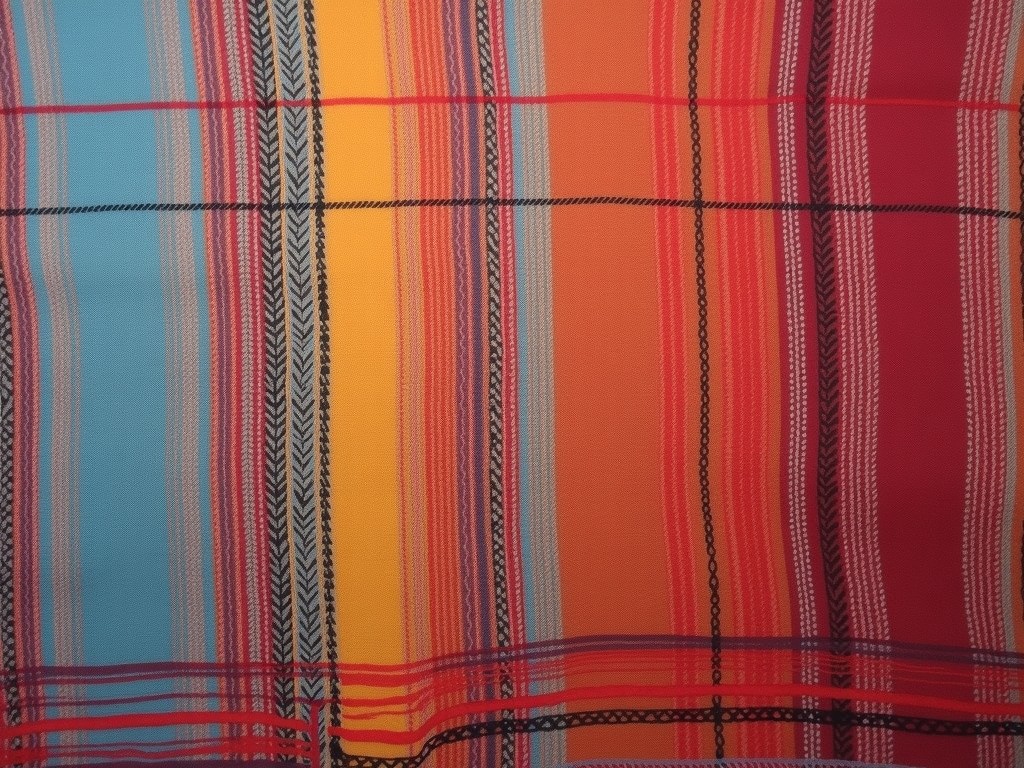
Cotton voile is a lightweight, plain-weave fabric made from combed cotton yarns, typically ranging from 60 to 100 yarn count. The striped variation is produced by dyeing specific warp or weft yarns in contrasting colors before weaving, creating linear patterns that run either lengthwise (warp stripes) or crosswise (weft stripes). This construction maintains the fabric’s inherent breathability and drape while introducing visual directionality useful in applications requiring subtle patterning without added weight or stiffness.
Material Composition and Construction
The base fabric uses 100% cotton fibers with a typical yarn count of 80s/2 in both warp and weft, resulting in a balanced plain weave with a thread density of approximately 120 ends per inch (EPI) and 80 picks per inch (PPI). Stripe patterns are introduced by substituting dyed yarns at regular intervals—commonly every 4 to 8 mm—without altering the weave structure. This method ensures the fabric retains its lightweight nature, with a typical weight of 60–80 gsm, while achieving consistent colorfastness through reactive dyeing processes that bond dye molecules directly to cotton cellulose.
Yarn twist levels are maintained between 3.5 and 4.5 turns per inch (TPI) to preserve softness and minimize snagging during processing. The greige fabric undergoes scouring and bleaching to remove natural impurities before dyeing, ensuring uniform stripe definition and preventing uneven absorption. Unlike printed voile, where surface pigments may crack or fade, yarn-dyed stripes exhibit superior wash durability because color resides within the fiber core. This construction also avoids the stiffness associated with pigment-based printing, preserving the fabric’s characteristic fluid drape.
Technical Specifications
| Property |
Typical Value |
Test Method |
| Fabric Weight |
60–80 gsm |
ASTM D3776 |
| Thread Count (EPI × PPI) |
120 × 80 |
ASTM D3775 |
| Stripe Width |
2–10 mm (customizable) |
Visual measurement |
| Breaking Strength (Warp) |
≥ 60 N/5cm |
ASTM D5034 |
| Breaking Strength (Weft) |
≥ 40 N/5cm |
ASTM D5034 |
| Colorfastness to Washing |
Grade 4–5 |
AATCC 61 |
| Colorfastness to Light |
Grade 4 |
AATCC 16.3 |
| Shrinkage (Wash 30°C) |
≤ 3% |
AATCC 135 |
Stripe width and spacing are defined during warping and can be adjusted to meet specific design repeat requirements, such as 6 mm stripes with 12 mm gaps for architectural drapery or 3 mm pinstripes for apparel linings. Custom dye lots are available for exact color matching to Pantone or RAL standards, with laboratory dip approvals provided before bulk production. The fabric’s low mass and open structure result in high air permeability, typically exceeding 200 cm³/cm²/s, making it suitable for applications where thermal comfort and moisture management are critical.
Industrial Applications
In architectural interior design, striped cotton voile is used for layered window treatments where the vertical orientation of warp stripes enhances perceived ceiling height, particularly in spaces with low headroom. The fabric’s translucency allows diffuse daylight penetration while maintaining visual privacy, and its lightweight nature reduces strain on curtain tracks and motorized systems. Unlike heavier fabrics, it does not require additional weighting at the hem to achieve proper drape, simplifying installation and reducing long-term maintenance.
For apparel manufacturing, the fabric serves as a lightweight overlay in blouses, dresses, and skirts, where striped patterns provide visual interest without adding bulk. Its breathability and moisture absorption (typical regain of 8.5% at 65% RH) make it suitable for warm-climate linings and interfacings in unstructured garments. The yarn-dyed construction ensures stripes remain aligned after repeated washing, avoiding the misalignment common in printed fabrics that can distort during garment assembly.
In technical textiles, striped cotton voile functions as a separator or filter layer in composite manufacturing, where the consistent stripe pattern aids in visual alignment during layup processes. Its tensile stability and resistance to delamination under low stress make it suitable for temporary bonding applications in aerospace and automotive prototyping. The fabric’s biodegradability and low ash content (<0.5%) also support compliance with end-of-life environmental regulations in disposable medical or hygiene products.
Customization Options
Stripe orientation, width, color, and repeat interval can be tailored to specific end-use requirements. Warp stripes are standard for longitudinal patterning, but weft stripes or balanced plaid effects are available upon request. Stripe widths range from 1 mm (pinstripe) to 15 mm (broad stripe), with spacing adjustable to create effects such as shadow stripes or graded gradients. Color options include standard dyed shades or custom laboratory-matched hues, with minimum dye lots typically starting at 50 kg per colorway.
Fabric width can be customized from the standard 150 cm to 180 cm or 220 cm for large-format applications, reducing seam frequency in drapery or wall covering installations. Finishing options include softening agents to enhance hand feel, optical brighteners for increased whiteness in base fabric, or anti-static treatments for environments requiring electrostatic discharge (ESD) control. Width stabilization through heat setting or resin finishing is available to minimize shrinkage in precision-cut applications.
For regulated industries, certifications such as OEKO-TEX® Standard 100 or GOTS can be applied upon request, with full traceability of yarn sourcing and dye chemicals. Packaging options include rolled on cardboard tubes with polyethylene wrapping or folded in polybags with humidity indicators, depending on shipment distance and storage conditions. Custom labeling, barcoding, and lot documentation are supported for integration into supply chain management systems.
Quality Control and Testing
Quality assurance begins with yarn inspection, where tensile strength, elongation, and evenness are monitored using Uster® testing equipment to ensure consistency across batches. During weaving, real-time warp stop motion and weft感应 sensors detect breaks or mispicks, minimizing defects in the greige fabric. Stripe alignment is verified using automated vision systems that compare dyed yarn placement against digital master patterns, flagging deviations beyond ±0.5 mm tolerance.
Post-dyeing, fabric undergoes spectrophotometric analysis to confirm color consistency across stripe and ground areas, with Delta E values maintained below 1.5 for visual match. Physical properties such as weight, thread count, and tensile strength are tested per lot according to ASTM standards, with results documented in batch-specific test reports. Shrinkage and colorfastness are evaluated after simulated washing and light exposure cycles to predict real-world performance.
Final inspection includes a 4-point system for visual defects, where points are assigned based on defect size and length, with acceptance thresholds typically set at ≤40 points per 100 square yards. Fabric is inspected under standardized lighting (D65, 1000 lux) to ensure accurate color and stripe perception. All test data is retained for a minimum of three years and made available to customers upon request, supporting audit readiness and compliance verification.
Comparison with Alternative Fabrics
| Property |
Striped Cotton Voile |
Printed Cotton Voile |
Polyester Voile |
| Pattern Method |
Yarn-dyed stripes |
Surface printing |
Yarn-dyed or printed |
| Weight |
60–80 gsm |
60–80 gsm |
50–70 gsm |
| Breaking Strength (Warp) |
≥ 60 N/5cm |
≥ 55 N/5cm |
≥ 80 N/5cm |
| Colorfastness to Washing |
Grade 4–5 |
Grade 3–4 |
Grade 4–5 |
| Breathability (Air Perm.) |
> 200 cm³/cm²/s |
> 180 cm³/cm²/s |
> 150 cm³/cm²/s |
| Shrinkage (30°C Wash) |
≤ 3% |
≤ 4% |
≤ 1% |
| Biodegradability |
High |
High |
Low |
Compared to printed cotton voile, the yarn-dyed striped version offers superior durability in wash and light exposure due to the absence of surface-bound pigments that can crack or fade. While polyester voile provides higher tensile strength and lower shrinkage, it lacks the moisture absorption and breathability of cotton, resulting in reduced comfort in direct-skin or humid environments. The biodegradability of cotton also supports end-of-life considerations in disposable or short-life applications where environmental impact is a factor.
For applications requiring frequent laundering or prolonged sunlight exposure—such as hospitality drapery or outdoor event staging—yarn-dyed stripes maintain visual integrity longer than printed alternatives. In contrast, polyester may be preferred in high-abrasion industrial filters where mechanical strength outweighs comfort properties. The choice ultimately depends on balancing performance requirements, regulatory constraints, and lifecycle expectations.
Ordering and Lead Times
Minimum order quantities typically start at 200 kg per colorway for standard shades, with lower quantities available for stock colors at a higher unit cost. Custom dye development requires a minimum of 50 kg per shade and includes laboratory dip approval before bulk production. Standard lead times for greige fabric are 2–3 weeks, with an additional 7–10 days for dyeing and finishing, resulting in a total of 4–5 weeks for custom-striped orders. Stock fabrics in common widths and stripe patterns can ship within 3–5 business days.
Fabric is supplied in rolls of 50–100 meters length, depending on weight and width, with core diameters of 76 mm or 102 mm. Packaging includes inner polyethylene wrapping and outer cardboard protection to prevent moisture ingress and physical damage during transit. For export shipments, fumigated pallets and moisture-barrier liners are available upon request to comply with international phytosanitary standards. All documentation, including commercial invoices, packing lists, and test certificates, is provided digitally and in hard copy.









