chiffon hijab Technical Production and Performance Analysis

Latest Articles

chiffon hijab Technical Production and Performance Analysis
2026-10-28

custom silk scarf textile manufacturing and performance analysis
2026-10-26
Scarf Manufacturers Technical Production Analysis
2026-10-22

Voile Valance how to hang valance scarf swag voile Installation Analysis
2026-10-20
Voile Window Scarf Technical Manufacturing and how to make a voile window scarf
2026-09-21
2026-10-28
chiffon hijab Technical Production and Performance Analysis
Selecting the right fabric for a hijab involves a delicate balance between modesty, breathability, and aesthetic drape. For many women in Southeast Asia and the Middle East, the material choice is not merely a fashion preference but a practical necessity for daily comfort in humid climates.
The shift toward lightweight, semi-transparent textiles has elevated the chiffon hijab as a staple accessory. Its unique ability to hold a shape while remaining airy makes it ideal for professional and formal settings where a polished look is required without sacrificing ventilation.
Understanding the manufacturing nuances—from the weaving process to the digital printing techniques—allows buyers to distinguish between mass-market options and high-quality professional textiles that maintain their integrity over time.
The Material Logic of Chiffon Textiles
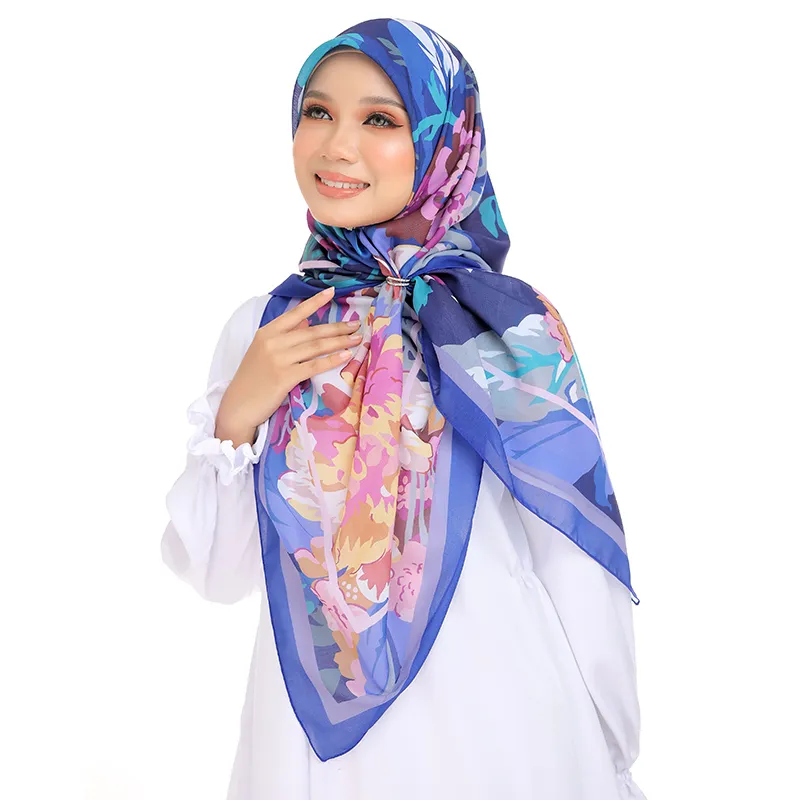
Chiffon is characterized by its sheer appearance and slightly rough feel, achieved through the use of highly twisted yarns in a plain weave. This structure creates a fabric that is lightweight and possesses a graceful drape, which is essential for the fluid movements of a hijab.
In the context of professional manufacturing, the quality of the chiffon depends on the consistency of the weave and the purity of the fibers used. When produced in a dedicated weaving workshop, the resulting fabric avoids the common pitfalls of snagging and uneven density, ensuring a uniform look across large production batches.
Technical Production and Printing Standards
The transition from raw fabric to a finished hijab requires a precise series of industrial steps. A complete production line—incorporating weaving, printing, and finished processing—is vital to ensure that the colors remain vivid and the edges remain secure. For a professional manufacturer, the integration of these workshops reduces material waste and maintains strict quality control.
Digital printing has revolutionized the industry by allowing for intricate, clear, and bright designs that were previously impossible with screen printing. This method is particularly effective for chiffon and voile, as it penetrates the fibers without compromising the fabric's breathability or softness.
Finishing touches, such as the "pintuck" edge or neat suturing, define the longevity of the product. A high-quality finish prevents fraying and ensures that the hijab maintains its rectangular or square dimensions even after repeated washing and wearing.
Evaluating Fabric Performance in Humid Climates
In markets like Malaysia, Thailand, and Singapore, fabric breathability is the primary driver of consumer preference. The ability of a textile to allow air circulation while providing necessary coverage is a technical challenge that determines the market success of a hijab line.
The core value of a professional hijab textile lies in its ability to balance structural flexibility with thermal regulation, ensuring the fabric does not cling to the skin during high humidity.
Cotton voile often serves as a benchmark for breathability, but the modern chiffon hijab offers a more formal aesthetic. By optimizing the yarn density and finishing process, manufacturers can create a chiffon that mimics some of the airy properties of voile while retaining its characteristic elegance.
Suitability Indices for Different Hijab Materials
Comparing various materials requires a qualitative scoring model based on key performance indicators such as breathability, drape, and opacity. While satin provides high luster for formal events, chiffon is preferred for daily versatility, and voile is prized for its extreme lightness.
The following analysis illustrates the relative strengths of common hijab fabrics based on typical user requirements in Southeast Asian markets.
Figure 2. Material Performance Comparison Index
Practical Application in Global Markets
The application of these textiles varies by region. In Malaysia and Singapore, the focus is on breathability and "flexibility," leading to high demand for cotton voile and lightweight chiffon. In contrast, the Sudanese Toub market requires different weights and dimensions to suit cultural traditions and environmental conditions.
For wholesale buyers, the ability to customize size, design, and packaging is critical. A manufacturer with a comprehensive facility—like the 10,000 square meter plant operated by Xinji Weiwei Textile—can handle both small customized orders and mass production, bridging the gap between boutique designs and large-scale retail.
Emerging Shifts in Hijab Design
Modern hijab trends are moving toward a fusion of traditional modesty and contemporary fashion. This is evident in the rise of digital prints that incorporate architectural patterns, botanical motifs, and abstract art, allowing the hijab to function as a unique fashion element.
The demand for "all-day comfort" has pushed manufacturers to refine the weight of the fabric. A standard 72g weight for cotton voile, for example, is often targeted to ensure the fabric is light enough for heat but heavy enough to maintain opacity.
Furthermore, there is an increasing emphasis on "quality assurance" in the supply chain. Buyers are no longer looking for the lowest price, but rather for a reliable production line that guarantees color fastness and neat suturing across thousands of pieces.
Selection Framework for Wholesale Buyers
When sourcing hijabs, professional buyers should use a multidimensional evaluation framework rather than relying on a single metric. The trade-off between luster, breathability, and ease of styling varies significantly between materials.
Understanding the technical parameters—such as the 115115 size standard or the difference between digital and screen printing—helps in predicting the final product's market reception.
The following table provides a comparative analysis to assist in the decision-making process for different market segments.
| Fabric Type | Primary Benefit | Ideal Scenario | Selection Priority |
|---|---|---|---|
| Chiffon | Elegant Drape | Formal / Office | Aesthetic Flow |
| Cotton Voile | High Breathability | Daily Wear / Heat | Thermal Comfort |
| Satin | High Luster | Evening / Wedding | Visual Impact |
| Jersey | Stretch/Elasticity | Sport / Casual | Ease of Use |
| Silk Blend | Premium Texture | Luxury Retail | Material Prestige |
| Custom Blend | Tailored Specs | Brand Specific | Market Niche |
Questions & Answers
Chiffon is preferred primarily for its unique drape and lightweight nature. Unlike heavier fabrics, it allows for elegant folding and layering without adding bulk around the head and neck. Its semi-sheer quality provides a sophisticated look that is suitable for both professional environments and formal gatherings, making it a versatile option for the modern Muslim woman.
Digital printing offers superior precision and color brightness compared to traditional methods. It allows for complex designs and gradients to be rendered clearly on the fabric. Because the ink is applied precisely, it maintains the fabric's natural breathability and softness, ensuring that the design does not create a "stiff" area on the scarf, which is critical for comfort.
A high-quality hijab should feature neat, consistent suturing or a professional "pintuck" edge. Poorly finished edges are prone to fraying after a few washes and can distort the shape of the scarf. Checking for tight, uniform stitching indicates that the product was processed in a specialized finished product workshop rather than through low-cost, manual alternatives.
Generally, yes. Cotton voile is highly prized in markets like Malaysia for its exceptional breathability and moisture-wicking properties. However, the choice depends on the occasion. While voile is superior for extreme heat and casual daily wear, chiffon provides a more formal aesthetic and a better drape for professional settings, though it may be slightly less breathable than pure cotton.
Yes, professional manufacturing factories typically offer extensive customization services. This includes adjusting the dimensions (e.g., 115115), choosing specific digital prints, selecting edge styles (like pintuck), and customizing logos or packaging. This allows brands to tailor their products to the specific cultural and fashion preferences of their local target market.
A typical high-standard cotton voile hijab often targets a weight around 72g. This specific weight is chosen to ensure the fabric is light enough to remain breathable and flexible in hot weather, yet possesses enough substance to provide adequate coverage and durability for long-term use.
Final Thoughts
The evolution of the chiffon hijab reflects a broader trend in the textile industry where technical performance meets cultural expression. By integrating advanced digital printing with traditional weaving expertise, manufacturers can now provide products that are both aesthetically striking and practically viable for diverse climates.
For buyers and retailers, the key to long-term success lies in partnering with manufacturers who control the entire production chain. This vertical integration ensures that from the first thread of the weave to the final stitch of the edge, the quality remains consistent and the product meets the rigorous demands of the global Muslim fashion market.
Products
Related Products
News
Related News
2026-10-28
chiffon hijab Technical Production and Performance AnalysisSelecting the right fabric for a hijab involves a delicate balance between modesty, breathability, and aesthetic drape. For many women in Southeast Asia and the Middle East, the ma···
2026-10-26
custom silk scarf textile manufacturing and performance analysisSelecting a high-quality scarf is no longer just about color matching; it is an exercise in understanding how textile weight, drape, and print scale interact with individual facial···
2026-10-22
Scarf Manufacturers Technical Production AnalysisSelecting a manufacturing partner for textile accessories often comes down to a delicate balance between material precision and design flexibility. In the specialized world of head···
