Oem Patterned Cotton Voile Fabric






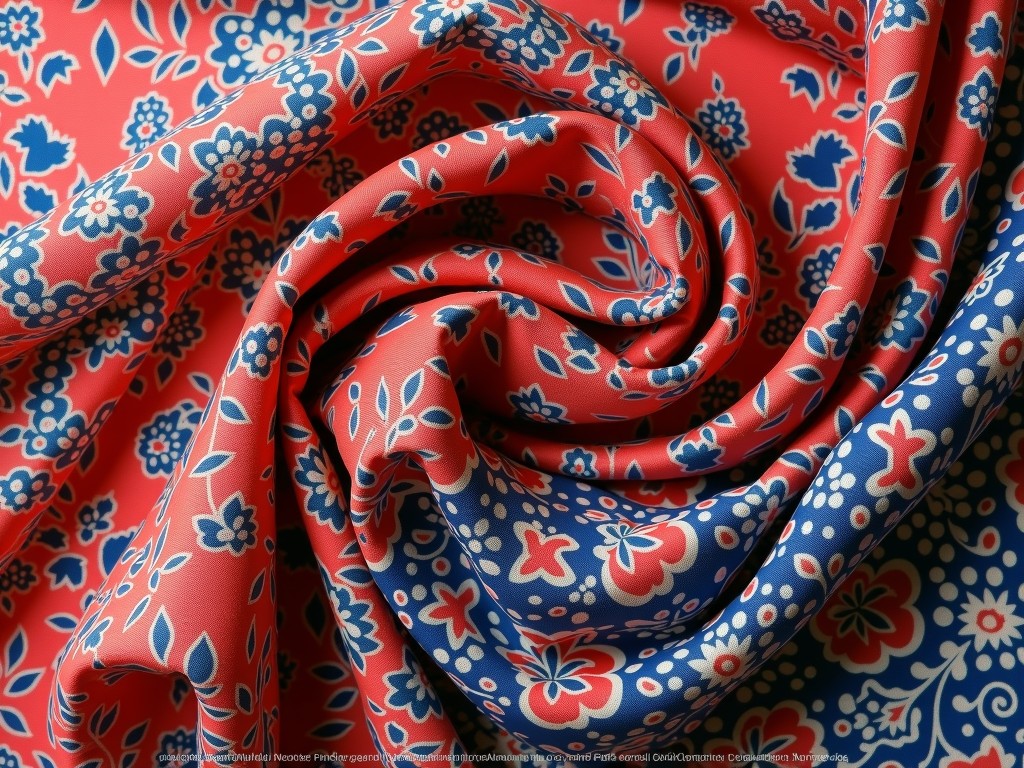
Oem Patterned Cotton Voile Fabric
OEM patterned cotton voile fabric is a lightweight, semi-sheer textile made from 100% combed cotton yarns, featuring repeat designs applied through rotary screen or digital printing processes. The
OEM Patterned Cotton Voile Fabric
OEM patterned cotton voile fabric is a lightweight, semi-sheer textile made from 100% combed cotton yarns, featuring repeat designs applied through rotary screen or digital printing processes. The base voile construction typically uses 2/60s to 2/80s Ne combed cotton in a plain weave, yielding a fabric weight between 40 and 70 gsm. Pattern repeat dimensions are engineered to match end-use requirements, commonly ranging from 8 to 64 cm in width and 8 to 128 cm in length, depending on the printing method and design complexity.
Cotton voile’s low mass and open structure provide air permeability of approximately 150 to 250 mm/s under standard test conditions (ISO 9237), making it suitable for applications requiring breathability and drape. The fabric’s tensile strength averages 18 to 25 N in the warp direction and 12 to 18 N in the weft direction, measured per ISO 13937-2, which supports its use in lightweight apparel and decorative panels where minimal mechanical load is expected. Dimensional stability after washing is typically within ±3% for length and ±2% for width when following recommended care procedures (30°C wash, tumble dry low).
Pattern application methods influence both visual quality and production flexibility. Rotary screen printing allows for high-speed production of repeating patterns with precise color registration, ideal for large-volume orders exceeding 5,000 linear meters per design. Digital printing enables unlimited color variation and photorealistic detail without screen limitations, suited for short runs, prototypes, or designs with gradients and fine lines under 0.2 mm width. Both methods use reactive or pigment inks formulated for cotton, achieving colorfastness ratings of 4 to 5 (ISO 105-B02) for light and 3 to 4 for washing, depending on dye selection and post-treatment.
Customization options extend beyond pattern design to include yarn count, weave tightness, and finishing treatments. Customers may specify alternative combed cotton counts (e.g., 2/40s Ne for increased opacity or 2/100s Ne for ultra-sheer variants) or request blended constructions such as 80/20 cotton/nylon to improve tear resistance. Finishing options include softening agents for enhanced hand feel, optical brighteners for whiteness improvement, or antimicrobial treatments for hygienic applications. All customizations are subject to minimum order quantities, typically starting at 1,000 linear meters for standard patterns and 3,000 meters for bespoke designs.
Quality assurance follows a multi-stage protocol aligned with OEM textile supply standards. Raw yarn is tested for unevenness (U%), hairiness, and tensile properties before knitting or weaving. Greige fabric undergoes inspection for ends/picks per 10 cm, width consistency, and defect density using 4-point or 10-point systems. Post-printing, each batch is evaluated for color depth (K/S value), pattern repeat accuracy, and hand feel via standardized lighting (D65) and tactile assessment. Final rolls are marked with batch numbers, length metadata, and care instructions before packaging.
Applications
The lightweight drape and semi-translucent appearance of patterned cotton voile make it particularly suited for layered window treatments in hospitality and residential interiors, where it diffuses natural light while maintaining privacy. In apparel, it serves as an overlay fabric for blouses, dresses, and ceremonial garments, providing decorative detail without adding significant weight. Its breathability and soft hand also support use in lightweight summer linings for jackets and coats, as well as in mosquito netting and medical screens where airflow and visibility are critical.
Industrial buyers in contract manufacturing often specify patterned cotton voile for private-label home textile collections, leveraging its compatibility with standard sewing techniques and low shrinkage. The fabric’s smooth surface allows for clean heat-transfer labeling and embroidery, while its low propensity for seam puckering reduces reprocessing costs. For export-oriented production, the fabric’s compliance with OEKO-TEX® Standard 100 (upon request) and ability to pass formaldehyde and pH testing supports adherence to international import regulations in the EU and North America.
Technical Specifications
| Parameter | Typical Range | Test Method |
|---|---|---|
| Fabric Weight | 40–70 gsm | ISO 3801 |
| Warp Tensile Strength | 18–25 N | ISO 13937-2 |
| Weft Tensile Strength | 12–18 N | ISO 13937-2 |
| Air Permeability | 150–250 mm/s | ISO 9237 |
| Dimensional Change (Wash) | Length: ±3%, Width: ±2% | ISO 6330 |
| Colorfastness to Light | 4–5 (blue wool scale) | ISO 105-B02 |
| Colorfastness to Washing | 3–4 (gray scale) | ISO 105-C06 |
Values represent typical ranges for standard 2/60s Ne combed cotton voile with reactive printing. Actual performance may vary based on yarn count, weave density, ink type, and finishing treatment. Custom specifications are available upon request.
Customization Logic
Pattern repeat size is determined by the printing cylinder circumference in rotary screen systems or the digital printer’s tile width. Common repeats include 8, 16, 24, 32, and 64 cm in width, with length adjusted to match design symmetry. For digital printing, repeats can be non-integer and freely scaled, enabling placement prints or engineered borders. Customers seeking to minimize fabric waste often align pattern repeats with cut piece dimensions in marker planning, reducing off-cuts by up to 15% in high-volume apparel production.
Yarn selection directly affects hand, durability, and cost. Finer counts (e.g., 2/100s Ne) increase sheerness and drape but reduce tear resistance, making them suitable for overlays rather than structural components. Coarser counts (e.g., 2/40s Ne) improve opacity and abrasion resistance at the expense of drape, beneficial for lightweight curtains or industrial filters. Blending with synthetic fibers such as polyester or nylon adds dimensional stability and reduces wrinkling, though it may alter moisture regain and dye uptake characteristics.
Finishing treatments are selected based on end-use performance requirements. Softening agents (e.g., silicone-based) improve hand feel for skin-contact applications but may reduce crockfastness if not properly cured. Antimicrobial finishes using zinc pyrithione or silver citrate inhibit odor-causing bacteria, extending service life in humid environments. Flame-retardant treatments are available for contract specifications but require separate certification and may affect hand and color.
Quality Control Philosophy
Defect detection focuses on visual and dimensional consistency rather than purely mechanical properties, given the fabric’s decorative role. Common defects addressed include misprints, color smearing, missing yarns, and uneven tension streaks. Inspection is conducted under 2000 lux daylight simulation (D65) at a 45-degree angle, with defects classified by size and visibility. Acceptable quality limits (AQL) are typically set at 2.5 for major defects and 4.0 for minor defects per ANSI/ASQ Z1.4, adjusted per customer agreement.
Batch traceability is maintained from yarn lot to finished roll, enabling rapid isolation of issues in the supply chain. Each roll receives a unique identifier linking to test reports for tensile, colorfastness, and dimensional stability. For regulated markets, documentation packages include test certificates, material safety data sheets (MSDS) for finishes, and compliance declarations. Suppliers typically retain records for 36 months to support audit requirements.
Continuous improvement is driven by customer feedback on seam performance, color matching accuracy, and roll uniformity. Process adjustments may include tension calibration on printing machines, drying curve optimization to prevent cockling, or winding pressure adjustments to avoid core crushing. These refinements aim to reduce waste and improve first-pass yield in cut-and-sew operations.
Packaging and Shipping
Finished rolls are typically wound on 3-inch or 6-inch diameter cores with inner diameters of 76 mm or 152 mm, depending on customer equipment. Standard roll lengths range from 50 to 100 linear meters, though longer lengths up to 200 meters are available for high-volume applications to minimize splices. Rolls are wrapped in polyethylene film to prevent moisture ingress and labeled with barcode, batch number, length, and care symbols. Outer packaging uses corrugated cardboard boxes or woven polypropylene sacks for palletized shipment.
Export shipments are protected against humidity and condensation using desiccant packs and ventilated pallet covers. For long-distance transit, rolls may be interleaved with acid-free tissue to prevent color transfer, especially for dark or highly saturated patterns. Compliance with ISPM 15 is ensured for wooden pallets, and all packaging materials are recyclable upon request. Lead times average 3 to 6 weeks for standard patterns and 6 to 10 weeks for custom designs, inclusive of sample approval and pre-production verification.
To request a quotation or technical data sheet for oem patterned cotton voile fabric, please provide your required specifications including pattern design (or reference), yarn count, finish type, roll length, and annual volume estimate. Our team will respond with detailed pricing, lead time, and sample availability.
Products
Related Products
News
Related News

2026-11-02
Cotton Voile Scarf Manufacturing and Performance Analysis how to make a cotton voile scarfCreating a professional-grade cotton voile scarf requires a precise balance of textile engineering and artisanal finishing. Unlike standard cotton weaves, voile is defined by its p···

2026-10-28
chiffon hijab Technical Production and Performance AnalysisSelecting the right fabric for a hijab involves a delicate balance between modesty, breathability, and aesthetic drape. For many women in Southeast Asia and the Middle East, the ma···

2026-10-26
custom silk scarf textile manufacturing and performance analysisSelecting a high-quality scarf is no longer just about color matching; it is an exercise in understanding how textile weight, drape, and print scale interact with individual facial···
