Floral Cotton Voile Fabric Scarf






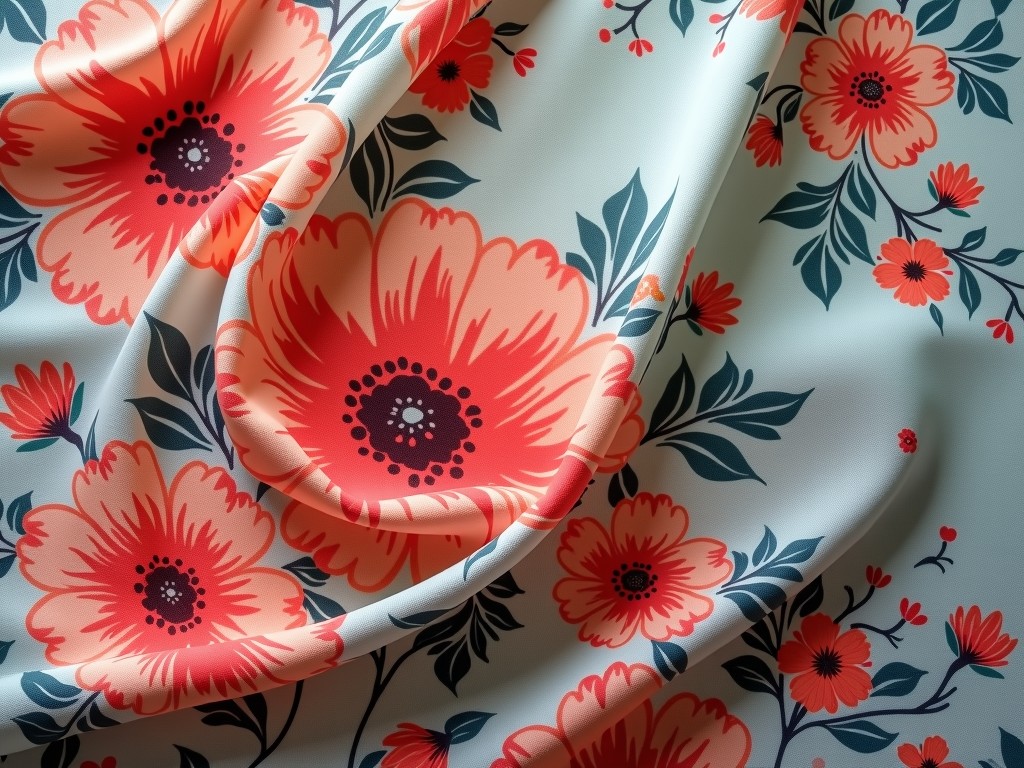
Floral Cotton Voile Fabric Scarf
Floral cotton voile fabric scarves combine the breathability of lightweight cotton with the open weave structure of voile, creating a textile suitable for applications requiring drape, air
Floral Cotton Voile Fabric Scarf
Floral cotton voile fabric scarves combine the breathability of lightweight cotton with the open weave structure of voile, creating a textile suitable for applications requiring drape, air permeability, and subtle pattern visibility. The floral motif is typically achieved through reactive dye printing or yarn-dyed jacquard weaving, depending on the desired durability and colorfastness.
Voile is characterized by its low thread count and plain weave construction, resulting in a fabric weight typically ranging from 60 to 100 gsm (grams per square meter). This construction allows for high air permeability while maintaining sufficient tensile strength for handling and end-use in scarf applications. The use of combed or carded cotton yarns influences surface smoothness and pilling resistance.
Material Composition and Construction
The base fabric is 100% cotton, selected for its moisture absorption capacity (approximately 8–10% regain at 65% RH) and biodegradability. Voile construction uses single-ply yarns in both warp and weft, with ends per inch (EPI) and picks per inch (PPI) typically between 60–80 and 40–60, respectively. This open structure reduces fabric density while preserving dimensional stability under low tension.
Floral patterns are applied via reactive printing, which forms covalent bonds between dye molecules and cellulose fibers, offering wash fastness ratings of 4–5 on the grey scale for both color staining and color change. Alternative methods include discharge printing for lighter grounds or yarn-dyed techniques for higher abrasion resistance, though these may increase lead time and cost.
Dimensional Specifications
Standard scarf dimensions are engineered to balance coverage, drape, and material efficiency. Common rectangular sizes range from 160 cm × 40 cm to 180 cm × 70 cm, allowing for multiple wrapping styles while minimizing fabric waste during cutting. Square variants (e.g., 90 cm × 90 cm) are also available for folded or layered use.
Hem tolerances are maintained within ±3 mm for rolled or whip-stitched edges, ensuring flat lay and preventing curling. For folded hems, width consistency is controlled to ±2 mm over a 10 mm fold width. These tolerances are critical for automated packing and consumer perception of quality.
Performance Characteristics
Air permeability, measured per ISO 9237, typically ranges from 150 to 300 mm/s for cotton voile, significantly higher than poplin or broadcloth constructions. This property enhances comfort in warm environments by facilitating convective heat transfer. Moisture vapor transmission rate (MVTR) is correspondingly elevated, reducing skin-side humidity buildup.
Tensile strength in the warp direction averages 18–25 N/tex, with weft values slightly lower due to fewer ends per inch. Elongation at break is approximately 8–12%, providing adequate recovery under light draping loads. Pilling resistance, assessed via Martindale testing, generally achieves 3–4 rating after 500 cycles, acceptable for decorative scarf use.
Customization Options
Customization is available for pattern scale, color palette, and fabric width. Floral motifs can be scaled from small-repeat (5–10 cm) to large-format (25–40 cm) depending on the intended visual impact and cutting efficiency. Color matching follows Pantone or CIELAB standards, with lab dips provided for approval prior to bulk production.
Fabric width can be adjusted between 110 cm and 150 cm on loom, influencing scarf layout and yield. Hem styles include rolled, whipped, folded (single or double), or fringed finishes, each affecting edge weight and drape. Custom labels, tags, or packaging inserts can be integrated upon request.
| Parameter | Typical Range | Test Method |
|---|---|---|
| Fabric Weight | 60–100 gsm | ISO 3801 |
| Air Permeability | 150–300 mm/s | ISO 9237 |
| Tensile Strength (Warp) | 18–25 N/tex | ISO 13934-1 |
| Color Fastness to Washing | 4–5 (Grey Scale) | ISO 105-C06 |
| Pilling Resistance | 3–4 after 500 cycles | ISO 12945-2 |
Quality Control and Inspection
Incoming cotton yarn is tested for micronaire, strength, and uniformity before knitting or weaving. Greige fabric undergoes inspection for ends-per-inch, picks-per-inch, and width consistency. Printed or dyed lots are evaluated for color difference (ΔE < 2.0), pattern alignment, and defect frequency using 4-point or 10-point systems under standardized lighting (D65, 2000 lux).
Final inspection includes dimensional verification, hand feel assessment, and edge integrity checks. AQL levels are typically set at 2.5 for major defects and 4.0 for minor defects. Test reports, including color fastness and dimensional stability data, are available upon request for qualifying orders.
Applications and End-Use Suitability
Floral cotton voile scarves are suited for environments where lightweight layering and breathability are prioritized, such as spring/summer retail, hospitality uniform accessories, or promotional merchandise. The open weave allows for easy folding and packing without excessive wrinkling, reducing steaming or ironing requirements in logistics.
Due to cellulose-based composition, the fabric is compatible with biodegradable or compostable end-of-life pathways when uncontaminated by synthetic additives. This supports sustainability goals in textile circularity initiatives. UV stability is moderate; prolonged direct sunlight exposure may cause fading, particularly in darker shades, suggesting limited outdoor permanence.
Products
Related Products
News
Related News

2026-11-02
Cotton Voile Scarf Manufacturing and Performance Analysis how to make a cotton voile scarfCreating a professional-grade cotton voile scarf requires a precise balance of textile engineering and artisanal finishing. Unlike standard cotton weaves, voile is defined by its p···

2026-10-28
chiffon hijab Technical Production and Performance AnalysisSelecting the right fabric for a hijab involves a delicate balance between modesty, breathability, and aesthetic drape. For many women in Southeast Asia and the Middle East, the ma···

2026-10-26
custom silk scarf textile manufacturing and performance analysisSelecting a high-quality scarf is no longer just about color matching; it is an exercise in understanding how textile weight, drape, and print scale interact with individual facial···
