China Ultrafine Voile Premium Scarf






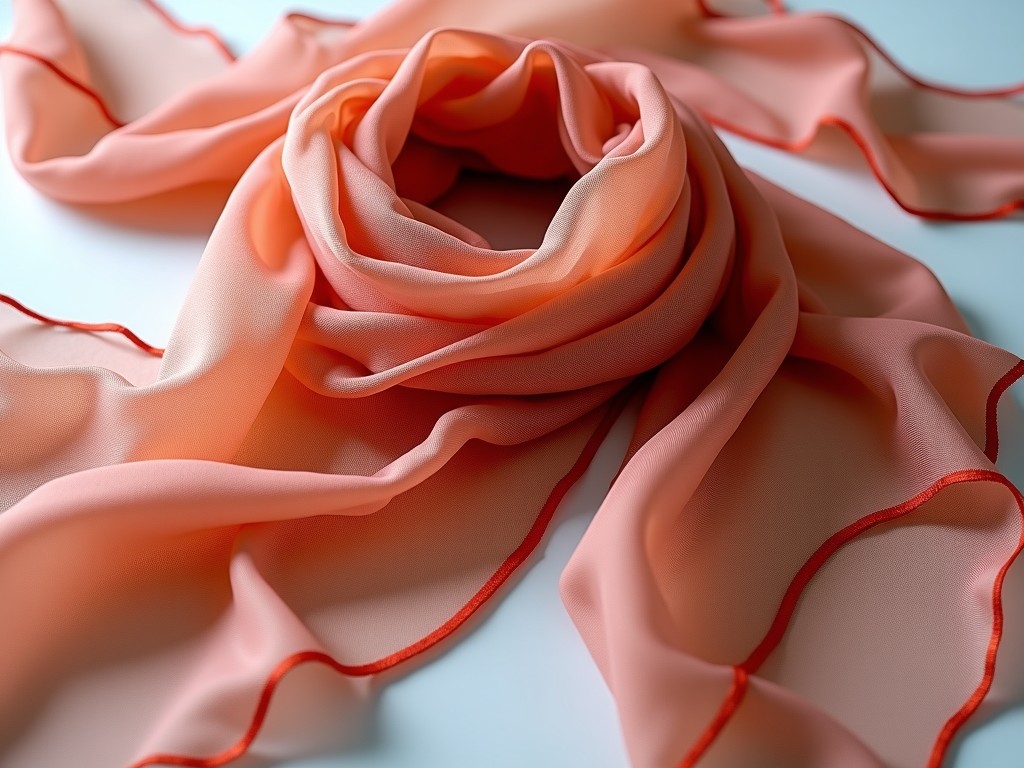
China Ultrafine Voile Premium Scarf
Ultrafine voile is a lightweight, plain-woven fabric characterized by its high thread count and low basis weight, typically ranging from 20 to 40 g/m². In premium scarf applications, this fabric is
China Ultrafine Voile Premium Scarf
Ultrafine voile is a lightweight, plain-woven fabric characterized by its high thread count and low basis weight, typically ranging from 20 to 40 g/m². In premium scarf applications, this fabric is constructed using combed, ring-spun cotton or polyester filaments with individual yarn counts exceeding 120 Ne (Number English), resulting in a fabric density of 180–220 threads per square inch. The tight, balanced plain weave minimizes surface distortion while maximizing drape and breathability, making it suitable for applications where minimal added bulk and maximum air permeability are required.
The term “premium” in this context refers to controlled fiber morphology, consistent twist levels, and post-weaving treatments that enhance dimensional stability without compromising hand feel. Unlike standard voile, premium grades undergo mercerization or plasma treatment to increase luster, improve dye affinity, and reduce residual shrinkage to less than 2% after five home launderings at 40°C. These specifications are verified through ASTM D1423 (yarn count), ASTM D3776 (fabric weight), and AATCC Test Method 135 (dimensional change).
Material Composition and Construction
The base fabric is predominantly 100% long-staple cotton (Gossypium hirsutum) with a fiber length of 32–36 mm, sourced from Xinjiang or Nile Delta regions, known for low short-fiber content (<8%) and high uniformity index (>85%). Alternatively, recycled polyester filaments (1.2 dtex, semi-dull) may be used for applications requiring enhanced wrinkle resistance and faster drying rates, with a tenacity of 4.5–5.5 cN/tex and elongation at break of 25–35%.
Yarns are spun using compact spinning technology to minimize fiber protrusion, resulting in a smoother yarn surface and reduced pilling tendency. The fabric is woven on air-jet looms operating at 1,800–2,200 picks per minute, with a reed count of 72–80 ends per cm and a pick density of 60–70 per cm. This construction achieves a tensile strength of 18–22 N warp and 14–18 N weft (ASTM D5034), with a tear strength of 8–12 N (Elmendorf method).
Post-weaving, the fabric undergoes a three-stage finishing process: scouring to remove natural impurities, bleaching to achieve a base whiteness of ISO 105-B02 >85%, and optical brightening to enhance perceived brightness without UV degradation. For colored variants, reactive dyes are applied at 60–80°C fixation temperature, achieving wash fastness ratings of 4–5 (AATCC 61) and light fastness of 4–6 (ISO 105-B02).
Dimensional Specifications and Tolerances
Premium ultrafine voile scarves are manufactured to consistent geometric tolerances to ensure compatibility with downstream processes such as printing, folding, and packaging. Standard dimensions are defined by finished edge-to-edge measurements after hem completion, accounting for fabric relaxation and hem take-up.
| Dimension | Typical Value | Tolerance | Test Method |
|---|---|---|---|
| Width | 140 cm | ±1.0 cm | ASTM D3774 |
| Length | 180 cm | ±1.5 cm | ASTM D3774 |
| Hem Width | 0.6 cm | ±0.1 cm | Visual/Tape |
| Basis Weight | 28 g/m² | ±2 g/m² | ASTM D3776 |
| Thread Count | 200 tc/in² | ±10 tc/in² | ASTM D3775 |
These tolerances are maintained through real-time width monitoring on the stenter frame and laser-guided cutting systems during final trimming. Deviations beyond tolerance trigger automatic rejection to prevent cumulative errors in bulk orders. For custom dimensions, tooling adjustments are available upon request, with lead time implications communicated during quotation.
Performance Characteristics
The fabric’s low mass and high porosity result in an air permeability of 280–350 cm³/cm²/s (ASTM D737), significantly higher than standard cotton voile (150–220 cm³/cm²/s), making it effective for applications requiring thermal comfort and moisture vapor transmission. Water vapor transmission rate (WVTR) measures 2,200–2,800 g/m²/24h (ASTM E96, desiccant method), indicating efficient sweat transport in warm environments.
Surface smoothness, measured by profilometry (Ra value), averages 0.8–1.2 µm, reducing friction against skin and minimizing irritation during prolonged wear. The fabric exhibits a bending length of 1.8–2.2 cm (ASTM D1388), confirming low flexural rigidity and superior drape compared to heavier voile variants (typically >3.0 cm). Pilling resistance, assessed after 5,000 cycles (Martindale, ASTM D4970), rates 4–5 on the visual scale, indicating minimal surface fuzzing under normal use.
Chemical resistance is moderate; the fabric withstands exposure to diluted detergents (pH 9–10) and mild bleach (50 ppm available chlorine) without significant strength loss (>85% retention after 20 cycles). However, prolonged exposure to strong acids or oxidizing agents should be avoided. UV stability is enhanced through optical brightener selection, with less than 10% tensile strength loss after 40 hours of xenon arc exposure (AATCC TM16-3, Option 3).
Applications in Industrial and Commercial Sectors
Ultrafine voile premium scarves are selected in industries where lightweight, breathable, and skin-compatible textiles are required for functional or decorative purposes. In the apparel sector, they serve as linings for unstructured jackets, lightweight scarves, and summer shawls where minimal thermal retention and high air exchange are design priorities. The fabric’s drape allows it to conform to body contours without adding bulk, making it suitable for layering systems in temperate climates.
In medical textiles, the material is used as a barrier layer in single-use patient gowns and surgical drapes where low lint generation and breathability are critical to maintain sterile field integrity. Its low particle shedding (<50 particles/cm² after 10 rubs, IEST-RP-CC003.3) meets Class 10,000 cleanroom requirements when combined with appropriate packaging. The fabric’s ability to withstand gamma irradiation (25 kGy) without significant discoloration or embrittlement supports its use in sterilizable disposable systems.
Promotional and event industries utilize these scarves as lightweight, foldable giveaways due to their high print receptivity and compact storage volume. A single scarf occupies <15 cm³ when folded, enabling efficient bulk distribution. The fabric’s compatibility with dye-sublimation and pigment printing allows for high-resolution graphics (>300 dpi) with minimal bleed, making it ideal for branded merchandise where visual fidelity and wear comfort are both required.
Quality Control and Inspection Protocol
Quality assurance begins at yarn receipt, where each batch is tested for count strength product (CSP), unevenness (U%), and imperfections per km using Uster® testing equipment. Only yarns with CSP >1,800, U% <10%, and thin/thick places <5/km are released for weaving. During weaving, real-time loom monitoring detects broken picks, wrong draws, and reed marks, with automatic stop mechanisms triggered upon defect detection.
Post-weaving, the fabric undergoes a four-point inspection system under 2,000 lux illumination, following ASTM D5430. Defects are assigned penalty points based on size and type: holes and cuts (>3 mm) = 4 points, stains and yarn defects = 2 points, minor imperfections = 1 point. A roll is accepted if the total penalty points per 100 sq yd do not exceed 40. For premium grades, the threshold is tightened to 25 points per 100 sq yd to ensure visual consistency.
Final inspection includes dimensional verification, hem integrity checks (90° seam angle, no skipped stitches), and color matching against Pantone or CIELAB standards (ΔE < 1.5 for solid colors, < 2.0 for prints). Each batch is accompanied by a test report covering basis weight, thread count, shrinkage, pilling, and colorfastness. Random samples are retained for 12 months for traceability.
Customization Options
Customization is available across multiple parameters to align with specific end-use requirements. Fabric construction can be adjusted by altering yarn count (range: 100–140 Ne), weave density (160–240 tc/in²), or fiber blend ratio (e.g., 65/35 cotton/polyester for improved recovery). These modifications directly impact basis weight, air permeability, and mechanical properties, allowing optimization for target performance criteria.
Finishing treatments can be tailored to include antimicrobial agents (e.g., silver-ion or zinc pyrithione, 200 ppm active), flame retardants (PROBAN® or APC-based, LOI ≥26%), or UV absorbers (benzotriazole derivatives, 1.5% owf). Each additive is selected based on compatibility with the base fabric and intended laundering cycle. For example, antimicrobial finishes retain >90% efficacy after 30 washes at 60°C (AATCC TM100).
Dimensions, hem styles (rolled, fused, or picot), and edge treatments (fringe, tassel, or piping) can be specified per drawing. Custom packaging options include individual polybagging, flat folding with tissue interleaving, or bulk packing in corrugated cartons with desiccant packs. All customizations are subject to minimum order quantities and tooling considerations, which are clarified during the technical quotation phase.
Packaging and Logistics
Scarves are folded to a uniform size of 20 × 15 × 2 cm using automated folding tables with vacuum-assisted alignment to ensure consistency. Each unit is placed in a low-density polyethylene (LDPE) bag, 40 µm thickness, with a self-sealing adhesive strip to prevent moisture ingress and particulate contamination during transit. Bags are printed with batch codes, SKU, and care instructions in ISO 15223-1 symbols.
Cartons are constructed from single-wall corrugated fiberboard (150 g/m² test liner, 125 g/m² flute), dimensions 40 × 30 × 25 cm, holding 50 units per carton. Inner liners of kraft paper or polypropylene are available upon request for enhanced moisture barrier properties. Cartons are sealed with pressure-sensitive tape (width 48 mm, adhesion 8.5 N/cm) and strapped with polypropylene bands (12 mm width) for pallet stability.
Pallet configuration follows ISO 6780 standards: 1,000 × 1,200 mm footprint, maximum height 1,800 mm, with a load capacity of 800 kg. Units are stacked in interlocking patterns to prevent shifting. For export shipments, fumigation-compliant pallets (ISPM 15) are used, and container loading is optimized for weight distribution. Transit testing (ISTA 3A) confirms performance under simulated handling, vibration, and climate conditions.
Technical Inquiry
To request a quotation or technical data sheet, please provide the following information: intended application, required dimensions, fiber preference (cotton, polyester, or blend), desired finish (standard, antimicrobial, UV-protected, etc.), color specifications (Pantone or CIELAB values), and annual volume estimate. Including a sample or reference image accelerates the matching process.
Our engineering team will review your specifications and respond with a detailed proposal covering material construction, performance estimates, tooling requirements, lead time, and pricing. Samples are available upon request, typically dispatched within 3–5 business days after specification confirmation. For custom developments, a lab dip or strike-off can be provided for approval before bulk production.
We maintain traceability from raw material to finished product and can provide documentation including OEKO-TEX® Standard 100 certification, REACH compliance statements, and test reports from third-party laboratories. All inquiries are handled confidentially, and technical support is available throughout the product lifecycle.
Request Technical SpecificationProducts
Related Products
News
Related News

2026-11-02
Cotton Voile Scarf Manufacturing and Performance Analysis how to make a cotton voile scarfCreating a professional-grade cotton voile scarf requires a precise balance of textile engineering and artisanal finishing. Unlike standard cotton weaves, voile is defined by its p···

2026-10-28
chiffon hijab Technical Production and Performance AnalysisSelecting the right fabric for a hijab involves a delicate balance between modesty, breathability, and aesthetic drape. For many women in Southeast Asia and the Middle East, the ma···

2026-10-26
custom silk scarf textile manufacturing and performance analysisSelecting a high-quality scarf is no longer just about color matching; it is an exercise in understanding how textile weight, drape, and print scale interact with individual facial···
