Leopard Print Satin Scarf






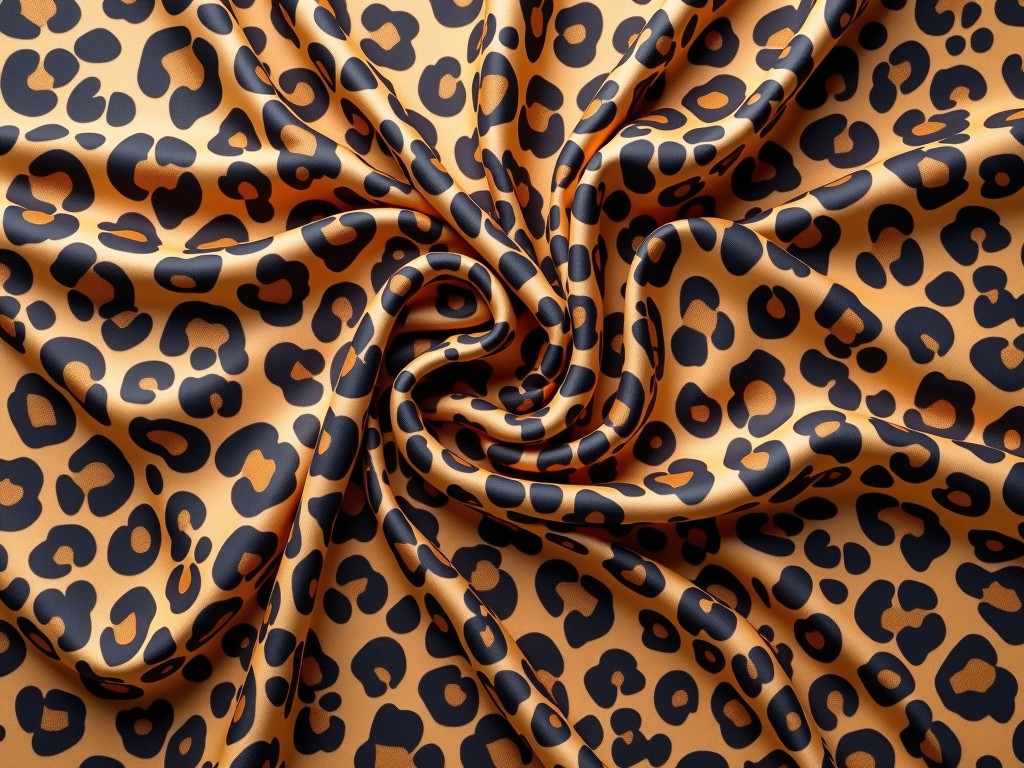
Leopard Print Satin Scarf
This product page details the specifications, construction, and industrial considerations for leopard print satin scarves intended for commercial and professional use. The information provided
Leopard Print Satin Scarf
This product page details the specifications, construction, and industrial considerations for leopard print satin scarves intended for commercial and professional use. The information provided supports informed procurement decisions by focusing on material behavior, dimensional stability, and finish consistency.
Material Composition and Construction
The scarf is constructed from 100% polyester filament yarn with a satin weave structure. This weave pattern features a high thread count on the face side, typically exceeding 120 ends per inch, creating a smooth, reflective surface with a distinct directional sheen. The reverse side exhibits a matte finish due to the floating warp threads characteristic of satin construction.
Polyester was selected for its dimensional stability under varying humidity conditions, resisting shrinkage and elongation better than natural fibers like silk or rayon. The filament yarn construction minimizes surface fuzzing and pilling during handling, preserving the print integrity over repeated use.
Printing Process and Colorfastness
The leopard print is applied using disperse dye sublimation printing, a process where solid dyes transition directly to gas under heat and pressure, bonding permanently with the polyester fibers. This method ensures the print becomes part of the fiber matrix rather than sitting on the surface, reducing the risk of cracking, peeling, or fading during flexing or washing.
Colorfastness ratings for this printing method typically achieve ISO 105-B02 lightfastness levels of 4-5 and ISO 105-E04 washfastness levels of 4-5 under standard test conditions. These values indicate strong resistance to fading from light exposure and moderate to good resistance to color loss during laundering, supporting suitability for environments with intermittent cleaning requirements.
Dimensional Specifications and Tolerances
Standard dimensions are 180 cm in length by 90 cm in width, with a tolerance of ±2% in both axes. This tolerance accounts for minor variability in the weaving and finishing processes while maintaining usability across intended applications such as draping, wrapping, or display use.
The hem is finished with a 3-mm double-fold overlock stitch, providing edge reinforcement without adding significant stiffness. This construction prevents fraying while maintaining the scarf’s drape characteristics. Edge weight is approximately 0.8 g per linear inch, contributing to stable hanging behavior.
Surface Properties and Handling Characteristics
The satin finish produces a coefficient of friction of approximately 0.2–0.3 against common lining materials like cotton or acetate, allowing for smooth movement when layered. This low friction reduces abrasion risk during wear or handling but requires consideration in applications where slip resistance is a factor.
The fabric exhibits a bending length of 2.5–3.5 cm in the warp direction and 2.0–3.0 cm in the weft direction, indicating a soft, flexible drape suitable for conforming to varied shapes without retaining creases. Recovery from light creasing is typically complete within 15–30 minutes at room temperature.
Quality Control and Inspection Criteria
Each roll undergoes 100% visual inspection under 500-lux daylight-simulated lighting to detect print defects such as misregistration, blotching, or color variation. Acceptable limits allow for no more than one minor print anomaly per linear meter, defined as a spot under 2 mm in diameter with ΔE < 3.0 against the approved standard.
Dimensional checks are performed at three points along each roll using calibrated optical gauges. Weight consistency is monitored at 5 g per square meter tolerance. Any roll exceeding these parameters is segregated for rework or downgrade. Final random audits include wash and light exposure testing on a 1:500 basis.
Packaging and Unitization
Scarves are folded to a final size of 30 cm × 20 cm and placed in individual polypropylene bags with a thickness of 40 μm. These bags provide a barrier against dust and moisture during transit while allowing visibility of the product. Each bag is sealed with a heat-seal closure to prevent opening during handling.
Twenty-five bagged units are packed into a single corrugated cardboard carton measuring 40 cm × 30 cm × 25 cm. Cartons are sealed with pressure-sensitive tape and strapped for palletization. Standard pallet configuration holds 48 cartons (1,200 units) with a total weight not exceeding 450 kg, facilitating efficient warehouse stacking and forklift handling.
| Property | Typical Value | Test Method / Reference |
|---|---|---|
| Fabric Weight | 95 g/m² ±5% | ISO 3801 |
| Tensile Strength (Warp) | 45 N/5cm | ISO 13937-2 |
| Tensile Strength (Weft) | 38 N/5cm | ISO 13937-2 |
| Elongation at Break (Warp) | 25% | ISO 13937-2 |
| Elongation at Break (Weft) | 30% | ISO 13937-2 |
| Lightfastness | 4–5 (Blue Wool Scale) | ISO 105-B02 |
| Washfastness (40°C) | 4–5 | ISO 105-E04 |
For procurement teams evaluating this product for uniform accessories, promotional bundles, or retail display, the combination of dimensional stability, print durability, and consistent hand feel supports reliable performance in controlled environments. Technical samples are available upon request to verify color match, drape, and finish under specific lighting or handling conditions.
To request a sample, discuss custom sizing, or inquire about bulk packaging options, please contact our technical sales team using the inquiry form linked below.
Contact Technical SalesProducts
Related Products
News
Related News

2026-11-02
Cotton Voile Scarf Manufacturing and Performance Analysis how to make a cotton voile scarfCreating a professional-grade cotton voile scarf requires a precise balance of textile engineering and artisanal finishing. Unlike standard cotton weaves, voile is defined by its p···

2026-10-28
chiffon hijab Technical Production and Performance AnalysisSelecting the right fabric for a hijab involves a delicate balance between modesty, breathability, and aesthetic drape. For many women in Southeast Asia and the Middle East, the ma···

2026-10-26
custom silk scarf textile manufacturing and performance analysisSelecting a high-quality scarf is no longer just about color matching; it is an exercise in understanding how textile weight, drape, and print scale interact with individual facial···
