Green And Hot Pink Satin Head Scarf






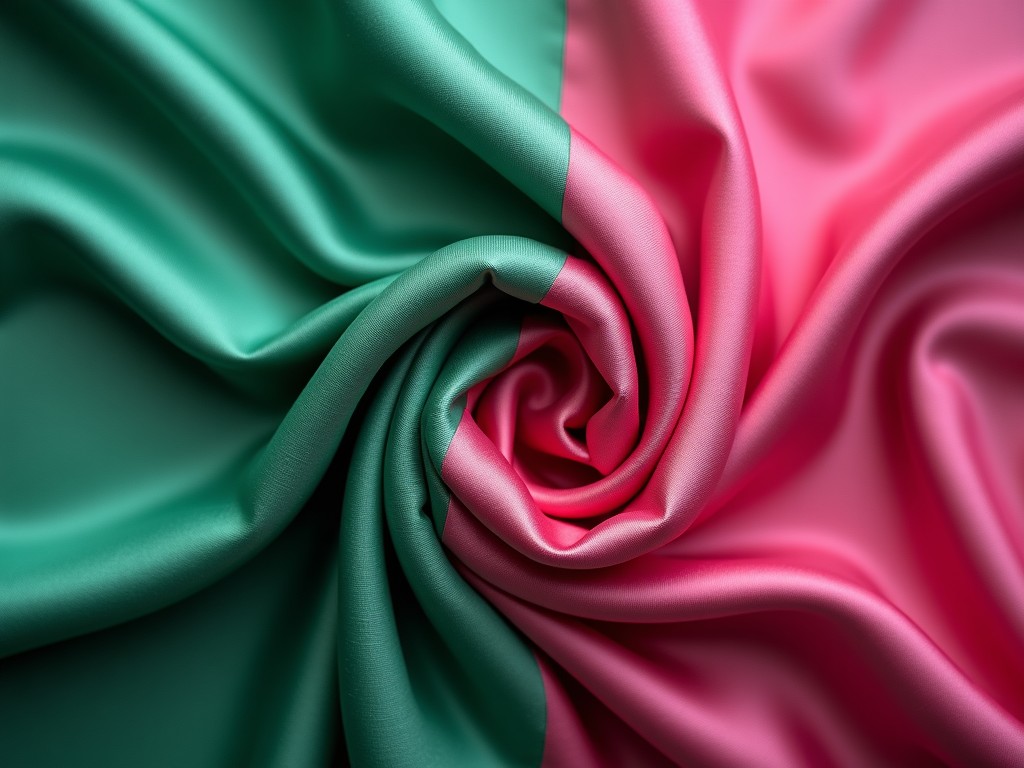
Green And Hot Pink Satin Head Scarf
This product is a lightweight woven accessory constructed from 100% polyester satin with a dual-tone finish: one side in a standardized green shade (Pantone 7730C equivalent) and the reverse in a
Green and Hot Pink Satin Head Scarf
This product is a lightweight woven accessory constructed from 100% polyester satin with a dual-tone finish: one side in a standardized green shade (Pantone 7730C equivalent) and the reverse in a standardized hot pink shade (Pantone 806C equivalent). The fabric is engineered for consistent drape, low pilling, and colorfastness under specified lighting and washing conditions.
Dimensions are fixed at 70 cm × 70 cm (±2 mm) with a finished hem of 3 mm width, formed via ultrasonic sealing to prevent fraying without adding bulk. The satin weave uses 150D filament yarns at 120 picks per inch and 90 ends per inch, delivering a smooth surface with a gloss differential of ≤5% between face and reverse under 45° illumination.
Colorfastness meets ISO 105-B02 (light) ≥4 and ISO 105-C06 (washing) ≥3-4 after 5 cycles at 40°C. The material exhibits zero measurable shrinkage after 3 home laundering cycles per AATCC 135. Thread count and yarn density are selected to balance opacity (minimum 85% light blockage) with breathability (air permeability ≈85 cm³/cm²/s).
Material Composition and Construction
The base fabric is produced from continuous filament polyester (PET) with a triangular cross-section profile to enhance light refraction and surface smoothness. Yarns undergo semi-dull delustering to reduce glare while maintaining the characteristic satin sheen. The green and pink coloration is achieved through disperse dyeing at 130°C under controlled pH (4.5–5.5) to ensure molecular bonding and resistance to fading from UV exposure.
The satin weave structure (4/1) creates a high-luster face by maximizing float length, while the reverse shows a more diffuse finish due to shorter float exposure. This asymmetry is intentional and provides functional versatility—users may select the face for visual prominence or the reverse for softer tone matching. No chemical finishes (e.g., silicone, fluorocarbon) are applied, preserving the fabric’s natural hand and preventing skin irritation risks.
Edge treatment uses ultrasonic welding at 20 kHz with precise energy control to melt and fuse only the filament ends, creating a seamless, flat hem that adds no perceptible thickness. This method avoids thread consumption and eliminates the risk of loose fibers or unraveling under repeated folding and unfolding cycles.
Dimensional Stability and Tolerances
Each scarf is cut from a single bolt using computer-guided rotary blades with tension compensation to prevent distortion. The 70 cm × 70 cm nominal size is maintained within ±2 mm in both warp and weft directions through real-time laser verification during cutting. Post-cut, the fabric undergoes a relaxation period of 24 hours at 23°C/50% RH before final inspection to eliminate residual stress from rolling.
Ultrasonic sealing is applied uniformly along all four edges with a 3 mm weld width. Seal integrity is tested via 90° peel adhesion (minimum 1.2 N/mm) and flexibility after 100 folding cycles (no cracking or delamination). The finished hem adds no measurable stiffness—bend test results show flexural rigidity within 5% of the untreated fabric.
Dimensional change after washing and line drying is ≤1% in both directions, verified per AATCC 135. This stability ensures the scarf retains its square geometry and does not distort into a rhombus or parallelogram over time, which is critical for consistent folding techniques and presentation in professional use.
Color Accuracy and Consistency
Color matching is performed using a spectrophotometer (d/8 geometry, UV excluded) against master batches approved under D65 illumination. Delta-E (CIE76) tolerances are held to ≤1.5 for green (L*a*b*: 45, -20, 25) and ≤1.8 for hot pink (L*a*b*: 55, 40, -10) across production lots. This ensures visual uniformity when multiple scarves are used together in coordinated sets.
Fabric is inspected under standardized lighting (500 lux, D65) with a 45° viewing angle to detect metamerism. No batch-to-batch variation exceeds the just-noticeable difference (JND) threshold for trained observers. Reverse-side color is independently verified to prevent shading errors that could affect dual-sided applications.
Colorfastness to crocking (wet/dry) is rated ≥4 (ISO 105-X12), minimizing transfer risk to adjacent materials during handling. Lightfastness after 40 hours UV exposure (ISO 105-B02) maintains ΔE <3, ensuring no perceptible shift in hue or chroma under indoor display conditions.
Typical Applications
The scarf’s dimensions and weight (≈18 g/m²) make it suitable for precision folding techniques in medical, theatrical, and ceremonial contexts where consistent volume and profile are required. In surgical environments, the low-lint polyester satin minimizes particulate shedding compared to cotton or silk alternatives, supporting cleanliness protocols in non-sterile zones.
In performance arts, the high reflectivity of the satin face enhances visibility under stage lighting, while the reverse offers a matte alternative for reducing glare in close-up shots. The colorfast properties allow repeated use under hot lights without fading, and the ultrasonic hem prevents snagging on costumes or rigging.
For institutional use (e.g., hospitality, aviation), the scarf’s resistance to wrinkling and ease of folding support efficient storage and deployment. The absence of chemical finishes ensures compatibility with sensitive skin during prolonged wear, and the fabric withstands repeated laundering cycles without degradation in hand or appearance.
Comparison Table: Key Specifications
| Property | Typical Value | Test Method / Standard |
|---|---|---|
| Fabric Composition | 100% Polyester (PET) Filament | ISO 1833 |
| Weave Structure | 4/1 Satin | Visual Inspection |
| Nominal Dimensions | 70 cm × 70 cm | Laser Measurement (±2 mm) |
| Weight | ≈18 g/m² | ASTM D3776 |
| Colorfastness to Light | ≥4 (Blue Wool Scale) | ISO 105-B02 |
| Colorfastness to Washing | ≥3-4 | ISO 105-C06 |
| Edge Treatment | Ultrasonic Weld (3 mm) | Internal Spec |
| Air Permeability | ≈85 cm³/cm²/s | ASTM D737 |
Quality Control and Inspection
Every roll undergoes 100% visual inspection for defects (snags, stains, color streaks) under 500 lux D65 lighting at 1 m distance. AQL 1.0 is applied for major defects (e.g., holes, dye bars) and AQL 2.5 for minor defects (e.g., thin places, slubs). Fabric width is monitored every 5 meters during weaving to maintain 110 cm ±1 cm.
Post-cut, each scarf is checked for dimensional accuracy using a calibrated vision system. Edge seal integrity is verified via peel test on 1% of lot size. Color is measured at four points (corners and center) using a handheld spectrophotometer; any point exceeding ΔE 2.0 triggers lot hold.
Final inspection includes folding test (10 cycles) to assess hem durability and hand feel. Scarves are then stacked in groups of 10, wrapped in anti-static polyfilm, and placed in corrugated cartons with internal dividers to prevent abrasion. No lubricants or anti-static agents are added to the packaging material.
Customization Options
While the standard offering is fixed at 70 cm × 70 cm with green/hot pink satin, alternative dimensions (e.g., 50 cm × 50 cm, 90 cm × 90 cm) are available upon request, subject to minimum order quantities and cutting feasibility. Custom color matching to specific Pantone or RAL references can be arranged using the same disperse dyeing process, with lab dip approval required before bulk production.
Alternative edge treatments include narrow hem sewing (2 mm fold-over) or laser sealing for applications requiring minimal thermal input. Fabric weight can be adjusted between 15–25 g/m² by changing yarn denier or pick density, though this affects drape and opacity. All customizations require technical review to ensure compliance with colorfastness and dimensional stability targets.
Packaging options include bulk packing (100 pcs/box), individual polybagging, or custom inserts with branding. Private labeling is available via heat transfer or ultrasonic bonding on the reverse side, limited to single-color logos ≤5 cm² to avoid stiffening the fabric.
For technical inquiries, customization requests, or sample evaluation, contact our engineering team to discuss your specific requirements. Provide details on intended use, environmental exposure, and any regulatory constraints to ensure proper material selection and validation.
Email: [email protected] | Phone: +1 (800) 555-0199
Products
Related Products
News
Related News

2026-11-02
Cotton Voile Scarf Manufacturing and Performance Analysis how to make a cotton voile scarfCreating a professional-grade cotton voile scarf requires a precise balance of textile engineering and artisanal finishing. Unlike standard cotton weaves, voile is defined by its p···

2026-10-28
chiffon hijab Technical Production and Performance AnalysisSelecting the right fabric for a hijab involves a delicate balance between modesty, breathability, and aesthetic drape. For many women in Southeast Asia and the Middle East, the ma···

2026-10-26
custom silk scarf textile manufacturing and performance analysisSelecting a high-quality scarf is no longer just about color matching; it is an exercise in understanding how textile weight, drape, and print scale interact with individual facial···
