Custom Satin Edge Scarf Factory






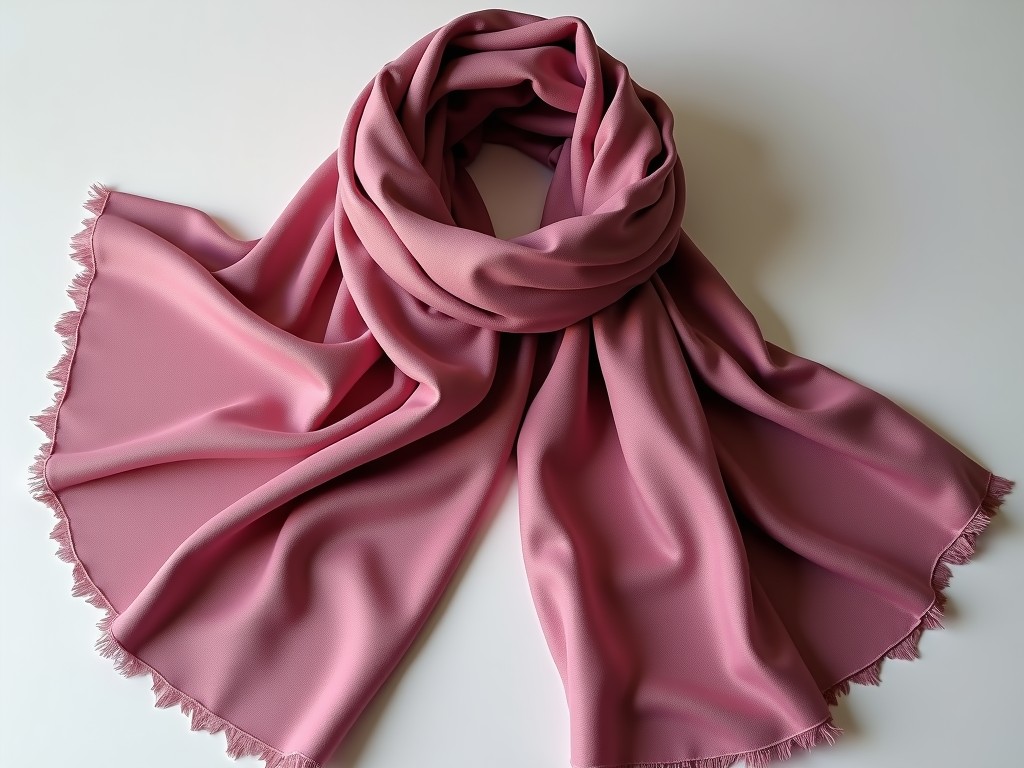
Custom Satin Edge Scarf Factory
Producing custom satin edge scarves requires precise control over fabric selection, edge finishing techniques, and dimensional stability to meet industrial textile standards. This process involves
Custom Satin Edge Scarf Factory
Producing custom satin edge scarves requires precise control over fabric selection, edge finishing techniques, and dimensional stability to meet industrial textile standards. This process involves integrating decorative satin trims with base fabrics while maintaining consistent width, hem integrity, and colorfastness across production batches.
Material Selection and Fabric Compatibility
The success of satin edge application depends on matching the coefficient of friction and thermal expansion between the base fabric and satin trim. Common base fabrics include polyester voile, cotton lawn, and silk blends, each requiring specific tension settings during edge attachment to prevent puckering or separation. Satin trims are typically woven from filament polyester or nylon with a denier range of 75D to 150D, chosen for luster, abrasion resistance, and compatibility with heat-sealing or ultrasonic bonding methods.
Fabric weight is critical: base materials under 40 GSM may require stabilizer backing to handle trim tension, while fabrics over 120 GSM need adjusted feed rates to avoid edge rolling. Color matching is performed using spectrophotometric analysis under D65 lighting to ensure Delta-E values below 2.0 between base and trim, particularly important for corporate branding or uniform applications where color consistency is contractually enforced.
Edge Finishing Techniques and Process Control
Satin edges are applied using one of three primary methods: fused adhesive bonding, ultrasonic welding, or narrow hem folding with topstitching. Adhesive bonding uses hot-melt polyamide films with melting points between 110°C and 130°C, applied at 0.2–0.3 g/cm² to create a flexible bond without stiffening the edge. Ultrasonic welding operates at 20–40 kHz with amplitude settings calibrated to fabric thickness, creating a seamless bond without consumables but requiring synthetic fiber content above 60% for optimal results.
For natural fiber blends, a double-fold hem with 2.5mm satin tape is topstitched using a 301 lockstitch at 10–12 stitches per cm, with thread tension monitored via load cell feedback to prevent loop formation. Edge width tolerance is maintained within ±0.3mm using laser-guided fabric guides and real-time tension sensors, critical for applications like promotional banners or medical garment trims where dimensional accuracy affects downstream assembly.
Quality Inspection and Testing Protocols
Every batch undergoes inline inspection using vision systems with 0.1mm resolution to detect edge misalignment, stains, or trim detachment. Pull-off strength is tested per ASTM D2261, with minimum values of 8.0 N/cm for bonded edges and 12.0 N/cm for stitched finishes to ensure durability under handling and laundering. Colorfastness to light (ISO 105-B02) and washing (ISO 105-C06) is validated, with typical ratings of 4–5 on the gray scale for UV exposure up to 50 AFU and 20 wash cycles at 40°C.
Dimensional stability is assessed after 5 laundering cycles, with maximum allowable skew of 1.5% and twist under 2.0° per linear meter. For clients requiring OEKO-TEX® Standard 100 certification, all adhesives, dyes, and trims are verified for restricted substance compliance, with test reports available upon request. Inspection data is logged per roll and linked to production batch numbers for full traceability.
Customization Options and Design Flexibility
Satin edge width is customizable from 2mm to 15mm, with narrower edges suitable for delicate apparel and wider trims used in decorative banners or ceremonial flags. Corner treatments include mitered, rounded, or butt-joined finishes, each selected based on stress distribution and aesthetic requirements. Custom patterns, logos, or jacquard designs can be integrated into the satin trim itself using disperse dye sublimation, allowing for full-color detailing without increasing edge stiffness.
Base fabric options extend to recycled polyester, organic cotton, and technical blends with moisture-wicking or antimicrobial finishes. Edge color can be matched to Pantone, RAL, or custom lab-dipped standards, with small-lot feasibility starting at 50 meters per variant. For clients requiring reversible designs, double-sided satin edges with contrasting colors are available, requiring precise tension balancing to prevent curling.
| Parameter | Standard Range | Custom Available |
|---|---|---|
| Satin Edge Width | 3mm–8mm | Yes, 2mm–15mm |
| Base Fabric Weight | 40–100 GSM | Yes, 20–150 GSM |
| Edge Bond Strength | 8.0–12.0 N/cm | Yes, per ASTM D2261 |
| Colorfastness (Light) | ISO 105-B02: 4–5 | Yes, upon request |
| Minimum Order Length | 100m per color | Yes, 50m for lab dips |
Applications in Industrial and Commercial Sectors
Custom satin edge scarves are widely used in corporate identity programs where employees wear branded accessories requiring resistance to fading and fraying from daily wear and commercial laundering. The edge finish prevents unraveling during high-cycle washing, extending service life in hospitality and healthcare uniforms. In promotional merchandise, the satin trim adds perceived value without significantly increasing weight or bulk, making it suitable for event giveaways and retail bundles.
Technical applications include use as protective covers for instrumentation edges, where the smooth satin surface reduces abrasion on sensitive equipment. In aerospace interiors, low-outgassing satin trims meeting ASTM E595 are applied to fabric panels to prevent fiber migration in sealed environments. The ability to produce consistent, narrow tolerances makes this product suitable for integration into automated sewing or lamination lines where edge uniformity affects downstream processing speed and yield.
Packaging and Logistics Considerations
Finished rolls are wound on 3-inch or 6-inch cores with internal diameter tolerance of ±0.5mm to ensure compatibility with automated unwind systems. Each roll is wrapped in polyethylene film with UV inhibitors and placed in corrugated cartons with edge protectors to prevent crushing during transit. Humidity indicators are included for shipments to high-moisture climates, and rolls are labeled with batch numbers, yardage, and care instructions in multiple languages as required.
For clients requiring just-in-time delivery, rolls can be segmented into 10-meter or 20-meter lengths with snap-adjustable cores to reduce changeover time on production lines. Export packaging complies with ISPM 15 for wood pallets and includes shockwatch labels for monitoring handling conditions. Lead times are typically 10–15 business days for standard materials, with express options available for approved fabric and trim combinations.
Products
Related Products
News
Related News

2026-11-02
Cotton Voile Scarf Manufacturing and Performance Analysis how to make a cotton voile scarfCreating a professional-grade cotton voile scarf requires a precise balance of textile engineering and artisanal finishing. Unlike standard cotton weaves, voile is defined by its p···

2026-10-28
chiffon hijab Technical Production and Performance AnalysisSelecting the right fabric for a hijab involves a delicate balance between modesty, breathability, and aesthetic drape. For many women in Southeast Asia and the Middle East, the ma···

2026-10-26
custom silk scarf textile manufacturing and performance analysisSelecting a high-quality scarf is no longer just about color matching; it is an exercise in understanding how textile weight, drape, and print scale interact with individual facial···
