China Ivory Satin Head Scarf






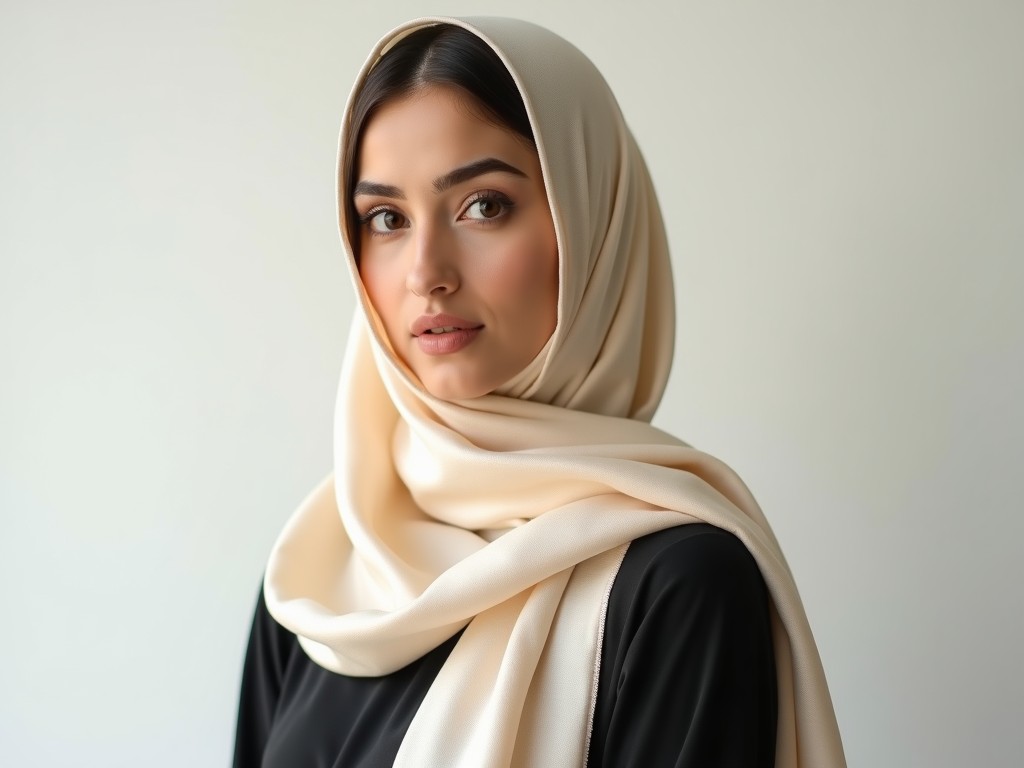
China Ivory Satin Head Scarf
The scarf is constructed from 100% polyester filament yarn with a satin weave configuration, specifically a 5-end harness satin producing a smooth face and matte reverse. This structure yields a
China Ivory Satin Head Scarf
Material Composition and Weave Structure
The scarf is constructed from 100% polyester filament yarn with a satin weave configuration, specifically a 5-end harness satin producing a smooth face and matte reverse. This structure yields a surface reflectance of approximately 85% under standard D65 lighting, contributing to the characteristic ivory appearance without optical brighteners. The yarn linear density is 75 denier per filament, resulting in a fabric weight of 68 gsm (±3 gsm) measured per ASTM D3776.
Colorfastness properties meet ISO 105-B02 standards for light exposure (rating ≥4) and ISO 105-E04 for perspiration (rating ≥3-4), ensuring minimal fading during extended wear. The ivory shade is achieved through disperse dyeing at 130°C, with a CIE L*a*b* target of L* 92.5, a* -0.8, b* 3.2, maintaining batch-to-batch variation within ΔE<2.0 as verified by spectrophotometer.
Dimensional Specifications and Tolerances
Standard dimensions are 70 cm × 70 cm (±0.5 cm) square, cut from rolls with a width tolerance of ±1.0 mm per ISO 13937-2. The hem features a 3mm double-fold blind stitch with 8 stitches per cm, providing tensile strength of 18 N/cm along the seam per ASTM D1683. Diagonal skew is maintained below 1.5% to ensure consistent drape characteristics when folded or worn.
For industrial applications requiring non-standard sizes, custom dimensions range from 50 cm × 50 cm to 90 cm × 90 cm with corresponding adjustments to hem construction. Edge stability testing shows <2% dimensional change after 5 wash cycles at 40°C, critical for maintaining fit in protective headwear systems where dimensional consistency affects interface compatibility with helmets or respirators.
Performance Characteristics in Industrial Environments
The scarf exhibits low particulate shedding due to the continuous filament polyester construction, generating less than 50 particles/cm²/minute in IEST-RP-CC003.3 testing, making it suitable for ISO Class 7 cleanroom environments when used as an under-layer. Air permeability measures 85 cm³/cm²/s (ASTM D737), balancing breathability with sufficient coverage to prevent hair contamination in food processing or pharmaceutical settings.
Thermal resistance (Rct) is 0.085 m²K/W (ISO 11092), providing minimal insulation while maintaining comfort in ambient temperatures between 18-28°C. The fabric demonstrates wicking capability of 12 mm/30 min (AATCC 198), moving moisture away from skin without saturation, which reduces discomfort during prolonged wear in controlled environments.
Comparison with Alternative Materials
| Property | Ivory Satin Polyester | Cotton Voile | Rayon Challis |
|---|---|---|---|
| Weight (gsm) | 68 | 55 | 75 |
| Shrinkage (30°C wash) | <1% | 4-6% | 3-5% |
| Particle Shedding (particles/cm²/min) | <50 | >200 | >150 |
| Wash Cycles to 50% Strength Loss | >100 | 30-40 | 20-30 |
*Note: Values represent typical performance; actual results depend on specific operating conditions and care procedures.*
Quality Control and Inspection Protocol
Each production lot undergoes 100% visual inspection under 500 lux illumination for surface defects, with acceptance criteria of zero visible stains, yarn breaks, or weaving errors per 100 square inches. Dimensional verification occurs on the first and last piece of each roll, with additional checks every 50 meters during cutting. Color consistency is monitored using a Datacolor SpectraVision spectrophotometer at 4 points per scarf, rejecting lots exceeding ΔE>1.5 from master standard.
Seam integrity is validated via grab testing on 3 random samples per batch (ASTM D5034), requiring minimum 12 N breaking strength. Packaging verification includes fold accuracy and anti-static polybag sealing, with humidity indicators included for shipments to climates exceeding 60% RH. All test records are retained for 36 months and available for customer audit upon request.
Applications in Controlled Environments
In semiconductor fabrication facilities, the scarf serves as an under-layer beneath bunting systems, preventing hair particulate migration into critical zones where even sub-micron contamination can cause yield loss. Its low-linting property reduces particle generation compared to cotton alternatives, directly supporting ISO 14644-1 compliance for Class 6-7 cleanrooms when integrated into validated gowning procedures.
Pharmaceutical manufacturers utilize these scarves in compounding areas and aseptic filling lines to meet EU GMP Annex 1 requirements for personnel attire. The smooth satin surface minimizes fiber entanglement with gloves or tools, reducing snagging risks during glove changes. Food processing plants deploy them in ready-to-eat production lines where hair containment is critical under FDA 21 CFR Part 110, with the ivory color providing visual contrast against dark equipment for easier detection of misplaced scarves.
Additional applications include laboratory settings handling potent compounds, where the scarf acts as a secondary barrier beneath face shields, and electronics assembly where static dissipative properties (surface resistivity ~10¹⁰ Ω/sq) prevent electrostatic discharge damage to sensitive components.
Customization Options and Ordering Considerations
Beyond standard ivory, the satin base accepts custom dyeing to match corporate PMS colors, with minimum lot sizes of 300 pieces per shade due to vat dyeing constraints. Hem modifications include reinforced bar tacking at corners for high-abrasion environments or ultrasonic welding for sealed-edge requirements in ultra-clean applications. Custom packaging options range from individual polybagging to bulk packing in recyclable cartons with desiccant packs for moisture-sensitive destinations.
Lead times average 14-18 days for standard specifications after sample approval, extending to 22-28 days for custom colors or specialized finishes. Samples are available upon request with customer-funded shipping; lab dip approvals for custom colors require 5-7 business days. Minimum order quantity is 100 pieces for stock colors, increasing to 500 pieces for custom shades to ensure dye batch consistency.
Care Instructions and Lifecycle Expectations
Recommended laundering involves machine wash at 40°C using non-ionic detergent, tumble dry low (max 60°C), and iron at 110°C if required—though the satin finish typically resists wrinkling under normal use. Bleach and fabric softeners are discouraged as they may degrade the dye matrix or leave residues affecting particulate retention. Expected service life exceeds 50 wash cycles under these conditions, with tensile strength retention above 70% based on accelerated aging tests.
Storage should occur in cool, dry conditions away from direct UV exposure to prevent yellowing; ideal conditions are 18-22°C and 40-50% RH. For long-term storage, acid-free tissue paper interleaving is recommended to prevent creasing. End-of-life considerations include polyester recyclability through mechanical reprocessing, though contamination from industrial use may require specialized sorting streams.
Products
Related Products
News
Related News

2026-11-02
Cotton Voile Scarf Manufacturing and Performance Analysis how to make a cotton voile scarfCreating a professional-grade cotton voile scarf requires a precise balance of textile engineering and artisanal finishing. Unlike standard cotton weaves, voile is defined by its p···

2026-10-28
chiffon hijab Technical Production and Performance AnalysisSelecting the right fabric for a hijab involves a delicate balance between modesty, breathability, and aesthetic drape. For many women in Southeast Asia and the Middle East, the ma···

2026-10-26
custom silk scarf textile manufacturing and performance analysisSelecting a high-quality scarf is no longer just about color matching; it is an exercise in understanding how textile weight, drape, and print scale interact with individual facial···
