Buy Satin Plain Square Hijab






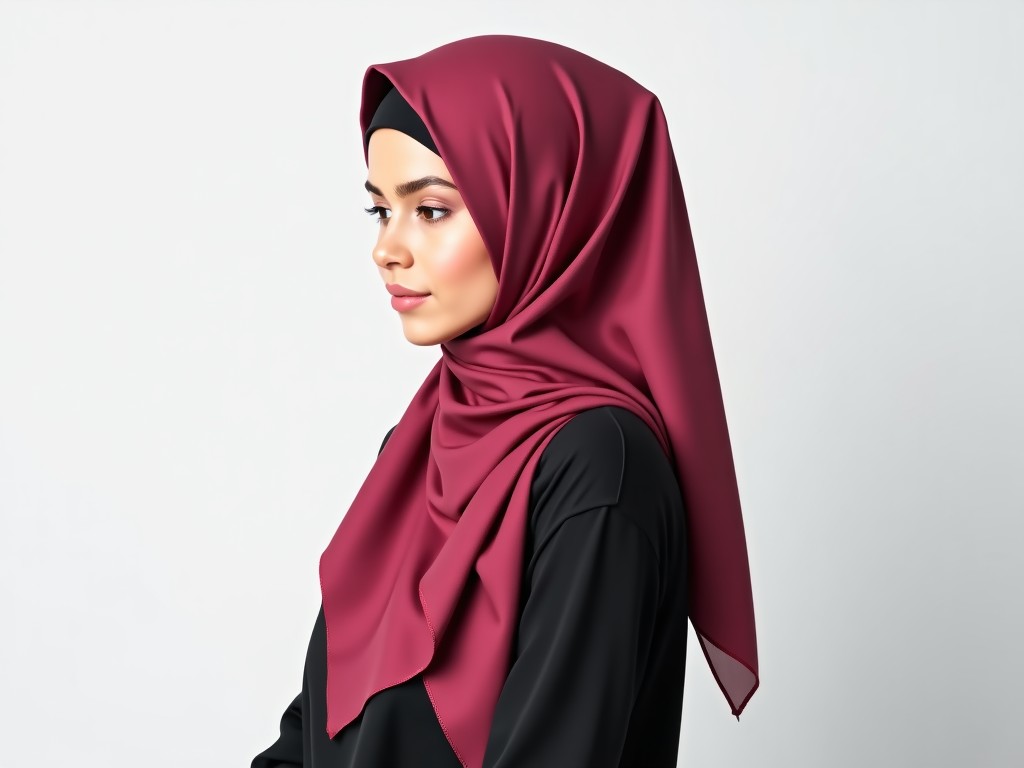
Buy Satin Plain Square Hijab
When procuring hijabs for bulk distribution, institutional use, or uniform programs, technical specifications determine long-term performance and user satisfaction. This guide details the measurable
Satin Plain Square Hijab – Industrial Specification Guide
When procuring hijabs for bulk distribution, institutional use, or uniform programs, technical specifications determine long-term performance and user satisfaction. This guide details the measurable characteristics of satin plain square hijabs to support informed purchasing decisions.
Material Composition and Construction
The base fabric is 100% polyester filament yarn, engineered for consistent luster and dimensional stability. Satin weave construction uses a 4/1 harness pattern, where four warp threads float over one weft thread, creating a smooth, reflective surface with reduced interlacing points. This structure minimizes surface friction and enhances drape characteristics critical for consistent folding and wear.
Filament yarn denier typically ranges from 75D to 150D per end, directly influencing fabric weight and opacity. Higher denier counts increase cover factor and reduce translucency, while lower denier improves flexibility. Yarn twist is maintained below 3 turns per inch to preserve surface smoothness and prevent snagging during handling.
Dimensional Specifications
Square hijabs are cut to precise tolerances to ensure uniformity across production lots. Standard dimensions are defined by finished edge measurements after hem completion, accounting for fold-over and stitching shrinkage.
| Dimension | Typical Range (cm) | Tolerance |
|---|---|---|
| Width | 100 – 120 | ±0.5 cm |
| Height | 100 – 120 | ±0.5 cm |
| Diagonal | 141 – 170 | ±0.7 cm |
Hem width is standardized at 0.6 cm ±0.1 cm, formed by a double-fold blind stitch to prevent fraying and maintain a clean edge. Stitch density is maintained at 8–10 stitches per cm to ensure seam integrity without causing pucker in the satin surface.
Surface and Optical Properties
Surface gloss is measured using a 60-degree glossmeter, with typical values between 40–60 GU (Gloss Units) for standard satin finish. This range balances visual appeal with practical resistance to fingerprint visibility and smudging during handling.
Colorfastness to light (ISO 105-B02) is rated at minimum 4 on the blue wool scale after 20 hours of xenon arc exposure, ensuring minimal fading under indoor lighting. Colorfastness to washing (ISO 105-C06) achieves grade 4–5 for both staining and color change after 5 cycles at 40°C, supporting repeated laundering without significant degradation.
Performance Characteristics
Tensile strength in warp and weft directions averages 18–25 N/tex, providing sufficient resistance to tearing during normal use while maintaining flexibility. Elongation at break ranges from 15–25%, allowing the fabric to conform to shape without permanent deformation.
Air permeability is typically 80–120 mm/s under ISO 9237 testing, indicating moderate breathability suitable for extended wear. Thermal conductivity is low due to the compact satin structure, contributing to thermal retention in cooler environments — a factor to consider in climate-controlled settings.
Care and Maintenance
Recommended washing temperature is 30–40°C using mild detergent, avoiding bleach or oxidizing agents that may degrade polyester surface finish. Tumble drying should be low-heat (<60°C) or air-dried to prevent heat-setting of wrinkles. Ironing, if required, is performed at 110°C max with a pressing cloth to avoid surface scoring.
The fabric exhibits minimal shrinkage (<2%) after five wash cycles when processed according to guidelines. Dimensional stability is further enhanced by heat-setting during fabrication, which relaxes internal stresses in the filament yarn.
Packaging and Handling
Hijabs are folded to a standard 20 cm × 20 cm square and packed in polybags of 10, 25, or 50 units depending on order volume. Each bag is labeled with size, color code, and batch number for traceability. Carton dimensions are optimized for palletization, typically 40 × 30 × 25 cm for 100 units, reducing shipping volume and handling complexity.
Anti-static treatment is available upon request to reduce cling during dispensing in high-volume environments. UV stabilization additives can be incorporated for extended outdoor exposure scenarios, though standard grades are intended for indoor or limited outdoor use.
Quality Assurance
Each production lot undergoes random sampling for width/length verification, shade matching against Pantone or CIELAB standards, and seam integrity testing. Color variation within a lot is controlled to ΔE < 1.5 under D65 lighting to ensure visual consistency across units.
Final inspection includes visual checks for snags, stains, or printing defects (if applicable), with AQL 1.0 for critical defects and AQL 2.5 for major defects. Test reports are available upon request for accredited laboratory evaluations.
Products
Related Products
News
Related News

2026-11-02
Cotton Voile Scarf Manufacturing and Performance Analysis how to make a cotton voile scarfCreating a professional-grade cotton voile scarf requires a precise balance of textile engineering and artisanal finishing. Unlike standard cotton weaves, voile is defined by its p···

2026-10-28
chiffon hijab Technical Production and Performance AnalysisSelecting the right fabric for a hijab involves a delicate balance between modesty, breathability, and aesthetic drape. For many women in Southeast Asia and the Middle East, the ma···

2026-10-26
custom silk scarf textile manufacturing and performance analysisSelecting a high-quality scarf is no longer just about color matching; it is an exercise in understanding how textile weight, drape, and print scale interact with individual facial···
