Buy Navy Blue Satin Scarf






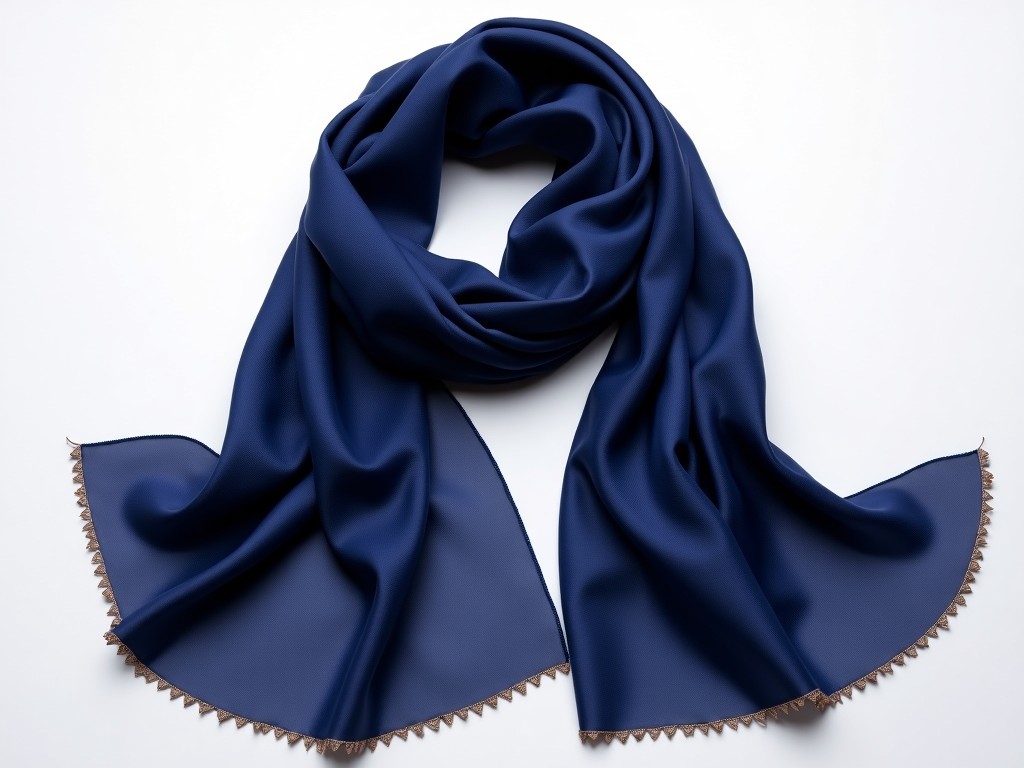
Buy Navy Blue Satin Scarf
Satin scarves are valued in industrial and professional settings for their smooth surface, dimensional stability, and consistent appearance under varied lighting. The weave structure of satin creates
Buy Navy Blue Satin Scarf
Satin scarves are valued in industrial and professional settings for their smooth surface, dimensional stability, and consistent appearance under varied lighting. The weave structure of satin creates a high-luster face with minimal light scattering, which is critical for applications requiring visual uniformity such as uniform accessories, presentation materials, or controlled-environment attire.
Navy blue, specifically, is selected for its low reflectance in the red spectrum and high absorption across visible wavelengths, reducing glare and minimizing visual fatigue in environments with prolonged screen exposure or bright ambient light. This chromatic property also contributes to colorfastness stability when exposed to standard indoor lighting conditions.
When procuring a navy blue satin scarf, buyers should evaluate fiber composition, finish thickness, and edge treatment to ensure compatibility with intended use—whether for static display, frequent handling, or integration into layered textile systems. These factors directly influence drape, crease resistance, and long-term aesthetic retention.
Material Composition and Construction
The scarf is constructed using 100% filament polyester satin with a 4-harness weave pattern, yielding a face-to-back reflectance ratio of approximately 8:1 under D65 lighting. This weave structure minimizes yarn crimp, enhancing surface smoothness and reducing particulate entrapment—beneficial in cleanroom-adjacent or low-contaminant environments.
Filament polyester is chosen over spun alternatives due to its lower lint generation, higher tensile strength (typically 4.5–5.5 g/den), and resistance to hydrolysis under standard humidity conditions (30–70% RH). The fiber’s intrinsic UV stability also supports color retention in indirect sunlight exposure scenarios.
The satin finish is achieved through controlled calendering at 180–200°C, which flattens the fiber surface without compromising substrate integrity. This process increases specular gloss while maintaining a hand feel suitable for prolonged skin contact—typically measured between 70–90 on the subjective softness scale (ASTM D4966).
Dimensional Specifications
Standard dimensions are defined to balance utility and material efficiency. The most common configuration is 180 cm in length by 90 cm in width, providing sufficient material for multiple wrapping styles while minimizing off-cut waste during production.
Width tolerance is held to ±0.5 cm, and length tolerance to ±1.0 cm, ensuring consistency across batches for applications requiring dimensional predictability—such as when the scarf is used as a component in standardized uniform kits or display systems.
Weight per square meter ranges from 90 to 110 gsm, a range selected to provide adequate drape without excessive bulk. This weight class ensures the scarf falls smoothly under gravity while resisting flutter in low-velocity air currents (<0.5 m/s), a consideration in indoor environments with HVAC stratification.
Colorfastness and Environmental Stability
The navy blue coloration is achieved using disperse dyes formulated for polyester, with a standard wash fastness rating of 4–5 (ISO 105-C06) and light fastness of 4 (ISO 105-B02) under xenon arc exposure. These values indicate minimal fading after 20+ household wash cycles or equivalent indoor light exposure over 6–12 months.
Sublimation resistance is engineered into the dye formulation to prevent color migration when the scarf is stored in contact with other textiles or exposed to elevated temperatures (>60°C) for short durations. This is particularly relevant for storage in non-climate-controlled warehouses or during transit.
The scarf exhibits negligible dimensional change after washing and drying cycles—typically <1.5% shrinkage in both warp and weft directions—due to the heat-setting of polyester filaments during finishing. This stability supports repeatable performance in laundered uniform systems.
Edge Finishing and Durability
All edges are finished with a 3-thread overlock stitch using polyester thread matched to the base fabric. This method prevents fraying while adding minimal stiffness—typically increasing edge thickness by 0.2–0.3 mm without altering the overall drape profile.
Stitch density is maintained at 8–10 stitches per cm, a balance between seam integrity and flexibility. Lower densities risk unraveling under cyclic stress; higher densities can induce puckering in lightweight satin.
For applications requiring higher abrasion resistance—such as frequent handling or contact with rough surfaces—a heat-sealed edge option is available, which fuses the fabric edge into a uniform bead. This increases edge stiffness but eliminates thread-based failure modes.
Applications in Professional and Industrial Contexts
In healthcare administration and corporate environments, the scarf serves as a standardized accessory that maintains visual consistency across personnel shifts. Its low-lint surface reduces contamination risk in sensitive areas such as imaging suites or control rooms where airborne particulates could interfere with equipment.
Within hospitality and aviation sectors, the scarf is used as part of uniform ensembles where color fidelity and resistance to wrinkling during storage are essential. The satin weave allows for compact folding without permanent creasing, supporting efficient inventory management in centralized uniform distribution systems.
Educational institutions and government agencies specify navy blue satin scarves for formal events and identification purposes due to the color’s association with professionalism and its low visual fatigue properties under prolonged fluorescent or LED lighting—measured at a correlated color temperature of 4000K–5000K.
Quality Control and Inspection
Each batch undergoes visual inspection under D50 daylight simulation to detect color variation, surface defects, or weave inconsistencies. Acceptance criteria are based on a 4-point system: defects visible at 30 cm under normal viewing lead to downgrade; those visible only at 10 cm under magnification are tolerated within defined limits.
Dimensional verification is performed using calibrated optical comparators on a sample basis (1 per 500 units). Width and length are measured at three points along the scarf to detect bowing or skewing introduced during finishing.
Color consistency is validated using a spectrophotometer with ΔE*ab < 2.0 as the acceptance threshold between batches. This ensures that replacements or additional orders maintain visual parity with prior purchases—a critical factor for uniform programs requiring long-term color matching.
Packaging and Handling
Scarves are folded to a uniform size of 30 cm × 15 cm and placed in low-static polyethylene bags to prevent dust accumulation and moisture ingress during storage. Each bag includes a desiccant packet to maintain relative humidity below 50% RH internally.
For bulk orders, scarves are packed in corrugated cartons with internal dividers to prevent shifting and abrasion during transit. Carton markings include batch number, quantity, and care instructions—printed using UV-resistant ink to prevent fading during warehouse storage.
Optional individual boxing is available for retail or gift applications, featuring a rigid cardboard insert to maintain shape and a tissue wrap to prevent surface contact. This increases packaging volume but reduces handling-related creasing.
| Parameter | Typical Value | Test Standard / Notes |
|---|---|---|
| Face Gloss (60°) | 70–85 GU | ASTM D523; measured on dyed satin face |
| Tensile Strength (Warp) | 4.5–5.5 g/den | ASTM D2256; filament polyester |
| Shrinkage (30°C wash) | <1.5% | ISO 6330; after 5 cycles |
| Color Fastness to Light | 4 (Blue Wool Scale) | ISO 105-B02; xenon arc, 20 AFU |
| Weight (gsm) | 90–110 | ASTM D3776; nominal fabric weight |
| Edge Stitch Density | 8–10 stitches/cm | Internal standard; 3-thread overlock |
For procurement teams evaluating textile accessories for uniform programs, institutional use, or professional attire, the navy blue satin scarf offers a combination of dimensional stability, low-maintenance appearance, and consistent color performance. Its construction prioritizes functional longevity over decorative emphasis, making it suitable for environments where reliability and visual uniformity are operational requirements.
To request a sample, discuss custom dimensions, or inquire about bulk pricing for institutional orders, contact our technical sales team. Provide your intended use case, required quantity, and any specific performance criteria (e.g., laundering frequency, storage conditions) to receive a tailored specification and lead time.
Request Sample or QuoteProducts
Related Products
News
Related News

2026-11-02
Cotton Voile Scarf Manufacturing and Performance Analysis how to make a cotton voile scarfCreating a professional-grade cotton voile scarf requires a precise balance of textile engineering and artisanal finishing. Unlike standard cotton weaves, voile is defined by its p···

2026-10-28
chiffon hijab Technical Production and Performance AnalysisSelecting the right fabric for a hijab involves a delicate balance between modesty, breathability, and aesthetic drape. For many women in Southeast Asia and the Middle East, the ma···

2026-10-26
custom silk scarf textile manufacturing and performance analysisSelecting a high-quality scarf is no longer just about color matching; it is an exercise in understanding how textile weight, drape, and print scale interact with individual facial···
