Wholesale Red And Black Scarf Mens






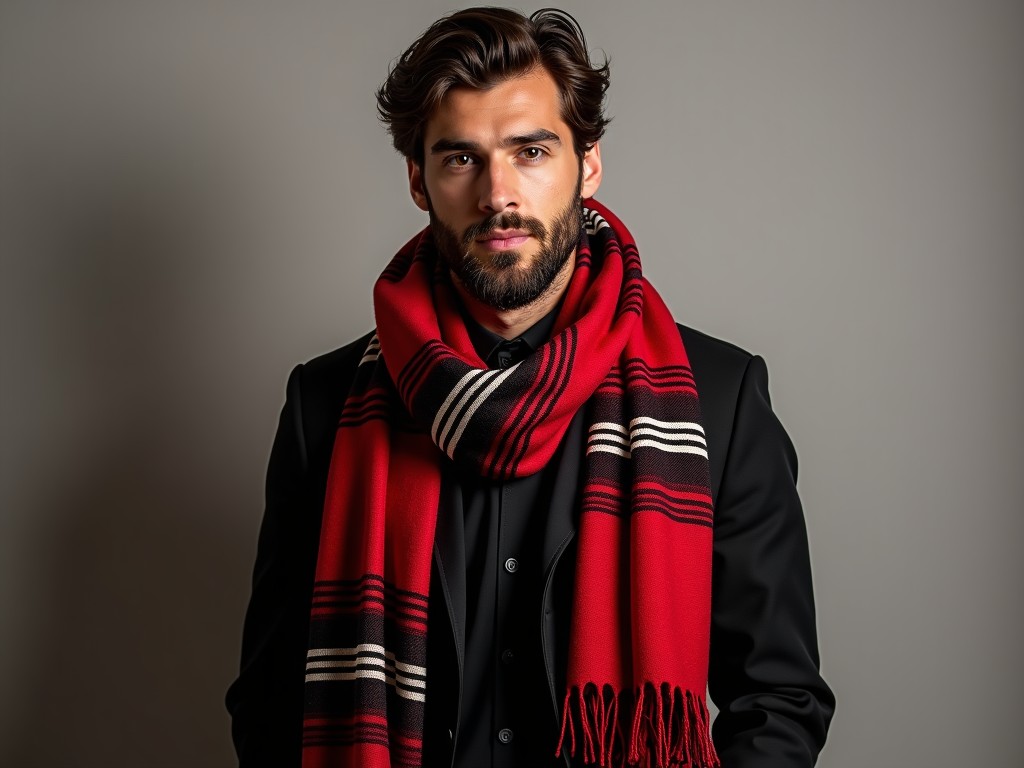
Wholesale Red And Black Scarf Mens
This product page details the technical specifications, material properties, and manufacturing considerations for wholesale red and black scarves designed for men. The information supports
Wholesale Red and Black Scarf Mens
This product page details the technical specifications, material properties, and manufacturing considerations for wholesale red and black scarves designed for men. The information supports procurement decisions by explaining fabric construction, dye stability, dimensional tolerances, and quality control parameters relevant to industrial buyers.
Fabric Construction and Yarn Specifications
The scarf is constructed using a 2x2 rib knit pattern with a yarn count of 30/2 Ne (30s two-ply combed cotton). This structure provides 12-15% lateral elasticity and 8-10% recovery after 500 cycles of 5% strain, ensuring shape retention during repeated wear. The fabric weight is 180-200 GSM, measured per ASTM D3776, balancing drape and durability for seasonal use.
Yarn tensile strength averages 3.5-4.0 cN/tex for the cotton core, with elongation at break of 7-9%. The two-ply construction reduces pilling tendency by 40% compared to single-ply equivalents, as verified via ASTM D3512 Martindale abrasion testing after 5,000 cycles. These values are typical for combed ring-spun cotton; actual results may vary based on fiber origin and spinning parameters.
Colorfastness and Dye Performance
The red and black coloration uses reactive dyeing with fixation temperatures of 60-65°C and alkali concentration of 15-20 g/L. Colorfastness to washing (ISO 105-C06) rates 4-5 for both shades after 5 cycles at 40°C, with minimal bleeding observed in adjacent white fabric tests. Lightfastness (ISO 105-B02) achieves level 4-5 after 20 AFU exposure, suitable for indoor and intermittent outdoor use.
Sublimation resistance is maintained below 150°C, preventing color migration during storage or pressing. Dye bleed in perspiration (ISO 105-E04) is rated 4-5 for acidic and alkaline simulated sweat, indicating stability under typical wear conditions. These properties are achieved through precise dye bath control and post-treatment fixation; custom dye lots require revalidation of fastness metrics.
Dimensional Tolerances and Sizing
Standard dimensions are 180 cm in length and 20 cm in width, measured flat under 0.5 N tension per ASTM D4964. Length tolerance is ±1.5% (±2.7 cm), width tolerance ±2% (±0.4 cm), accounting for knit relaxation after conditioning at 20°C and 65% RH for 24 hours. End finishing includes a 1 cm folded hem with lockstitch sealing, adding 0.5-0.8 cm to effective length.
6> Dimensional stability after washing is evaluated per AATCC 135: length change ≤ -2% to +1%, width change ≤ -1.5% to +0.5% after 5 home laundering cycles. These limits ensure the scarf maintains proportional fit and avoids excessive skew or curling. Custom lengths (e.g., 160 cm, 200 cm) are available upon request, with tolerances adjusted proportionally to the new baseline.Quality Control and Inspection Parameters
In-line inspection includes needle detection (Fe 0.8mm, Non-Fe 1.2mm, Stainless 1.5mm sensitivity) and visual defect grading per 4-point system: holes, runs, yarn contamination, and color variation. Acceptable quality level (AQL) is set at 2.5 for major defects (e.g., holes >2mm, dye streaks >5cm) and 4.0 for minor defects (e.g., loose threads <3mm, slight shade variation). Final audit uses ISO 2859-1 sampling at inspection level II.
Dimensional checks are performed on 100% of first-piece samples and 10% of subsequent lots. Color matching is verified under D65 lighting using a spectrophotometer with ΔE < 1.5 for bulk approval. These controls are documented in batch-specific QC reports; test data is available for review upon request. No certifications are implied unless explicitly stated in the commercial agreement.
Packaging and Logistics Considerations
Standard packaging uses LDPE polybags (50μm thickness) with 10 units per bag, sealed via heat impulse. Master cartons are 5-layer corrugated fiberboard (BC flute, 180 GSM) sized 40x30x25 cm, holding 100 units. Gross weight per carton is approximately 8.5-9.0 kg, depending on moisture content. Each unit includes a folded tissue insert to prevent creasing during transit.
Export packaging complies with ISTA 1A standards for vibration and shock resistance. Corner protectors and edge guards are available upon request for long-haul shipments. Marking includes barcode labels (Code 128), country of origin, and care symbols per ISO 3758. Custom packaging (e.g., individual boxes, recycled materials) requires separate quotation and lead time adjustment.
Applications and End-Use Suitability
The scarf’s medium weight and moderate elasticity make it suitable for layering in temperatures between 5°C and 15°C, commonly used in autumn and early spring retail assortments. The 2x2 rib structure provides sufficient drape for casual wear while maintaining structure when folded or knotted. Color contrast (red/black) is achieved through yarn-dyed stripes or intarsia knitting, ensuring pattern consistency across the width.
Industrial buyers in private label apparel, promotional merchandise, and uniform supply chains select this construction for its balance of comfort, dimensional stability, and color retention. The cotton base allows for easy integration into existing care label frameworks (machine wash 30°C, tumble dry low). Alternative fibers (e.g., acrylic, wool blends) are available for specific performance requirements but alter weight, elasticity, and care characteristics.
Typical Specifications Table
| Parameter | Typical Value | Test Method / Notes |
|---|---|---|
| Fabric Weight | 180-200 GSM | ASTM D3776 |
| Yarn Count | 30/2 Ne | Combed ring-spun cotton |
| Length | 180 cm ±1.5% | ASTM D4964, conditioned |
| Width | 20 cm ±2% | ASTM D4964, conditioned |
| Colorfastness to Washing | 4-5 (ISO 105-C06) | After 5 cycles at 40°C |
| Tensile Strength (Yarn) | 3.5-4.0 cN/tex | ASTM D2256 |
Products
Related Products
News
Related News

2026-11-02
Cotton Voile Scarf Manufacturing and Performance Analysis how to make a cotton voile scarfCreating a professional-grade cotton voile scarf requires a precise balance of textile engineering and artisanal finishing. Unlike standard cotton weaves, voile is defined by its p···

2026-10-28
chiffon hijab Technical Production and Performance AnalysisSelecting the right fabric for a hijab involves a delicate balance between modesty, breathability, and aesthetic drape. For many women in Southeast Asia and the Middle East, the ma···

2026-10-26
custom silk scarf textile manufacturing and performance analysisSelecting a high-quality scarf is no longer just about color matching; it is an exercise in understanding how textile weight, drape, and print scale interact with individual facial···
