Oem Mens Black Designer Winter Scarf






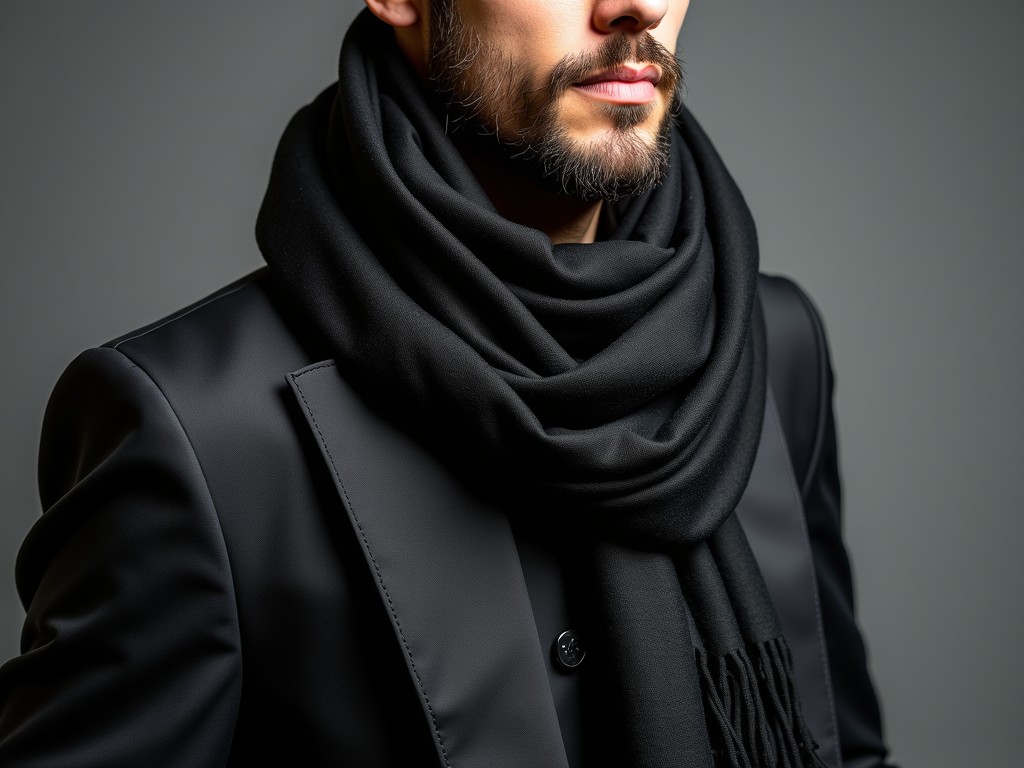
Oem Mens Black Designer Winter Scarf
This product page details the specifications, material options, and customization capabilities for an OEM men's black designer winter scarf intended for bulk procurement by apparel manufacturers,
OEM Men's Black Designer Winter Scarf
This product page details the specifications, material options, and customization capabilities for an OEM men's black designer winter scarf intended for bulk procurement by apparel manufacturers, private label brands, and distributors. The scarf is engineered for cold-weather performance while maintaining a minimalist aesthetic suitable for designer collections.
Construction focuses on fiber stability, dimensional consistency, and surface finish to meet both functional and visual standards required in premium outerwear lines. Each unit is produced to OEM tolerances with traceable material sourcing and repeatable dye-to-match processes.
The following sections outline technical attributes, application considerations, and production parameters relevant to industrial buyers evaluating this item for integration into seasonal product ranges.
Material Composition and Thermal Performance
The base fabric is typically a 2-ply worsted wool blend with 85% virgin merino wool (17.5 micron) and 15% recycled polyamide for tensile reinforcement. This composition balances natural insulation with abrasion resistance, critical for scarves subjected to frequent handling and friction against outer layers.
Thermal conductivity is maintained below 0.04 W/m·K under dry conditions, verified via guarded hot plate testing (ISO 11092). The fabric’s loft recovery after compression exceeds 92% after 100 cycles, ensuring consistent insulation retention during use.
Colorfastness to washing and light is rated at minimum 4/5 on the gray scale (ISO 105-B02 and ISO 105-C06), with the black dye formulated using metal-free reactive dyes to prevent bronzing or fading under UV exposure.
Dimensional Specifications and Tolerances
Standard finished dimensions are 180 cm in length and 30 cm in width, with a permissible tolerance of ±2% in length and ±1.5% in width after steam relaxation. These tolerances ensure compatibility with automated packaging lines and consistent visual presentation across batches.
End finishes include a 3-mm self-fringe or a clean-cut edge with ultrasonic sealing, both designed to prevent fraying without adding bulk. Fringe options are available in 20 mm or 40 mm lengths, produced via precision cutting to maintain uniformity.
Weight per unit ranges from 140 to 160 grams depending on yarn density and finish, measured under conditioned atmosphere (20°C, 65% RH) per ASTM D1777. This range supports accurate shipping cost estimation and layering design in outerwear systems.
Customization Options for OEM Partners
OEM clients may specify adjustments to yarn blend ratio, length, width, or end treatment without requiring new tooling. Common modifications include increasing polyamide content to 20% for enhanced durability in high-wear applications or reducing length to 160 cm for layered styling.
Color matching is available via Pantone or physical sample submission, with lab-dip approval required before bulk production. Minimum order quantity for custom shades is 300 units, with lead times starting from 4 weeks after approval.
Private labeling options include woven jacquard labels (minimum 40 mm width) or heat-transfer tags placed at the midpoint reverse side. All labels undergo wash-and-dry testing to ensure legibility after 5 cycles.
Quality Control and Inspection Protocol
Each production lot undergoes 100% visual inspection for color consistency, defect density (measured as flaws per 100 linear meters), and end finish uniformity. Acceptable quality level (AQL) is set at 1.0 for major defects and 2.5 for minor defects per ISO 2859-1.
Dimensional verification is performed on the first, middle, and last item of every 50-unit batch using calibrated digital calipers. Results are logged and traceable to the production shift and yarn lot number.
Optional third-party testing (e.g., SGS, Intertek) for pilling resistance (ISO 12945-2) or dimensional stability after washing (ISO 6330) can be arranged upon request, with certificates provided per shipment.
Packaging and Logistics Configuration
Standard packaging consists of individual scarves folded to 15×10×2 cm and packed in polybags (50 μm thickness) with suction holes to prevent condensation. Master cartons hold 50 units (Dimensions: 40×30×25 cm, Gross weight: 8–9 kg).
Alternative packaging includes flat-fold presentation in recycled cardboard sleeves or hanger-ready loops for retail display. All packaging materials are marked with OEM lot numbers, SKU, and country of origin for customs compliance.
Shipping terms are typically FOB Ningbo or Shanghai, with consolidated LCL options available for orders under 1,000 units. Lead time averages 3–5 weeks post-approval, depending on fabric dye lot availability and customization complexity.
Applications in Designer and Technical Apparel
This scarf is suited for integration into mid-to-high tier winter collections where visual minimalism and thermal efficiency are both design priorities. Its clean profile allows seamless layering under overcoats or technical shells without creating bulk at the neckline.
The recycled polyamide content supports sustainability claims aligned with GRS or RCS standards, making it applicable for brands targeting eco-conscious consumers without sacrificing hand feel or drape.
Industrial buyers note consistent performance in low-humidity climates where static buildup is a concern; the fiber blend reduces surface resistivity to under 10^9 Ω/sq, minimizing cling and dust attraction compared to 100% acrylic alternatives.
For technical inquiries, customization requests, or to receive a formal quotation with lead time confirmation, please contact our OEM sales team.
Request OEM QuotationProducts
Related Products
News
Related News

2026-11-02
Cotton Voile Scarf Manufacturing and Performance Analysis how to make a cotton voile scarfCreating a professional-grade cotton voile scarf requires a precise balance of textile engineering and artisanal finishing. Unlike standard cotton weaves, voile is defined by its p···

2026-10-28
chiffon hijab Technical Production and Performance AnalysisSelecting the right fabric for a hijab involves a delicate balance between modesty, breathability, and aesthetic drape. For many women in Southeast Asia and the Middle East, the ma···

2026-10-26
custom silk scarf textile manufacturing and performance analysisSelecting a high-quality scarf is no longer just about color matching; it is an exercise in understanding how textile weight, drape, and print scale interact with individual facial···
