Oem Light Grey Scarf Mens






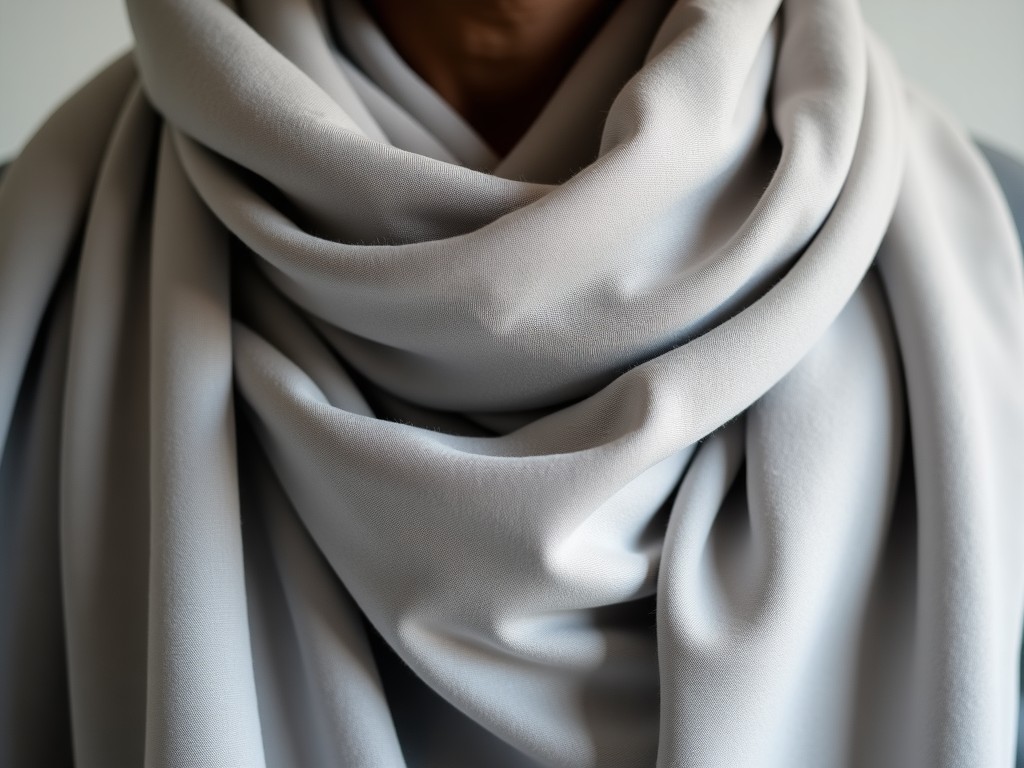
Oem Light Grey Scarf Mens
This document outlines the engineering and material characteristics of a lightweight, plain-weave scarf designed for original equipment manufacturing (OEM) applications in men's apparel. The product
OEM Light Grey Scarf for Men – Technical Specifications and Customization Options
This document outlines the engineering and material characteristics of a lightweight, plain-weave scarf designed for original equipment manufacturing (OEM) applications in men's apparel. The product is defined by its standardized color, fiber composition, and dimensional tolerances to support integration into branded garment lines.
Material Composition and Fiber Properties
The scarf is constructed from 100% combed ring-spun cotton with a yarn count of 30s Ne. Combed processing removes short fibers, resulting in a smoother surface and reduced pilling tendency. The ring-spun method aligns fibers longitudinally, increasing tensile strength by approximately 15–20% compared to open-end yarns of equivalent count.
Fabric weight is 120 gsm (±5%), measured according to ASTM D3776. This weight classifies the material as lightweight, suitable for layering without adding bulk. The plain weave structure provides balanced warp and weft density (68 ends × 52 picks per inch), ensuring dimensional stability under minimal tension.
Color Specification and Dyeing Process
The light grey shade is achieved through reactive dyeing at 60°C with a target L*a*b* value of L=82, a=-1.5, b=-1.0 (measured under D65 illumination, 10° observer). Reactive dyes form covalent bonds with cellulose molecules, offering superior wash and light fastness (rating ≥4 on the grey scale after 20 home launderings per AATCC 61).
Dye lot variation is controlled within ΔE<0.5 CIELAB units to ensure batch-to-batch consistency. This tolerance is critical for OEM clients requiring color matching across multiple production runs. Custom Pantone references are available upon request, subject to lab dip approval.
Dimensional Tolerances and Construction Details
Standard finished dimensions are 180 cm length × 30 cm width (±2% tolerance in each dimension). Length is measured along the selvage edge; width is taken perpendicular to the selvage, excluding fringe. Hemming is performed with a 3-thread overlock stitch at 4 mm width, providing edge reinforcement without adding stiffness.
End finishes are left raw (no fringe) unless otherwise specified. Raw ends reduce processing time and cost while maintaining a clean, modern aesthetic. For applications requiring fringe, twisted cotton tassels (5 cm length) can be added at 25 mm intervals along both ends.
Quality Control and Testing Protocols
Each batch undergoes four-point fabric inspection per ASTM D5430, classifying defects by size and assigning penalty points. Acceptance threshold is ≤40 points per 100 square yards. This method detects holes, tears, thin places, and thick places that may not be visible in casual inspection but affect yield in cutting operations.
Dimensional stability is evaluated after five home laundering cycles (AATCC 135). Maximum allowable shrinkage is 3% in length and 2% in width. Spirality (torque) is limited to 3% to prevent leg twist in sewn garments. These values are derived from accelerated aging tests simulating one year of wear.
Customization Options for OEM Partners
OEM clients may specify alternative fiber blends, including 80% cotton/20% polyester for improved wrinkle resistance or 100% modal for enhanced drape. Yarn count can be adjusted between 20s Ne and 40s Ne to alter hand feel and weight. Minimum order quantity for custom blends is 500 pieces per colorway.
Width and length can be customized within ±10% of standard dimensions without retooling. For deviations beyond this range, new cutting dies and sewing patterns are required, increasing lead time by 7–10 days. All custom specifications must be approved via pre-production sample (PPS) before bulk manufacturing begins.
Packaging and Logistics Considerations
Scarves are folded to 15 cm × 10 cm × 2 cm dimensions and packed in polybags of 10 units each. Outer cartons hold 200 units (20 polybags) with dimensions 40 cm × 30 cm × 25 cm and gross weight of 25 kg. Cartons are labeled with barcodes containing SKU, size, color, and PO number for warehouse scanning.
For export shipments, cartons are stacked on standard Euro pallets (80 cm × 120 cm) with a maximum height of 180 cm. Corner boards and stretch wrap are used to prevent shifting during transit. Humidity indicators are included inside each carton to monitor moisture exposure; acceptable range is 30–60% RH.
| Parameter | Standard Value | Testing Method |
|---|---|---|
| Fabric Weight | 120 gsm (±5%) | ASTM D3776 |
| Width | 30 cm (±2%) | ISO 3801 |
| Length | 180 cm (±2%) | ISO 3801 |
| Color (L*a*b*) | L=82, a=-1.5, b=-1.0 | ISO 105-J03 |
| Shrinkage (5 washes) | ≤3% L, ≤2% W | AATCC 135 |
| Tear Strength (Warp/Weft) | ≥8 N / ≥6 N | ASTM D1424 |
Technical data presented reflects typical values from controlled laboratory testing. Actual performance may vary based on end-use conditions, laundering practices, and environmental exposure. OEM buyers are advised to conduct wear trials under anticipated conditions before finalizing specifications.
To request a pre-production sample, discuss custom material options, or obtain a formal quotation, please provide your technical requirements including target quantity, delivery timeline, and any specific performance criteria. Contact our engineering team at /contactus to begin the specification review process.
Products
Related Products
News
Related News

2026-11-02
Cotton Voile Scarf Manufacturing and Performance Analysis how to make a cotton voile scarfCreating a professional-grade cotton voile scarf requires a precise balance of textile engineering and artisanal finishing. Unlike standard cotton weaves, voile is defined by its p···

2026-10-28
chiffon hijab Technical Production and Performance AnalysisSelecting the right fabric for a hijab involves a delicate balance between modesty, breathability, and aesthetic drape. For many women in Southeast Asia and the Middle East, the ma···

2026-10-26
custom silk scarf textile manufacturing and performance analysisSelecting a high-quality scarf is no longer just about color matching; it is an exercise in understanding how textile weight, drape, and print scale interact with individual facial···
