Oem Arab Male Head Scarf Styles






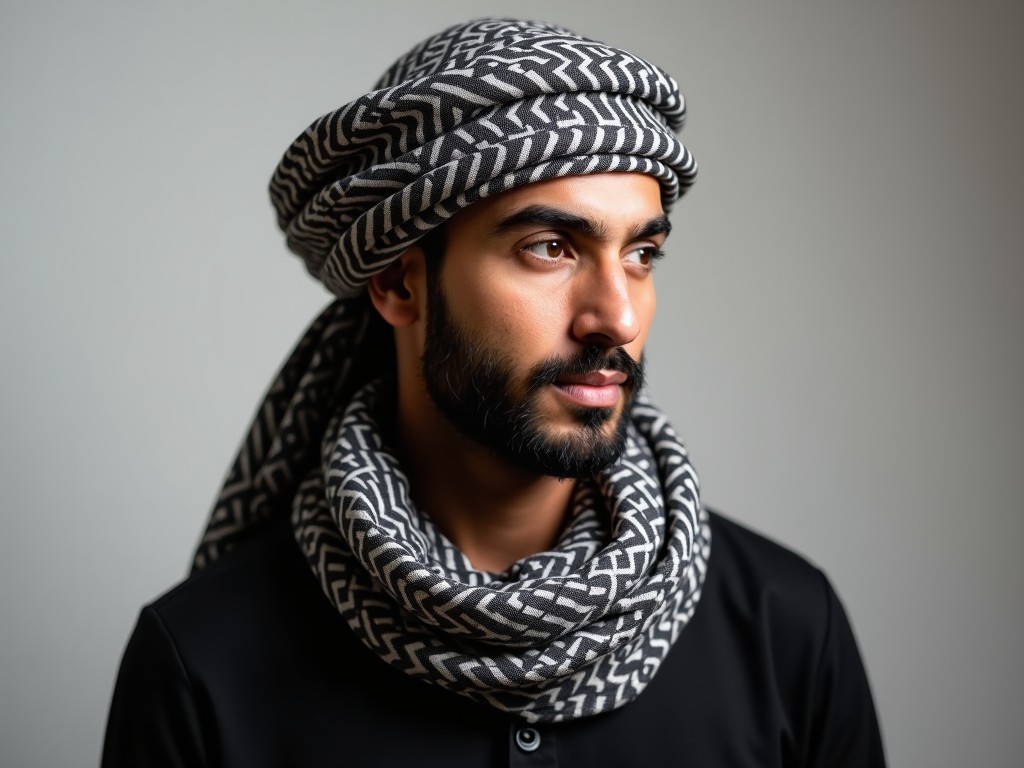
Oem Arab Male Head Scarf Styles
Arab male head scarves, commonly known as keffiyeh or ghutra, serve both cultural and functional purposes across Middle Eastern regions. These garments are traditionally woven from cotton, wool, or
OEM Arab Male Head Scarf Styles
Arab male head scarves, commonly known as keffiyeh or ghutra, serve both cultural and functional purposes across Middle Eastern regions. These garments are traditionally woven from cotton, wool, or blended fibers to provide protection from sun, wind, and sand while maintaining breathability in arid climates. Industrial production requires precise control over yarn count, weave density, and dye stability to meet regional specifications and end-use demands.
Material Composition and Weave Structures
The performance of an OEM head scarf depends on fiber selection and fabric construction. Cotton remains the dominant material due to its moisture absorption, comfort, and ease of dyeing, with typical yarn counts ranging from 20s to 40s Ne for balanced durability and softness. Wool blends, often at 10–30% content, improve thermal regulation for cooler climates while adding resilience. Synthetic fibers like polyester are rarely used in premium offerings due to reduced breathability, though they may appear in low-cost variants for improved wrinkle resistance.
Weave patterns directly influence drape, visibility of design, and structural integrity. Plain weave is standard for solid-color ghutras, offering uniform thickness and ease of printing. Keffiyeh patterns typically employ a combination of plain weave backgrounds with supplementary warp or weft float techniques to create the characteristic checkerboard or geometric motifs. Thread density typically ranges from 80x60 to 120x90 ends per inch (epi) x picks per inch (ppi), with higher counts yielding finer detail and improved wind resistance.
Standard Dimensions and Customization Parameters
Conventional head scarves are produced as square panels, with side lengths varying by regional preference and intended wearing style. The most common dimensions fall between 110 cm and 130 cm per side, allowing sufficient fabric for multiple wrapping techniques around the head and shoulders. Smaller variants (90–100 cm) are occasionally requested for youth or ceremonial use, while larger formats (140 cm+) may be specified for full-body coverage in desert environments.
Customization extends beyond size to include border treatments, pattern scaling, and colorfastness specifications. Hemming options include rolled edges (3–5 mm width) for a clean finish or fringe additions (50–100 mm length) tied by hand or machine. Pattern repeat scales are adjustable—standard keffiyeh motifs range from 1.5 cm to 3 cm per square, but OEM clients may request enlargement or reduction to align with brand identity or cultural nuances. Dye lots are controlled to ΔE < 3 under CIELAB for consistent color matching across production batches.
Regional Style Variations and Functional Adaptations
Distinct regional preferences drive OEM specifications. In the Levant, the black-and-white keffiyeh is often associated with symbolic significance and is typically woven with a tighter weave for durability during prolonged outdoor use. Gulf states predominantly favor solid white ghutras, where high reflectance and minimal visible soiling are prioritized—achieved through optical brighteners and mercerization of cotton fibers to enhance surface smoothness and light reflection.
Functional adaptations address specific environmental challenges. For high-sand-exposure zones, fabrics may undergo surface treatment with silica-based coatings to reduce particle adhesion without compromising breathability. In regions with intense UV radiation, UV-protective finishes (UPF 30–50+) are applied via benign, textile-safe chemicals that maintain wash resistance over 20+ cycles. These treatments are applied post-weaving and verified via spectrophotometric testing to ensure compliance with buyer-defined performance thresholds.
Quality Control and Production Consistency
Industrial buyers require repeatable quality across large orders. Key control points include yarn tensile strength (min. 18–22 cN/tex for cotton), colorfastness to washing (min. grade 4 on ISO 105-C06), and dimensional stability after laundering (max. 3% shrinkage). Each batch undergoes random sampling for thread count verification using optical scanning systems, with tolerance bands set at ±5% for epi and ppi to ensure pattern integrity.
Visual inspection occurs under standardized daylight simulation (D65, 1000 lux) to detect shading variations, print misalignment, or defects such as thick/thin places or missing picks. Automated systems flag deviations exceeding 2 mm in pattern repeat or 0.5 mm in line width. Final measurements are taken under relaxed conditions after 24 hours of conditioning at 20°C and 65% RH to eliminate moisture-related variability. Packaging includes acid-free tissue folding and polybag sealing to prevent creasing and contamination during transit.
Applications Across End-Use Sectors
Beyond traditional wear, OEM head scarves serve specialized sectors where performance and conformity to regional norms are critical. In security and defense contracting, uniforms for personnel operating in Middle Eastern environments often include standardized ghutras or keffiyehs as part of cultural integration gear—these require NIR compliance for compatibility with night-vision equipment and resistance to degradation from repeated field laundering.
Hospitality and aviation sectors specify custom-branded head scarves for staff uniforms in luxury hotels or regional airlines, where color precision and fabric hand feel directly impact brand perception. These orders frequently involve corporate Pantone matching and softener treatments to achieve a premium drape without stiffening. Relief agencies and NGOs procuring for refugee or displaced populations prioritize low-cost, high-durability variants with reinforced corners and fade-resistant dyes to extend service life under harsh conditions.
| Parameter | Typical Range | Notes |
|---|---|---|
| Yarn Count (Cotton) | 20s–40s Ne | Balances softness and durability |
| Thread Density (epi x ppi) | 80x60 to 120x90 | Higher counts improve wind resistance |
| Standard Dimensions | 110–130 cm square | Regional variants: 90–140 cm |
| Colorfastness (Washing) | ISO 105-C06 Grade ≥4 | Critical for white ghutras |
| Shrinkage (After Wash) | ≤3% | Measured after 5 cycles at 40°C |
| Pattern Repeat (Keffiyeh) | 1.5–3 cm per square | Customizable per OEM spec |
Technical documentation, including material safety data sheets (MSDS) for finishes, OEKO-TEX® certification copies, and test reports for colorfastness and shrinkage, are available upon request. Sample development typically requires 7–10 business days after approval of lab dips and strike-offs, with lead times for production orders ranging from 25 to 40 days depending on order volume and complexity of customization.
To initiate a quotation or request technical samples, provide your detailed specifications including target dimensions, preferred material blend, pattern requirements, color references (Pantone or physical sample), and estimated annual volume. Our engineering team will review feasibility, suggest optimizations for cost or performance, and return a formal proposal within 48 hours.
Request Technical Specification SheetProducts
Related Products
News
Related News

2026-11-02
Cotton Voile Scarf Manufacturing and Performance Analysis how to make a cotton voile scarfCreating a professional-grade cotton voile scarf requires a precise balance of textile engineering and artisanal finishing. Unlike standard cotton weaves, voile is defined by its p···

2026-10-28
chiffon hijab Technical Production and Performance AnalysisSelecting the right fabric for a hijab involves a delicate balance between modesty, breathability, and aesthetic drape. For many women in Southeast Asia and the Middle East, the ma···

2026-10-26
custom silk scarf textile manufacturing and performance analysisSelecting a high-quality scarf is no longer just about color matching; it is an exercise in understanding how textile weight, drape, and print scale interact with individual facial···
