New Men Shemagh Woven Keffiyeh Scarf Arab Palestin






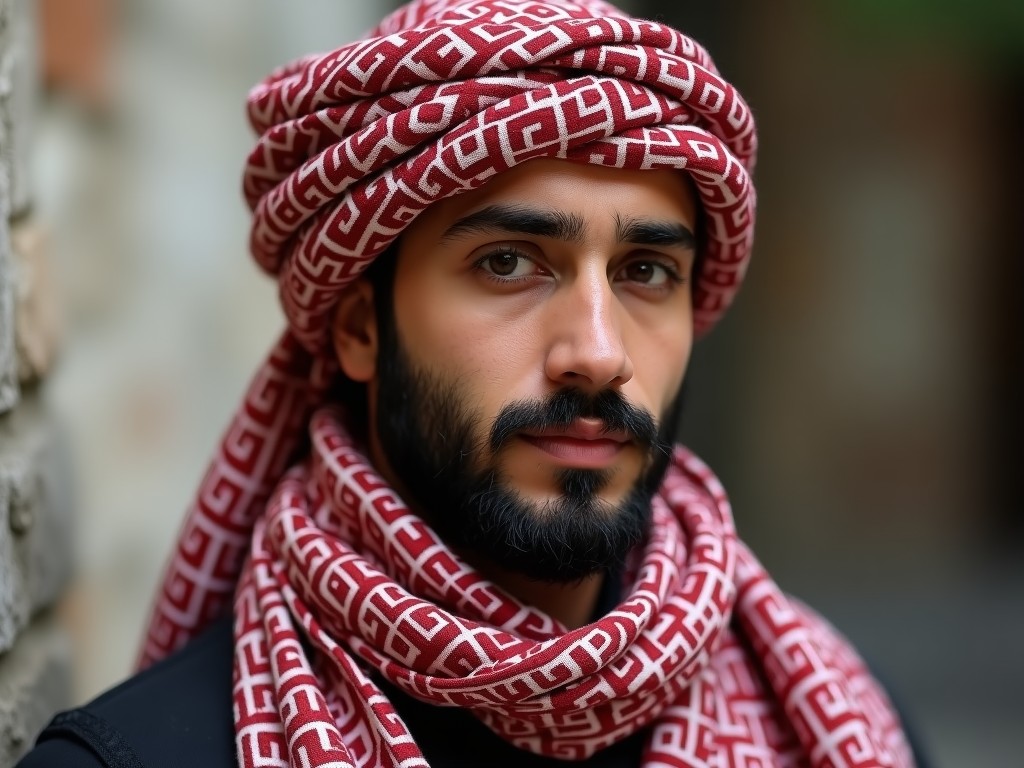
New Men Shemagh Woven Keffiyeh Scarf Arab Palestin
The traditional shemagh, also known as a keffiyeh, is a square cotton scarf historically worn across the Levant for protection against sun, wind, and sand. Modern industrial applications require
New Men Shemagh Woven Keffiyeh Scarf Arab Palestinian
The traditional shemagh, also known as a keffiyeh, is a square cotton scarf historically worn across the Levant for protection against sun, wind, and sand. Modern industrial applications require consistent weave density, dimensional stability, and colorfastness to meet bulk procurement standards for workwear, uniform programs, and protective gear distribution.
This product is engineered as a ready-to-wear men's accessory that preserves cultural authenticity while meeting modern textile performance benchmarks. Each unit is cut from a single woven panel to maintain pattern integrity across the entire surface, minimizing seam-related weak points.
Material Construction and Weave Specifications
The base fabric is 100% combed cotton yarn, carded to remove short fibers and improve tensile uniformity. Yarn count averages 20s Ne (30 tex) in both warp and weft directions, producing a balanced plain weave with approximately 85 ends per inch and 75 picks per inch.
This construction yields a nominal weight of 180 g/m² (±10%), sufficient for drape and durability without excessive bulk. The cotton undergoes mercerization to increase luster, improve dye affinity, and enhance dimensional stability during repeated washing cycles.
Unlike blended alternatives, pure cotton ensures breathability and moisture absorption critical for prolonged wear in variable climates. Shrinkage is controlled through sanforization, limiting longitudinal and lateral change to under 3% after five home launderings at 40°C.
Pattern Consistency and Dyeing Process
The characteristic checkerboard pattern is woven directly into the fabric using dyed yarns, not printed or embroidered post-weave. This ensures the design remains visible on both sides and resists fading from abrasion or UV exposure.
Two standard colorways are offered: natural white with black pattern, and natural white with red pattern. The black and red dyes are reactive types, chemically bonding to cellulose fibers for superior wash and light fastness (minimum rating 4 on the ISO 105-B02 scale).
Dye lots are monitored via spectrophotometer to maintain ΔE < 1.5 between batches, ensuring color consistency across large orders. Custom color matching is available upon request, subject to minimum quantity and lab dip approval.
Dimensions and Finishing Details
The finished scarf measures 110 cm × 110 cm (±2 cm) after cutting and hemming. This size accommodates multiple wrapping styles while remaining manageable for storage and distribution.
All four edges are folded 3 mm and secured with a double-needle lockstitch, using polyester thread matched to the base fabric color. Stitch density averages 8 stitches per cm, providing edge reinforcement without stiffening the handle.
No chemical finishes, softeners, or anti-static agents are applied by default to preserve the fabric’s natural hand and avoid potential skin irritation. Optional treatments such as stain resistance or insect repellent can be discussed for specialized applications.
Typical Applications in Industrial and Occupational Settings
Beyond cultural use, the shemagh functions as effective personal protection in dusty, arid, or high-sun environments. Industries such as construction, mining, agriculture, and security operations utilize similar garments for particulate barrier and thermal regulation.
When folded and worn correctly, the cotton layers can filter larger airborne particles while allowing vapor transmission, reducing heat stress compared to non-breathable synthetics. Its moisture-wicking property helps manage sweat accumulation during prolonged physical activity.
Uniform programs in logistics, field services, and outdoor maintenance often adopt the shemagh as a standardized head or neck covering due to its low cost, reusability, and ease of laundering. It serves as a practical alternative to disposable balaclavas or nylon neck gaiters in non-hazardous zones.
Quality Control and Inspection Protocol
Each batch undergoes visual inspection under 500 lux daylight simulation lighting to detect yarn defects, pattern misalignment, or staining. Acceptable quality limit (AQL) is set at 2.5 for major defects (e.g., holes, tears, dye smears) and 4.0 for minor defects (e.g., loose threads, slight shade variation).
Dimensional checks are performed on a random sample of 5% of the lot, measuring length and width at three points per specimen. Weight is verified per square meter using a calibrated analytical balance. Colorfastness to washing and light is tested per ISO 105-C06 and ISO 105-B02 on initial production and annually thereafter.
Packaging integrity is verified before shipment: each scarf is folded uniformly and packed in polyethylene bags (50 μm thickness) with desiccant packs, then placed in export cartons. Carton seals are inspected for tamper evidence, and labels include SKU, size, color, quantity, and country of origin.
Comparison Table: Standard vs. Custom Options
| Attribute | Standard Offering | Customizable Upon Request |
|---|---|---|
| Fabric Composition | 100% combed cotton | Cotton-polyester blends (65/35, 80/20) |
| Weight | 180 g/m² (±10%) | 150–220 g/m² range |
| Colorway | White/Black or White/Red | Custom colors (Pantone-matched) |
| Size | 110 cm × 110 cm (±2 cm) | 100 cm, 120 cm, 130 cm squares |
| Edge Finish | Double-needle hem, 3 mm fold | Overlock, fringed, or raw edge |
| Packaging | Polybag, 50 pcs/ctn | Individual boxes, branded labels, bale packing |
For procurement teams evaluating this product for uniform programs, protective gear kits, or resale channels, key considerations include lead time, minimum order quantity, and sample availability. Standard production lead time is 25–30 working days after receipt of deposit and final artwork approval, assuming stock yarn availability.
Minimum order quantity starts at 300 pieces per colorway, with price breaks at 1,000 and 5,000 units. Pre-production samples are available upon request, typically delivered within 7–10 days after sample fee receipt, which is creditable toward the first order.
Shipping terms are flexible: FOB factory, CIF port, or DDP destination can be arranged based on buyer logistics preferences. All export documentation includes commercial invoice, packing list, certificate of origin, and Oeko-Tex Standard 100 certification upon confirmation of compliance testing.
Products
Related Products
News
Related News

2026-11-02
Cotton Voile Scarf Manufacturing and Performance Analysis how to make a cotton voile scarfCreating a professional-grade cotton voile scarf requires a precise balance of textile engineering and artisanal finishing. Unlike standard cotton weaves, voile is defined by its p···

2026-10-28
chiffon hijab Technical Production and Performance AnalysisSelecting the right fabric for a hijab involves a delicate balance between modesty, breathability, and aesthetic drape. For many women in Southeast Asia and the Middle East, the ma···

2026-10-26
custom silk scarf textile manufacturing and performance analysisSelecting a high-quality scarf is no longer just about color matching; it is an exercise in understanding how textile weight, drape, and print scale interact with individual facial···
