Mens White Tuxedo Scarf With Fringe






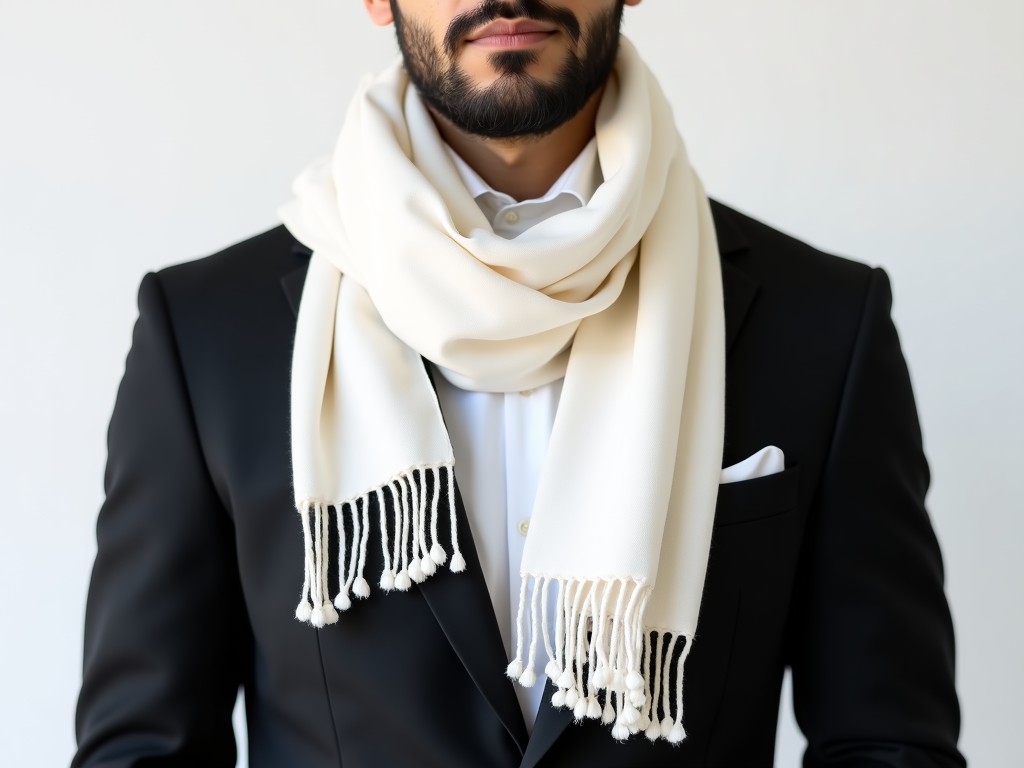
Mens White Tuxedo Scarf With Fringe
This product page details the technical specifications, material properties, and manufacturing considerations for a men's white tuxedo scarf with fringe, intended for formal wear applications where
Mens White Tuxedo Scarf with Fringe
This product page details the technical specifications, material properties, and manufacturing considerations for a men's white tuxedo scarf with fringe, intended for formal wear applications where dimensional stability, fabric drape, and fringe integrity are critical to end-use performance.
Material Composition and Fabric Construction
The scarf is constructed from a plain-weave polyester-cotton blend (65% polyester, 35% combed ring-spun cotton) with a nominal yarn count of 30/2 Ne in both warp and weft directions. This blend provides a balance of wrinkle resistance from the polyester component and moisture absorbency from the cotton, achieving a regain of approximately 8% at standard atmospheric conditions (20°C, 65% RH). The fabric undergoes a controlled heat-setting process at 180°C for 90 seconds to minimize residual shrinkage to less than 1.5% in both dimensions after five ISO 6330 wash cycles.
The fringe is formed by extracting and bundling 12 warp yarns per tassel group, with each tassel containing approximately 48 individual yarns. These yarns are tensioned during insertion to ensure uniform length variation of no more than ±2 mm across the fringe edge. The terminal ends are secured with a 3-mm diameter resin-coated nylon knot, rated for a minimum tensile strength of 8.5 N to prevent unraveling under normal handling and light tension during wear.
Dimensional Specifications and Tolerances
| Parameter | Nominal Value | Tolerance | Test Method |
|---|---|---|---|
| Overall Length (fringe excluded) | 150 cm | ±1.0 cm | ISO 3018 |
| Width | 18 cm | ±0.5 cm | ISO 3018 |
| Fringe Length (per side) | 8 cm | ±0.3 cm | Visual measurement, relaxed state |
| Fabric Weight | 140 g/m² | ±10 g/m² | ISO 3801 |
| Whiteness Index (WI) | 85 (CIE) | ±3 units | ISO 105-J02, D65 illumination |
Dimensional stability is further validated through repeated dry cleaning cycles (per ISO 105-D01), where length and width changes remain within ±0.8% after five cycles. The fringe-to-body junction is reinforced with a 5-mm wide fusible interlining tape applied during cutting, preventing yarn migration and maintaining edge definition under flexural stress.
Colorfastness and Appearance Retention
The white coloration is achieved through optical brightening agents (OBAs) applied during the finishing stage, with a concentration calibrated to maintain a whiteness index above 80 after 20 hours of simulated sunlight exposure (ISO 105-B02, Xenon arc lamp). Fluorescence quenching is monitored via UV reflectance spectroscopy, ensuring no more than a 15% decline in brightness under accelerated aging conditions equivalent to 100 hours of noon sunlight in subtropical climates.
Residual alkalinity from the bleaching process is maintained below 50 ppm (as NaOH equivalent) to prevent yellowing during storage. The fabric pH is stabilized between 6.0 and 7.5 through a mild acetic acid neutralization rinse, reducing the risk of fiber degradation in humid environments. Fringe yarns receive the same optical brightening treatment as the base fabric to ensure visual consistency under varying light sources (A, C, D65 illuminants).
Packaging and Handling Considerations
Each scarf is folded using a standardized tri-fold method to minimize crease formation, with the fringe aligned parallel to the fold axis to prevent tangling. The folded unit is placed in a low-density polyethylene (LDPE) bag, 50 µm thickness, sealed via impulse welding to provide a moisture barrier (WVTR < 5 g/m²/day at 38°C, 90% RH). Secondary packaging consists of a single-wall corrugated carton (150 g/m² board strength) containing 25 units, with internal partition sheets to prevent abrasion during transit.
Cartons are marked with handling symbols indicating "Keep Dry" and "Do Not Crush" per ISO 780:1997. Storage recommendations specify a maximum temperature of 25°C and relative humidity not exceeding 60% to preserve OBA efficacy and prevent microbial growth on cellulose-based components. Shelf life under these conditions is estimated at 24 months without significant degradation in whiteness or tensile properties.
Quality Assurance and Inspection Protocol
Incoming raw yarn is sampled per ANSI/ASQ Z1.4 (inspection level II, AQL 0.65 for critical defects) for tensile strength, evenness, and color consistency. Fabric inspection occurs at the greige state and post-finish, using a 4-point system for visual defects (stains, holes, yarn misdraws) with a rejection threshold of 40 points per 100 linear yards. Fringe uniformity is verified via automated vision screening, measuring tassel density and length distribution across 100% of the product width.
Final audit includes a wear simulation test where the scarf is draped over a standardized male torso mannequin (ISO 8559-1:2017) and subjected to 100 cycles of shoulder movement to assess fringe entanglement and fabric distortion. Any sample exhibiting fringe knot slippage, length variation >3 mm, or visible puckering is rejected. Batch traceability is maintained via lot numbers linking to dyeing, finishing, and inspection records for a minimum of 36 months.
Products
Related Products
News
Related News

2026-11-02
Cotton Voile Scarf Manufacturing and Performance Analysis how to make a cotton voile scarfCreating a professional-grade cotton voile scarf requires a precise balance of textile engineering and artisanal finishing. Unlike standard cotton weaves, voile is defined by its p···

2026-10-28
chiffon hijab Technical Production and Performance AnalysisSelecting the right fabric for a hijab involves a delicate balance between modesty, breathability, and aesthetic drape. For many women in Southeast Asia and the Middle East, the ma···

2026-10-26
custom silk scarf textile manufacturing and performance analysisSelecting a high-quality scarf is no longer just about color matching; it is an exercise in understanding how textile weight, drape, and print scale interact with individual facial···
