Mens Vintage Paisley Neck Scarf






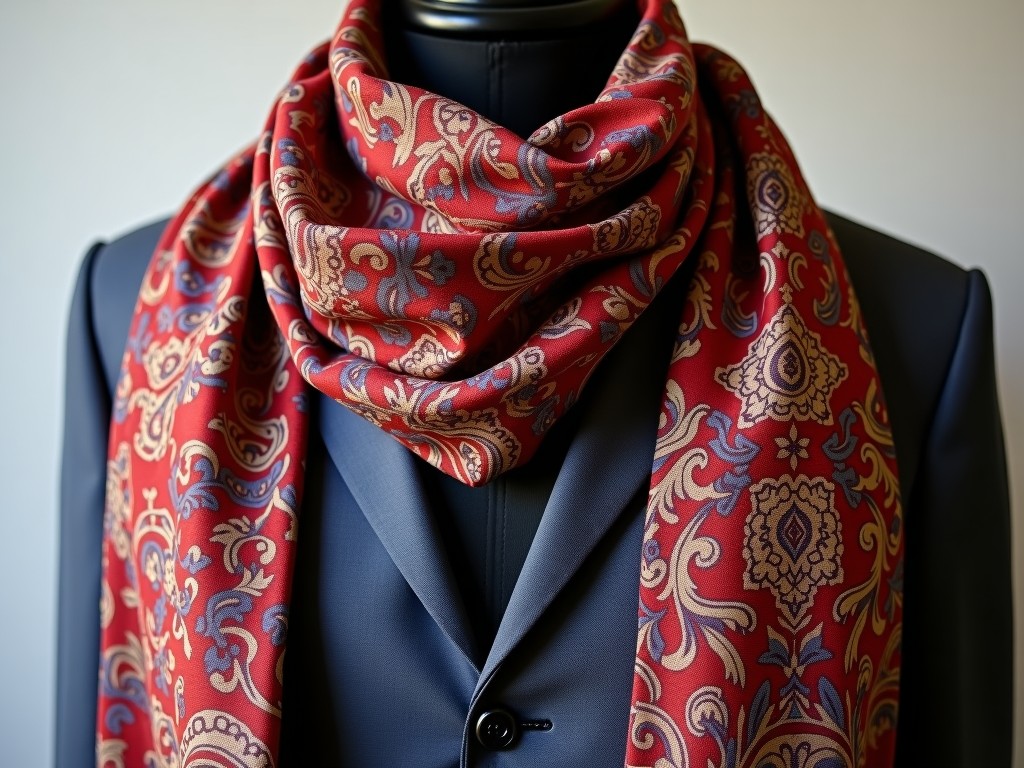
Mens Vintage Paisley Neck Scarf
This product page details the technical specifications, material characteristics, and application considerations for a mens vintage paisley neck scarf designed for professional and casual wear in
Mens Vintage Paisley Neck Scarf
This product page details the technical specifications, material characteristics, and application considerations for a mens vintage paisley neck scarf designed for professional and casual wear in industrial and corporate environments. The information provided supports informed procurement decisions by focusing on measurable attributes, manufacturing constraints, and functional performance rather than subjective marketing claims.
Material Composition and Construction
The scarf is constructed from 100% mulberry silk with a momme weight of 16, providing a balance between drape, durability, and light transmission. Silk fibers exhibit a tensile strength of approximately 3.5–5.0 g/den and recover up to 90% of their original length after 2% elongation, contributing to wrinkle resistance and shape retention under normal handling. The fabric is woven using a plain weave structure with a thread count of 190 ends per inch (EPI) and 120 picks per inch (PPI), ensuring dimensional stability and resistance to snagging.
Edges are finished with a 3mm rolled hem using a single-needle lockstitch, minimizing bulk while preventing fraying. The hem is secured with polyester-coated silk thread possessing a colorfastness rating of 4–5 on the gray scale under ISO 105-B02 (light exposure) and ISO 105-C06 (washing). Dyeing employs acid-based, metal-complex dyes selected for their affinity to silk fibroin, achieving a minimum colorfastness to rubbing of 3–4 (ISO 105-X12) and perspiration resistance of 4 (ISO 105-E04).
Dimensions and Dimensional Tolerances
The scarf is cut to a square format with nominal dimensions of 90 cm × 90 cm (±1.5 cm tolerance in both axes). This size allows for multiple folding configurations—single fold, double fold, or asymmetric drape—while maintaining proportional symmetry when worn as a neck accessory. The diagonal measurement measures approximately 127 cm (±2.1 cm), relevant for knot styles requiring extended length.
Dimensional stability is evaluated after 5 cycles of washing at 30°C followed by air drying; observed shrinkage does not exceed 2% in either warp or weft direction, consistent with ISO 6330 standards for silk textiles. These tolerances ensure consistent fit across production batches and compatibility with standard display and packaging systems.
Paisley Pattern Specification and Repeat Logic
The vintage paisley motif is derived from a 19th-century Persian boteh design, adapted into a seamless repeat pattern with a horizontal and vertical repeat interval of 15 cm. The pattern occupies 68% of the fabric surface area, leaving 32% as negative space to preserve visual balance and prevent pattern crowding when folded. Motif density averages 12.8 units per dm², calculated from the number of discernible boteh elements within a 10 cm × 10 cm sample area.
Pattern alignment is maintained within ±2 mm across selvage edges during cutting, ensuring continuity when the scarf is folded or draped. Screen printing is employed using flatbed rotary screens with a mesh count of 120 threads/cm, achieving edge definition with a line width tolerance of ±0.15 mm. Ink deposition is controlled to 8–10 µm dry film thickness per pass, with two passes used for deeper tones to achieve optimal color saturation without stiffening the hand.
Performance Characteristics and Environmental Response
The scarf exhibits a moisture regain of 11% at 65% relative humidity and 20°C, allowing it to absorb and release perspiration without significant dimensional change or loss of hand feel. Thermal conductivity measures approximately 0.04 W/(m·K), providing mild insulation suitable for transitional seasons. Air permeability is rated at 85 cm³/(cm²·s) under ISO 9237, indicating breathability comparable to lightweight cotton voile.
UV protection factor (UPF) is estimated at 15–20 based on fabric construction and dye absorption properties, offering moderate protection against ultraviolet radiation during prolonged outdoor exposure. The silk protein structure naturally resists static buildup, with surface resistivity measured at >10¹⁰ Ω under ASTM D257, reducing cling and dust attraction in low-humidity environments.
Quality Control and Inspection Protocol
Each scarf undergoes 100% visual inspection under 5000 lux daylight simulation (D65) to detect printing defects, color variation, or soil inclusions. Acceptance criteria follow a 4-point system: defects >2 mm in length or visible at 30 cm viewing distance are classified as major; those <2 mm or detectable only at 10 cm are minor. A batch is accepted if major defects do not exceed 1.5% and total defects (major + minor) remain below 4.0% per ANSI/ASQ Z1.4 inspection level II.
Dimensional checks are performed on every 12th unit using a calibrated optical comparator with 0.01 mm resolution. Color consistency is verified via spectrophotometer (Datacolor Check) with ΔE00 < 1.5 accepted for solid grounds and < 2.0 for patterned areas relative to the master standard. pH of the aqueous extract is maintained between 5.5 and 7.0 to prevent fiber degradation, tested per ISO 3071.
Packaging and Handling Requirements
Each scarf is folded using a standardized tri-fold method to minimize crease formation, then placed in a 100% recycled polyethylene terephthalate (PET) sleeve with a thickness of 50 µm and oxygen transmission rate (OTR) of 15–20 cm³/m²·day·atm. The sleeve is sealed with a heat-seal barrier to limit moisture ingress and particulate contamination during storage and transit.
Units are packed in corrugated cardboard flutes (B-flute, 3mm thickness) with 60% recycled content, dimensions 32 cm × 32 cm × 8 cm, accommodating 25 scarfs per carton. Cartons are sealed with water-activated tape and labeled with handling instructions: “Keep dry, avoid direct sunlight, store flat.” Storage conditions should not exceed 25°C and 60% RH to prevent dye migration or fiber weakening over time.
| Parameter | Typical Value | Test Standard |
|---|---|---|
| Silk Momme Weight | 16 mm | ASTM D3776 |
| Thread Count (Warp × Weft) | 190 EPI × 120 PPI | ASTM D3775 |
| Colorfastness to Light | 4–5 (Gray Scale) | ISO 105-B02 |
| Dimensional Change (Washing) | ≤2% (Warp/Weft) | ISO 6330 |
| Moisture Regain | 11% (at 65% RH, 20°C) | ASTM D2495 |
| Air Permeability | 85 cm³/(cm²·s) | ISO 9237 |
Technical data presented reflects typical performance under standard test conditions. Actual values may vary slightly due to natural fiber heterogeneity, dye lot differences, or environmental exposure. Customization of dimensions, pattern scale, or hem finish is available upon request, subject to minimum order quantities and pattern repeat alignment constraints. For detailed specifications, material safety data, or sample evaluation, contact our technical team via the inquiry form.
For procurement inquiries, technical documentation, or sample requests, please submit your requirements through our official contact channel.
Submit InquiryProducts
Related Products
News
Related News

2026-11-02
Cotton Voile Scarf Manufacturing and Performance Analysis how to make a cotton voile scarfCreating a professional-grade cotton voile scarf requires a precise balance of textile engineering and artisanal finishing. Unlike standard cotton weaves, voile is defined by its p···

2026-10-28
chiffon hijab Technical Production and Performance AnalysisSelecting the right fabric for a hijab involves a delicate balance between modesty, breathability, and aesthetic drape. For many women in Southeast Asia and the Middle East, the ma···

2026-10-26
custom silk scarf textile manufacturing and performance analysisSelecting a high-quality scarf is no longer just about color matching; it is an exercise in understanding how textile weight, drape, and print scale interact with individual facial···
