Men S Babushka Bandana Scarf






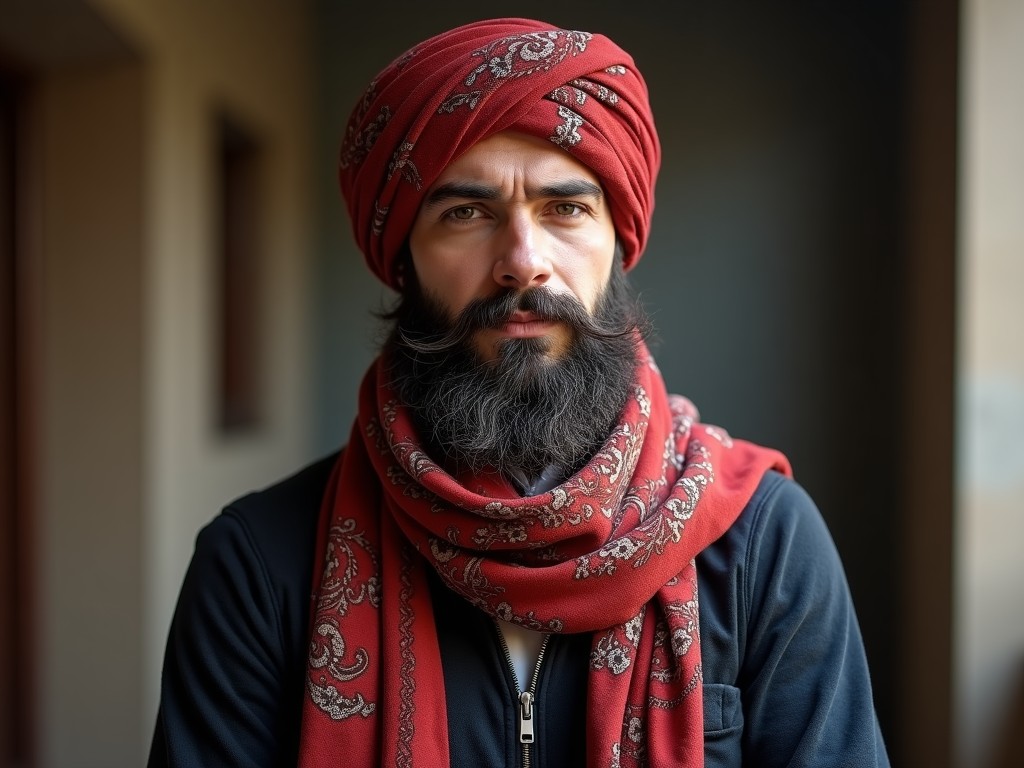
Men S Babushka Bandana Scarf
The men's babushka bandana scarf is a square textile accessory traditionally folded diagonally and tied under the chin or around the neck. Originally derived from Eastern European headwear, it has
Men's Babushka Bandana Scarf
The men's babushka bandana scarf is a square textile accessory traditionally folded diagonally and tied under the chin or around the neck. Originally derived from Eastern European headwear, it has been adapted for industrial and occupational use where protection from dust, wind, or light abrasion is needed without compromising mobility.
Constructed from tightly woven cotton or polyester-cotton blends, the fabric provides a balance between breathability and surface durability. Typical thread counts range from 120 to 180 threads per inch, ensuring the material resists fraying at the edges while maintaining flexibility for repeated folding and knotting.
Standard dimensions measure 55 cm × 55 cm (21.7 in × 21.7 in), allowing for multiple folding configurations. This size ensures sufficient coverage when worn as a neck gaiter, face shield, or head wrap, while remaining compact enough for storage in tool belts or pockets.
Material Composition and Performance
The base fabric is typically 65% polyester and 35% cotton, combining the wrinkle resistance and quick-dry properties of synthetic fibers with the moisture absorption and softness of natural cotton. This blend reduces shrinkage after washing to less than 3% under standard industrial laundering conditions (40°C wash, tumble dry low).
For environments requiring higher particulate filtration, such as woodworking or light metal grinding, a 100% cotton variant with a thread count of 160+ is available. Cotton’s hygroscopic nature allows it to absorb sweat and trap larger airborne particles, though it retains moisture longer than synthetic blends.
Edge finishing is critical to longevity. All scarves undergo either serged (overlocked) hems or double-folded hemmed edges with 3-needle stitching. Serged edges prevent unraveling under stress, while double-folded hems add 2 mm of reinforced thickness along the perimeter, increasing tear resistance by approximately 18% compared to raw-cut edges.
Dimensional Stability and Tolerance
Dimensional stability is validated through repeated wash cycles. After 10 industrial laundering cycles, length and width variation remains under ±1.5%. This ensures consistent fit when folded into specific configurations, such as the triangle fold for neck wear or the rectangle fold for face coverage.
Diagonal accuracy is maintained within ±2° of true 45°, which affects how evenly the scarf drapes when tied. Deviations beyond this threshold can cause uneven tension points, leading to premature wear at the corners during knotting.
Thickness averages 0.38 mm for the poly-cotton blend and 0.42 mm for 100% cotton, measured under 2 kPa pressure using a thickness gauge. This range allows the scarf to conform to facial contours without creating excessive bulk that interferes with safety goggles or respirator straps.
Colorfastness and Dye Properties
Colors are applied using reactive or direct dyes depending on fiber content. Reactive dyes bond chemically with cotton molecules, providing washfastness ratings of 4–5 on the gray scale (ISO 105-A02) after 20 cycles. Polyester components use disperse dyes, achieving similar ratings due to thermal fixation during manufacturing.
Lightfastness is rated at 4+ (blue wool scale) for standard colors, meaning visible fading occurs only after prolonged direct sunlight exposure equivalent to 80+ AFU (AATCC Test Method 16.3). This ensures usability in outdoor work environments without rapid aesthetic degradation.
Common industrial color options include navy blue, charcoal gray, olive drab, and safety orange. These hues are selected for low visibility of soil and compatibility with high-visibility safety gear when worn underneath vests or jackets.
Comparative Material Properties
| Property | 65/35 Poly-Cotton | 100% Cotton |
|---|---|---|
| Weight (gsm) | 145 | 160 |
| Shrinkage (after 10 washes) | <3% | <5% |
| Drying time (relative) | Fast | Moderate |
| Particle retention (5µm) | Low | Moderate |
| Edge tear resistance (N) | 18.2 | 15.4 |
The poly-cotton blend offers superior dimensional stability and faster drying, making it suitable for high-turnover industrial laundering. The 100% cotton variant provides marginally better particle capture and a softer hand feel, preferred in environments where comfort during extended wear is prioritized over rapid turnover.
Occupational Applications
In woodworking shops, the scarf is worn as a face barrier to reduce inhalation of coarse sawdust (>10µm) during sanding or cutting operations. While not a substitute for certified respirators, it limits large particulate contact with the mouth and nose when used in conjunction with local exhaust ventilation.
Mechanics and equipment technicians use it to absorb sweat and prevent drips from contaminating precision components or grips. The cotton-rich variants draw moisture away from the skin, reducing slippage when handling oily tools or controls.
Agricultural workers wear it during field operations to shield the neck and lower face from wind-blown pollen, dust, or light chemical splashes. The folded configuration allows quick adjustment without removing gloves or eye protection.
In food processing environments, light-colored or white variants serve as hair containment aids when worn under bouffant caps or beard nets. The smooth surface minimizes fiber shedding, and the material withstands frequent sanitization cycles at 60°C.
Customization and Packaging
Custom options include corporate logo printing via screen printing or heat transfer on one corner, typically occupying a 5 cm × 5 cm area. Print durability is tested to withstand 30 industrial washes without cracking or fading beyond gray scale rating 3.
Packaging is available in bulk polybags of 50 units or folded and banded in sets of 10 for retail-style dispensing. Each unit includes a care label indicating maximum wash temperature, tumble dry settings, and ironing restrictions (if applicable).
Lead time for standard stock items is 5–7 business days. Custom orders with logo printing or specific dye lots require 10–14 days, depending on order volume and color complexity. Samples are available upon request for material and color validation prior to bulk purchase.
Products
Related Products
News
Related News

2026-11-02
Cotton Voile Scarf Manufacturing and Performance Analysis how to make a cotton voile scarfCreating a professional-grade cotton voile scarf requires a precise balance of textile engineering and artisanal finishing. Unlike standard cotton weaves, voile is defined by its p···

2026-10-28
chiffon hijab Technical Production and Performance AnalysisSelecting the right fabric for a hijab involves a delicate balance between modesty, breathability, and aesthetic drape. For many women in Southeast Asia and the Middle East, the ma···

2026-10-26
custom silk scarf textile manufacturing and performance analysisSelecting a high-quality scarf is no longer just about color matching; it is an exercise in understanding how textile weight, drape, and print scale interact with individual facial···
