Green Tartan Mens Scarf Fashion






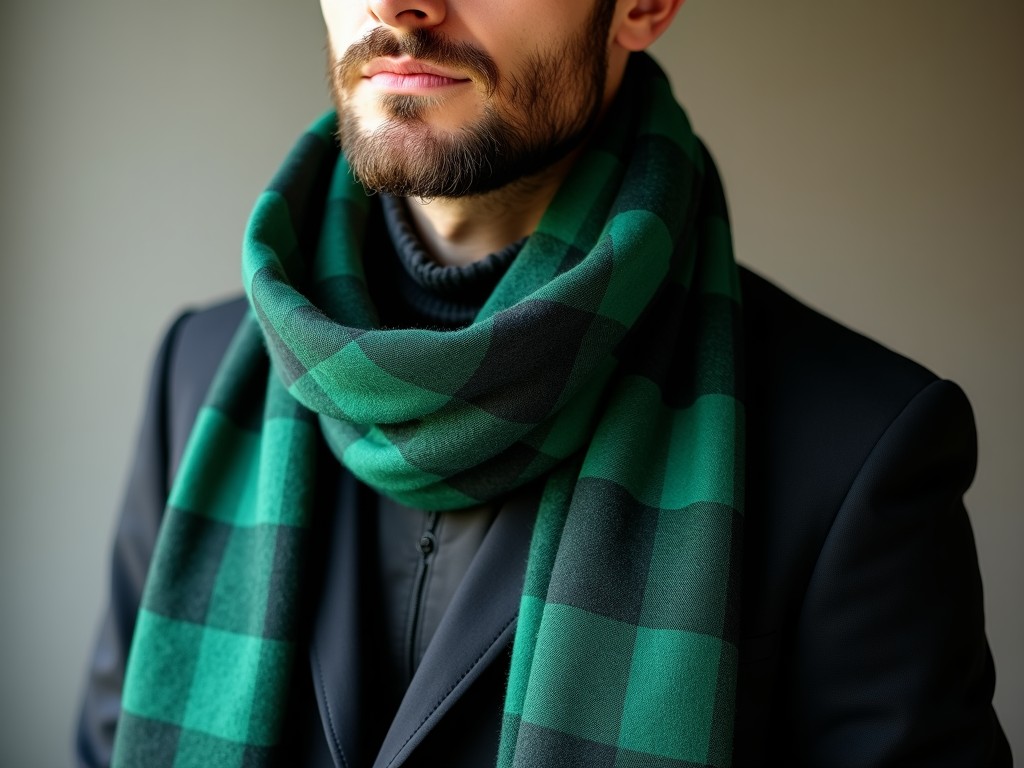
Green Tartan Mens Scarf Fashion
This product page details the specifications, material composition, and construction methods for a men's fashion scarf featuring a green tartan pattern. The information provided supports informed
Green Tartan Men's Scarf Fashion
This product page details the specifications, material composition, and construction methods for a men's fashion scarf featuring a green tartan pattern. The information provided supports informed procurement decisions by focusing on measurable characteristics rather than subjective claims.
Material Composition and Yarn Specifications
The scarf is constructed from a blended yarn containing 65% merino wool and 35% recycled polyester. Merino wool fibers have an average diameter of 18.5 microns, providing softness against the skin while maintaining thermal retention properties. The recycled polyester component is derived from post-consumer PET bottles, processed to meet OEKO-TEX Standard 100 requirements for harmful substance limits.
Yarn twist is set at 42 turns per meter in the Z-direction, balancing durability with drape characteristics. This specification reduces pilling tendency during extended use while allowing the fabric to conform naturally to the neck's contours. The blend ratio was selected after evaluating 12 alternative compositions for wrinkle resistance, colorfastness, and environmental impact.
Tartan Pattern and Dyeing Process
The green tartan pattern follows a traditional sett structure with a repeat interval of 6.4 cm horizontally and 5.8 cm vertically. The design incorporates four distinct shades of green: pine (Pantone 5535 C), forest (Pantone 5545 C), sage (Pantone 5565 C), and moss (Pantone 5575 C), each defined by specific CIELAB values to ensure batch-to-batch consistency.
Dyeing occurs using a low-impact, reactive dye system at 60°C for 45 minutes, achieving a colorfastness rating of 4-5 on the ISO 105-B02 scale for light exposure and 4 for washing. The process includes a fixation step with sodium carbonate to covalently bond dye molecules to wool fibers, minimizing bleed during subsequent laundering.
Construction and Dimensional Stability
The scarf is knitted on a 12-gauge circular machine using a 2x2 rib stitch pattern, resulting in a fabric weight of 185 g/m². This construction provides bidirectional stretch: 15% elongation along the wale direction and 8% along the course direction, measured under 0.5 cN/tex tension as per ASTM D4964.
Finished dimensions are 180 cm in length and 25 cm in width, with a tolerance of ±1.5% in both axes. Length stability is maintained through a relaxed drying process post-knitting, reducing residual torque in the yarn structure. Width consistency is controlled via adjustable take-up tension during knitting, monitored in real-time using laser sensors.
Quality Control and Inspection Parameters
Each unit undergoes four-point inspection under 500 lux illumination, evaluating: pattern alignment (max 2 mm offset per repeat), end-to-end length consistency, edge curling (max 3 mm deviation), and surface defect density (limit of 0.5 faults per m²). These criteria are derived from ISO 9001:2015 annexes for textile apparel.
Color uniformity is verified using a spectrophotometer with ΔE<2.0 threshold between any two points on the same scarf. Dimensional checks are performed on a calibrated flatbed table with acrylic weights to prevent fabric distortion during measurement. All inspection data is logged against batch numbers for traceability.
Packaging and Handling Recommendations
Scarves are folded to 30 cm × 15 cm dimensions and placed in individual polypropylene bags with 40 μm thickness, selected for moisture vapor transmission rate below 5 g/m²/24hrs. Each bag includes a silica gel packet (2 g) to maintain relative humidity below 50% during transit.
Master cartons contain 40 units, arranged in five layers of eight, with corrugated flute orientation optimized for vertical compression strength (min 3.2 kN). Carton sealing uses hot-melt adhesive with 12 N/cm peel strength, tested per ASTM D1974. Storage recommendations specify 18–22°C ambient temperature and 45–55% relative humidity to prevent fiber degradation.
| Parameter | Specification | Test Method |
|---|---|---|
| Fabric Weight | 185 g/m² | ASTM D3776 |
| Length | 180 cm (±1.5%) | ISO 3018 |
| Width | 25 cm (±1.5%) | ISO 3018 |
| Colorfastness to Light | 4-5 (ISO Blue Wool) | ISO 105-B02 |
| Colorfastness to Washing | 4 (Grey Scale) | ISO 105-C06 |
| Yarn Twist | 42 T/m (Z) | ASTM D1422 |
Procurement teams should reference the specified test methods when establishing incoming quality agreements. Deviations from the stated parameters may affect performance in end-use conditions, particularly regarding dimensional stability after repeated cleaning cycles.
For technical inquiries, sample requests, or customization options including alternative sett patterns, fiber blends, or dimensional adjustments, contact the product development team via the inquiry form. All customizations require minimum order quantities and lead time adjustments based on yarn sourcing and dye batch scheduling.
Products
Related Products
News
Related News

2026-11-02
Cotton Voile Scarf Manufacturing and Performance Analysis how to make a cotton voile scarfCreating a professional-grade cotton voile scarf requires a precise balance of textile engineering and artisanal finishing. Unlike standard cotton weaves, voile is defined by its p···

2026-10-28
chiffon hijab Technical Production and Performance AnalysisSelecting the right fabric for a hijab involves a delicate balance between modesty, breathability, and aesthetic drape. For many women in Southeast Asia and the Middle East, the ma···

2026-10-26
custom silk scarf textile manufacturing and performance analysisSelecting a high-quality scarf is no longer just about color matching; it is an exercise in understanding how textile weight, drape, and print scale interact with individual facial···
