China Mens Brown Camel Cashmere Scarf






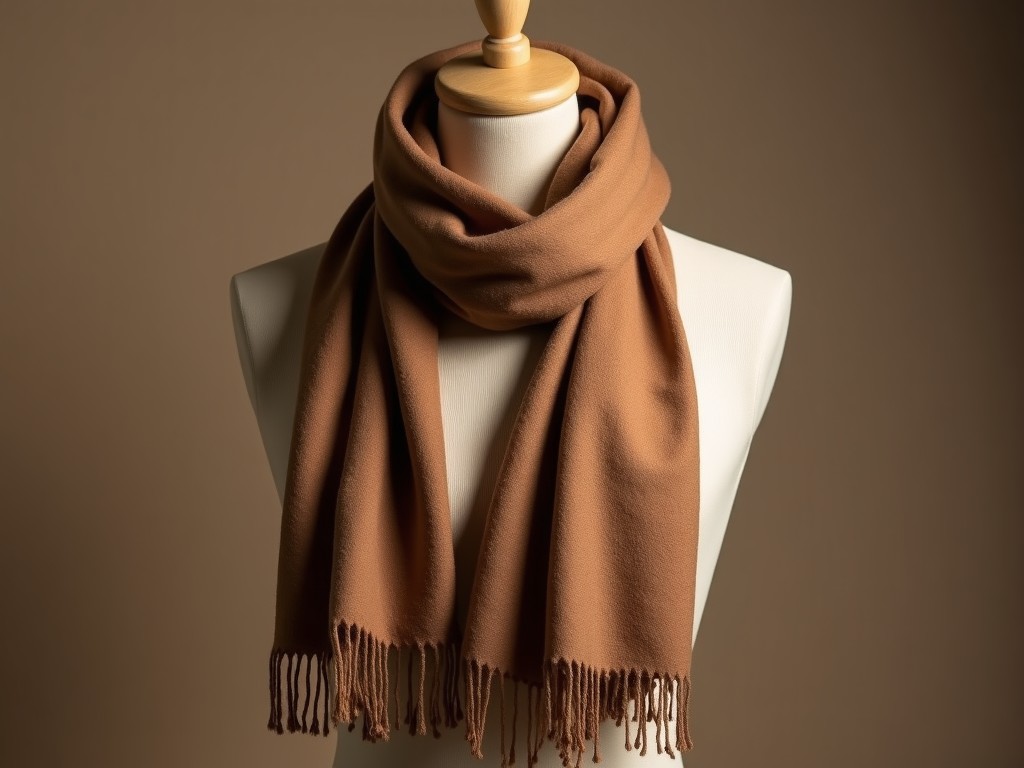
China Mens Brown Camel Cashmere Scarf
A men's brown camel cashmere scarf originates from Inner Mongolia and Ningxia regions of China, where specific goat breeds produce the fine underdown used in luxury textiles. The fiber diameter
China Men's Brown Camel Cashmere Scarf
A men's brown camel cashmere scarf originates from Inner Mongolia and Ningxia regions of China, where specific goat breeds produce the fine underdown used in luxury textiles. The fiber diameter typically ranges from 14 to 16 microns, placing it in the premium cashmere category suitable for direct skin contact without irritation. Natural camel brown coloration results from the inherent pigmentation of the goat's undercoat, eliminating the need for synthetic dyes and preserving fiber integrity.
Scarves manufactured in China benefit from established supply chains that source raw cashmere directly from nomadic herders during the spring molting season. Processing involves dehairing to remove coarse guard fibers, followed by washing, carding, and spinning into yarns typically ranging from 2/28nm to 2/48nm for scarf applications. The brown camel shade varies slightly between batches due to natural fiber characteristics, requiring sorting by color tolerance before blending to ensure visual consistency in finished products.
Industrial buyers should verify fiber test reports specifying micron count, yield percentage after dehairing, and staple length to confirm material authenticity. Reputable suppliers provide ISO/IEC 17025 accredited laboratory results for each lot, including tests for pilling resistance (Martindale method) and tensile strength. These metrics directly correlate with long-term wear performance and resistance to surface degradation during use.
Technical Specifications and Construction
Standard dimensions for men's cashmere scarves are 180cm in length and 30cm in width, providing sufficient material for multiple wrapping styles while maintaining proportional drape. Weight typically falls between 80 and 110 grams per square meter (gsm), calculated from yarn count, fabric density, and finished dimensions. This weight range ensures adequate thermal insulation without excessive bulk when worn under outerwear.
Construction methods include plain weave, twill weave, or jacquard patterns, with plain weave being most common for solid-colored scarves due to its balanced structure and minimal distortion risk. End finishes feature hand-rolled hems or machine-finished fringes, each requiring specific stitch density to prevent unraveling. Fringe length, when applied, is standardized at 5cm to maintain aesthetic proportion relative to scarf width.
Dimensional stability is critical; premium cashmere scarves exhibit less than 2% length and width change after ISO 6330 relaxed drying cycles. Buyers should request shrinkage test data under standardized washing conditions (30°C, neutral pH detergent) to assess care requirements. Residual soap alkalinity after washing must remain below pH 9 to prevent fiber degradation over multiple cleanings.
Material Properties and Performance Characteristics
Cashmere fibers possess a natural crimp angle of approximately 40 degrees, creating insulating air pockets that yield a thermal conductivity of roughly 0.04 W/m·K—comparable to wool but with lower density. The brown camel shade demonstrates similar insulating properties to lighter cashmere shades, as color pigmentation does not significantly alter the fiber's internal structure or moisture regain (typically 13-15% at 65% RH).
Surface smoothness, measured by coefficient of friction against stainless steel, ranges from 0.25 to 0.35 for untreated cashmere, contributing to its characteristic soft hand feel. Pilling resistance improves with tighter yarn twist and higher fabric density; scarves targeting industrial use often specify minimum 120 stitches per inch in both warp and weft directions to enhance durability.
Colorfastness to light (ISO 105-B02) for undyed camel brown cashmere typically rates 4-5 on the blue wool scale, indicating good resistance to fading under indirect sunlight exposure. However, prolonged UV exposure can weaken fiber tensile strength over time, necessitating storage recommendations away from direct light sources. Buyers in regions with high UV indices should consider protective packaging for long-term storage.
Manufacturing Considerations for Bulk Orders
Minimum order quantities (MOQs) for custom brown camel cashmere scarves typically start at 300 pieces per colorway, reflecting the economic threshold for setting up dyeing or blending equipment for natural fiber batches. Lead times average 45-60 days from approved sample to shipment, encompassing raw material procurement (15-20 days), spinning (10 days), weaving/knitting (10-15 days), finishing (5 days), and quality inspection (5 days). Air freight reduces transit time but increases cost; sea freight remains standard for bulk orders.
Quality control procedures include 4-point fabric inspection systems for woven scarves, assigning penalty points based on defect size and frequency. Acceptable quality limits (AQL) are commonly set at 2.5% for major defects (e.g., holes, incorrect dimensions) and 4.0% for minor defects (e.g., slight shade variation, loose threads). Buyers should specify inspection levels (e.g., II) and reference standards like ANSI/ASQ Z1.4 in purchase agreements.
Packaging options impact landed costs and product presentation. Individual polybagging adds approximately $0.15-$0.25 per unit but prevents dust accumulation during transit. Bulk packing in cartons (typically 50 pieces per carton) reduces handling but requires intermediate tissue paper to prevent abrasion. For export, cartons must meet ISTA 1A or equivalent durability standards to withstand handling stresses.
| Parameter | Typical Value | Inspection Method |
|---|---|---|
| Fiber Diameter | 14-16 microns | OFDA2000 or Laserscan |
| Weight (gsm) | 80-110 gsm | ISO 3801 |
| Length | 180 cm ±2% | ISO 3018 |
| Width | 30 cm ±2% | ISO 3018 |
| Shrinkage (relaxed) | <2% | ISO 6330 |
| Pilling Resistance | Grade 3-4 (Martindale) | ISO 12945-2 |
Applications in Professional and Industrial Contexts
Beyond personal wear, brown camel cashmere scarves serve as premium corporate gifts in industries where brand perception influences client relationships, such as finance, law, and luxury hospitality. The natural color complements neutral-toned business attire (navy, charcoal, beige) without requiring color matching to corporate branding, reducing customization complexity. Weight and drape characteristics allow easy folding into standard gift boxes (typically 25x25x5cm) for efficient distribution.
In cold-climate industrial environments (e.g., outdoor logistics, construction site supervision), these scarves provide supplementary thermal protection for personnel exposed to intermittent cold stress. Unlike synthetic alternatives, cashmere retains insulating properties when slightly damp from ambient humidity, a critical factor in transitional seasons. The fiber's natural odor resistance reduces the need for frequent washing during extended use periods.
Distributors sourcing for retail chains must consider seasonal demand patterns; peak ordering occurs Q3-Q4 for Northern Hemisphere winter stock. Color consistency across production batches is essential for maintaining shelf presentation, necessitating tight tolerances on natural shade variation (typically ΔE < 3 in CIELAB space). Buyers should validate supplier color-monitoring protocols involving spectrophotometer readings at multiple stages of production.
For technical inquiries, custom specifications, or sample requests regarding brown camel cashmere scarves, contact our manufacturing team to discuss material sourcing, construction options, and quality documentation requirements.
Products
Related Products
News
Related News

2026-11-02
Cotton Voile Scarf Manufacturing and Performance Analysis how to make a cotton voile scarfCreating a professional-grade cotton voile scarf requires a precise balance of textile engineering and artisanal finishing. Unlike standard cotton weaves, voile is defined by its p···

2026-10-28
chiffon hijab Technical Production and Performance AnalysisSelecting the right fabric for a hijab involves a delicate balance between modesty, breathability, and aesthetic drape. For many women in Southeast Asia and the Middle East, the ma···

2026-10-26
custom silk scarf textile manufacturing and performance analysisSelecting a high-quality scarf is no longer just about color matching; it is an exercise in understanding how textile weight, drape, and print scale interact with individual facial···
