China Dark Grey Mens Scarf






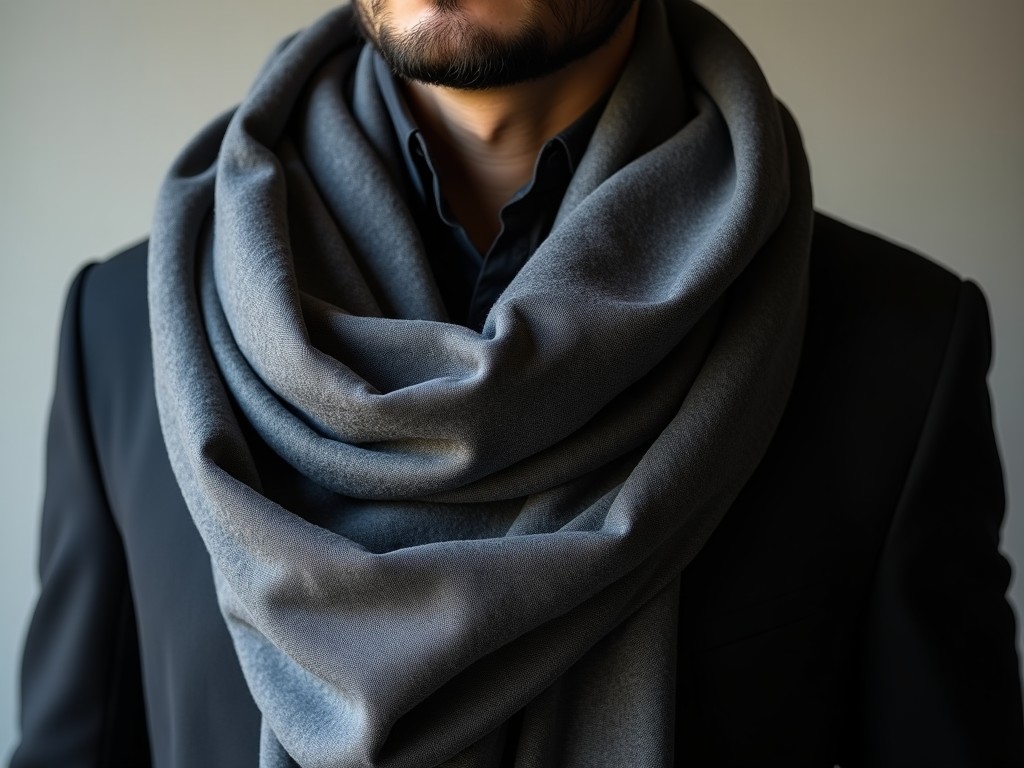
China Dark Grey Mens Scarf
A dark grey men's scarf sourced from Chinese manufacturers is typically constructed from woven or knitted textile blends designed for thermal regulation, drape consistency, and resistance to pilling
China Dark Grey Men's Scarf
A dark grey men's scarf sourced from Chinese manufacturers is typically constructed from woven or knitted textile blends designed for thermal regulation, drape consistency, and resistance to pilling under regular wear. The color is achieved through piece-dyeing or yarn-dyeing processes using disperse or reactive dyes suitable for synthetic or natural fiber bases, ensuring colorfastness to light (typically ≥4 on the Blue Wool Scale) and wash (typically ≥3-4 on the Grey Scale) as per ISO 105-B02 and ISO 105-C06 standards. These scarves are engineered for moderate climates, offering a balance between insulation and breathability without excessive bulk.
Material Composition and Construction
Common material blends include 70% polyester / 30% viscose for wrinkle resistance and drape, 100% acrylic for cost-effective thermal retention, or 80% wool / 20% nylon for enhanced durability and moisture wicking in cooler conditions. The fabric weight typically ranges from 180 to 280 GSM (grams per square meter), influencing both warmth and flexibility. Construction methods vary between plain weave, twill weave, or 1x1 rib knit, each affecting stretch recovery, edge stability, and surface texture—factors critical to long-term appearance and comfort during extended wear.
Dimensional Specifications
Standard dimensions for men's scarves in this category fall within a length of 160 to 180 cm and a width of 20 to 30 cm, allowing for multiple wrapping styles while maintaining proportionality to average male torso dimensions. Tolerances are typically held to ±2 cm in length and ±1 cm in width during cutting and sewing, ensuring consistency across production batches. End finishes may include overlock stitching, fringe (5–10 cm), or self-fabric tassels, selected based on aesthetic preference and fray resistance requirements.
Colorfastness and Dyeing Process
The dark grey shade is achieved through high-temperature dispersion dyeing for polyester or reactive dyeing for cellulose-based blends, ensuring molecular bonding of pigment to fiber. This minimizes crocking (dye transfer) and fading under UV exposure or repeated laundering. Post-dyeing fixation and washing cycles are controlled to remove unfixed dye, reducing the risk of staining adjacent garments. Color consistency across lots is monitored using spectrophotometry, with ΔE values typically kept below 1.5 to ensure visual uniformity under standard lighting (D65).
Thermal and Mechanical Performance
Thermal resistance (RCT) values for these scarves generally range from 0.08 to 0.15 m²·K/W, depending on fiber type and construction, providing moderate insulation suitable for autumn and early winter conditions. Air permeability is maintained between 50 and 150 mm/s to prevent overheating during active use. Tensile strength of the fabric typically exceeds 15 N in warp and weft directions, ensuring resistance to stretching during handling, while abrasion resistance (Martindale) is rated for at least 15,000 cycles to withstand surface friction from collars and jackets.
Quality Control and Inspection
In-line inspection includes width monitoring via laser sensors, defect detection for holes, stains, or yarn breaks, and dimensional verification at final folding. Random sampling follows AQL 2.5 for major defects (e.g., color mismatch, unraveling ends) and AQL 4.0 for minor defects (e.g., loose threads, slight shade variation). Each batch undergoes a minimum of 3 wash cycles at 40°C to simulate consumer care and assess dimensional stability and color retention prior to packaging. Inspection reports are available upon request, detailing test methods and results.
Packaging and Logistics
Scarves are typically folded to a uniform size (e.g., 25x15x2 cm) and packed in polybags (50–70 µm thickness) with optional paper inserts for branding or care instructions. Master cartons hold 50 to 100 units, depending on weight and volume, with dimensions optimized for palletization (e.g., 40x30x25 cm). Cartons are sealed with pressure-sensitive tape and marked with barcodes, country of origin (CN), and handling symbols. For export, moisture desiccants and corner protectors are commonly used to prevent damage during transit, especially in humid climates.
Customization Options
Buyers can specify fiber blend ratios, fabric weight, dimensions, end treatments (fringe, tassel, plain), and packaging configurations based on end-use requirements. Color matching to Pantone or textile swatches is available via lab-dip approval, with lead times extending by 3–5 days for custom shades. Private labeling options include woven labels, heat-transfer tags, or embossed patches, subject to minimum order quantities (typically 500–1000 pieces). All customization requests require technical confirmation before sampling.
Applications and End-Use Scenarios
These scarves are suited for urban commuting, light outdoor work in temperate climates, and retail resale as part of seasonal menswear collections. The dark grey color offers versatility in pairing with navy, charcoal, black, or olive outerwear, reducing the need for multiple accessories. In corporate uniform programs, the neutral tone supports brand consistency while allowing individual expression through styling. For distributors, the product’s standardized dimensions and stable color performance simplify inventory forecasting and reduce return rates due to appearance issues.
| Property | Typical Range or Value | Test Standard |
|---|---|---|
| Fabric Weight | 180–280 GSM | ISO 3801 |
| Length | 160–180 cm (±2 cm) | ASTM D4964 |
| Width | 20–30 cm (±1 cm) | ASTM D4964 |
| Thermal Resistance (RCT) | 0.08–0.15 m²·K/W | ISO 11092 |
| Air Permeability | 50–150 mm/s | ISO 9237 |
| Tensile Strength | >15 N (warp/weft) | ISO 13937-2 |
| Abrasion Resistance | ≥15,000 cycles | ISO 12947-2 |
| Colorfastness to Light | ≥4 (Blue Wool Scale) | ISO 105-B02 |
| Colorfastness to Wash | ≥3-4 (Grey Scale) | ISO 105-C06 |
For technical inquiries, sample requests, or quotation details including MOQ, lead time, and packaging specifications, please contact our sales team. Provide your required material blend, dimensions, end finish, and target quantity to receive a detailed response with applicable compliance documentation.
Request Technical Specification or QuoteProducts
Related Products
News
Related News

2026-11-02
Cotton Voile Scarf Manufacturing and Performance Analysis how to make a cotton voile scarfCreating a professional-grade cotton voile scarf requires a precise balance of textile engineering and artisanal finishing. Unlike standard cotton weaves, voile is defined by its p···

2026-10-28
chiffon hijab Technical Production and Performance AnalysisSelecting the right fabric for a hijab involves a delicate balance between modesty, breathability, and aesthetic drape. For many women in Southeast Asia and the Middle East, the ma···

2026-10-26
custom silk scarf textile manufacturing and performance analysisSelecting a high-quality scarf is no longer just about color matching; it is an exercise in understanding how textile weight, drape, and print scale interact with individual facial···
