The keffiyeh, traditionally worn across the Arabian Peninsula, serves both cultural and functional purposes in arid environments. Its square weave structure allows for multiple wrapping techniques
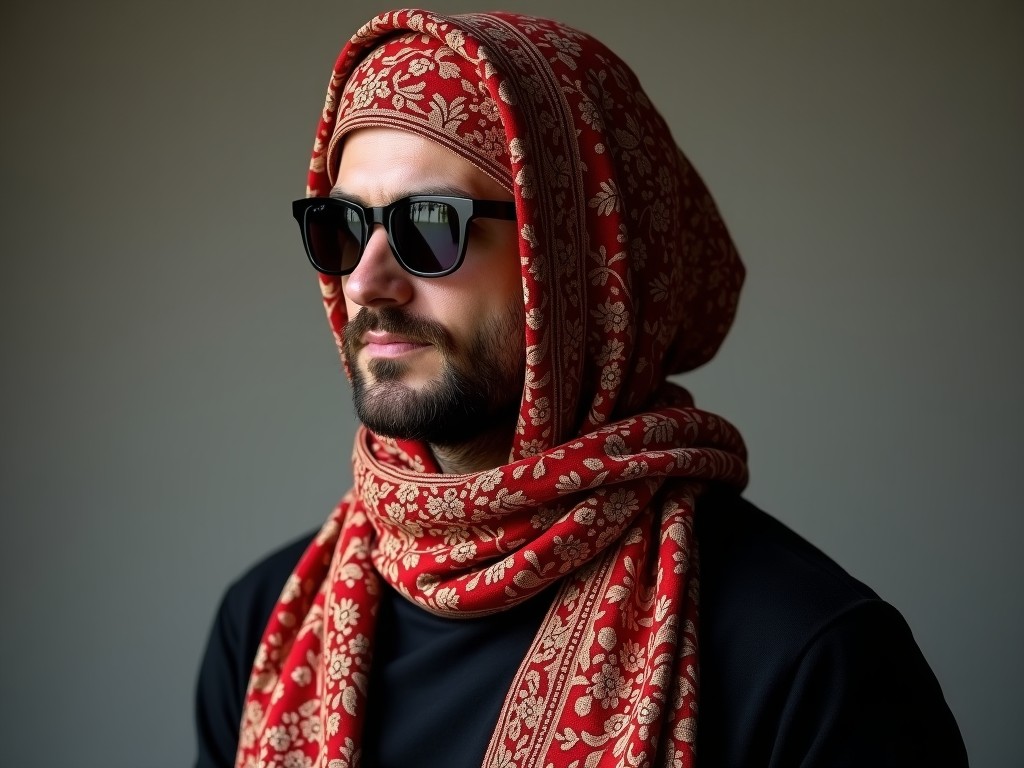
Buy Men's Arab Head Scarf Wrap
The keffiyeh, traditionally worn across the Arabian Peninsula, serves both cultural and functional purposes in arid environments. Its square weave structure allows for multiple wrapping techniques that provide sun protection, dust filtration, and thermal regulation. Industrial buyers sourcing these garments for workforce use or resale must evaluate material composition, weave density, and dimensional stability under prolonged UV exposure and abrasive conditions.
Material Construction and Performance Characteristics
Standard men's Arab head scarf wraps are typically constructed from 100% combed cotton yarns with a thread count ranging from 40s to 60s, producing a plain weave fabric weighing between 120-160 GSM. This weight range balances breathability with sufficient opacity to block direct sunlight while allowing air circulation to prevent heat buildup. The fabric undergoes mercerization to increase tensile strength and dye affinity, reducing fading after repeated washing cycles. Some variants incorporate a 5% polyester blend to improve wrinkle resistance and dimensional stability in high-humidity environments, though pure cotton remains preferred for moisture absorption in desert climates.
Dimensional Specifications and Wrapping Geometry
The standard square dimension for men's keffiyeh wraps is 110cm x 110cm, providing sufficient fabric length to create multiple layers around the head and neck while securing with an agal (cord ring). This size allows for the traditional double-fold technique that creates a triangular shape with approximately 55cm of fabric extending past the shoulders on each side. Smaller variants at 90cm x 90cm are used for lighter coverage in temperate conditions, while larger 120cm x 120cm versions accommodate additional wrapping layers for extreme sun or sand exposure. Fabric shrinkage after the first wash is typically limited to 3-5% in both warp and weft directions when pre-sanforized during manufacturing.
Weave Patterns and Functional Design Features
The distinctive patterned weave—often featuring a dominant color background with contrasting geometric motifs—is achieved through dobby or jacquard loom techniques that raise specific warp threads to create raised textures. These patterns are not merely decorative; the raised areas increase surface turbulence, enhancing convective cooling when air moves across the fabric. Common pattern densities range from 8 to 12 ends per centimeter in the motif zones, balanced against a ground weave of 24 ends per centimeter to maintain structural integrity. The selvage edges are reinforced with a tighter weave (typically 28 ends per cm) to prevent fraying during repeated folding and unwrapping cycles.
| Parameter |
Typical Range |
Functional Implication |
| Fabric Weight |
120-160 GSM |
Balances breathability and UV protection |
| Thread Count |
40s-60s combed cotton |
Determines softness and durability |
| Shrinkage (Wash 1) |
3-5% (warp/weft) |
Requires pre-sanforization for dimensional stability |
| Pattern Density |
8-12 ends/cm (motif) |
Enhances convective cooling via surface turbulence |
| Selvage Reinforcement |
28 ends/cm |
Prevents edge fraying during handling |
Colorfastness and Environmental Resistance
Color retention is critical for head scarves exposed to intense solar radiation and frequent washing. Reactive dyes are commonly used for cotton-based keffiyehs due to their covalent bond formation with cellulose fibers, achieving wash fastness ratings of 4-5 on the gray scale after 20 cycles at 40°C. Light fastness typically reaches level 4-5 on the blue wool scale under equivalent to 100 AFU (Arizona Fabric Units) of UV exposure. For applications requiring enhanced resistance to fading—such as outdoor workwear in desert regions—vat-dyed variants are available, offering light fastness of 6-7 but at a higher cost and limited color palette. Chlorine bleach resistance is generally low in standard reactive-dyed fabrics; non-chlorine bleach alternatives are recommended for cleaning.
Customization Options for Industrial Procurement
Industrial buyers can specify customizations beyond standard specifications to meet operational or branding requirements. Thread count can be adjusted between 30s and 80s to alter fabric weight and drape, with lower counts (30s-40s) producing heavier, more opaque fabrics suitable for cold-weather layering, and higher counts (60s-80s) yielding lighter, finer weaves for hot-climate use. Custom pattern development via jacquard looms allows for logo integration or sector-specific motifs, though minimum order quantities typically start at 500 units per design due to loom setup constraints. Edge finishing options include plain selvage, rolled hem, or overlock stitching, with overlock providing the highest resistance to unraveling in high-abrasion environments. Packaging can be standardized to polybags of 10 or 25 units, or bulk-packed in cartons with humidity indicators for long-term storage.
Quality Assurance and Inspection Protocols
Industrial buyers should verify quality through standardized inspection checkpoints. Fabric weight is validated using ASTM D3776/D3776M-20, with acceptance tolerance typically ±5% GSM. Dimensional stability is assessed via AATCC Test Method 135, measuring dimensional change after five home laundering cycles. Colorfastness to washing (AATCC 61) and light (AATCC 16.3) must meet minimum grade 4 for commercial acceptance. Seam integrity, where applicable, is evaluated using ASTM D1683/D1683M-22 for sewn products. Visual inspection under 2000 lux lighting checks for pattern consistency, dye uniformity, and absence of defects such as thick/thin places, neps, or missing ends. For bulk orders, AQL 2.5 standards are commonly applied to critical defects, with lower AQLs available upon request for premium specifications.
Submit Technical Inquiry for Custom Specifications and Pricing









