B2B Mens Muslim Head Wrap Scarf






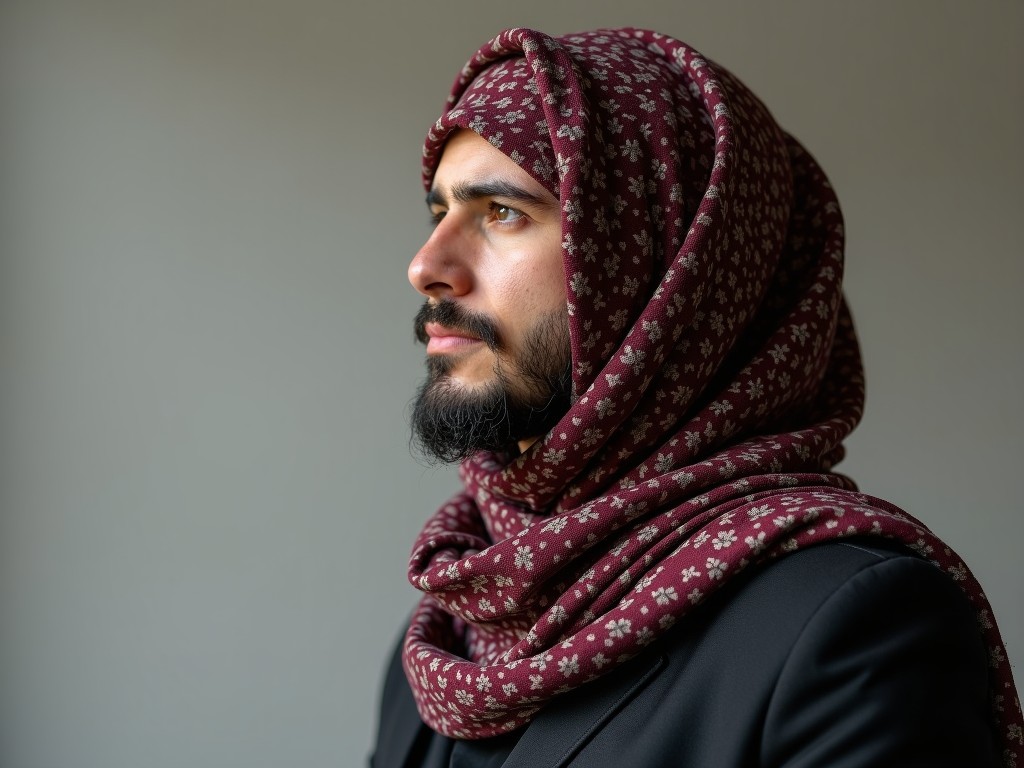
B2B Mens Muslim Head Wrap Scarf
A men's Muslim head wrap scarf, commonly known as a keffiyeh, shemagh, or ghutra, serves both cultural and practical functions in industrial and professional environments. For B2B procurement,
B2B Men's Muslim Head Wrap Scarf
A men's Muslim head wrap scarf, commonly known as a keffiyeh, shemagh, or ghutra, serves both cultural and practical functions in industrial and professional environments. For B2B procurement, understanding the technical specifications ensures the product meets workplace safety, comfort, and durability requirements across diverse operational settings.
This guide outlines the material properties, dimensional standards, and functional considerations relevant to industrial buyers sourcing these garments for workforce use, corporate uniforms, or protective attire in specific climates.
Material Composition and Performance Characteristics
The most common fabric for industrial-grade head wraps is 100% cotton or a cotton-polyester blend. Pure cotton offers high moisture absorption (typically 8-10% regain at 65% RH), breathability, and hypoallergenic properties, making it suitable for hot, humid environments. A 65/35 cotton-polyester blend improves wrinkle resistance and dimensional stability after repeated washing, with reduced shrinkage (<3% after 5 cycles at 40°C).
Thread count typically ranges from 60 to 80 ends per inch (epi) in both warp and weft, balancing durability with airflow. For high-abrasion environments, ripstop weaves using reinforced nylon threads at 5-7mm intervals increase tear strength by up to 40% without significantly affecting weight or flexibility.
Colorfastness is critical for industrial use. Reactive or vat dyes are preferred for cotton, achieving ISO 105-B02 lightfastness ratings of 6+ and washfastness of 4-5, ensuring minimal fading after 20+ industrial laundry cycles. Avoid azo-based dyes in regions with strict REACH or Oeko-Tex compliance requirements.
Standard Dimensions and Functional Design
Industrial head wraps are typically square, with standard side lengths ranging from 110cm to 130cm. A 115cm x 115cm size provides sufficient fabric for multiple wrapping styles while minimizing excess material that could pose entanglement risks near machinery. Larger sizes (125cm+) are used in desert or outdoor sectors where full neck and shoulder coverage is required for UV and sand protection.
The fabric weight generally falls between 180-220 GSM (grams per square meter). Below 180 GSM, durability decreases; above 220 GSM, heat retention increases, reducing comfort in prolonged wear. For thermal regulation in variable climates, some specifications include a dual-layer construction with an inner mesh liner (100gsm polyester) to wick sweat without adding bulk.
Fray resistance is achieved through overlock or flat-felled seams on pre-hemmed edges. Industrial specifications often require a minimum 6mm hem with 4-stitch overlock to prevent unraveling after 30+ wash cycles. Corner reinforcements may include bar tacking or bartack stitches (5-7mm length) to resist stress concentrations during folding and tying.
Applications in Industrial and Professional Settings
In construction and oil & gas sectors, head wraps are used under hard hats to absorb sweat, reduce heat buildup, and prevent salt residue from contacting the skin. The fabric’s wicking property helps maintain epidermal hygiene in high-temperature environments (>35°C), reducing the risk of heat rash or fungal irritation during 12-hour shifts.
In logistics and warehousing, particularly in Middle Eastern or North African facilities, head wraps serve as part of standardized uniforms to promote cultural inclusivity while meeting dress code policies. When worn correctly, they do not obstruct vision, hearing, or the use of PPE such as safety goggles or respirators, provided the wrap is secured above the ears and not layered excessively.
For outdoor maintenance, telecommunications, or solar panel installation crews, UV-treated variants (with UPF 30+ rating) offer additional protection against solar radiation. These treatments involve UV-absorbing agents bonded to the fiber, maintaining effectiveness for 40+ washes. Antimicrobial finishes (e.g., silver-ion or zinc pyrithione) are available upon request for environments requiring odor control or microbial resistance.
Customization Options for B2B Buyers
Color customization follows Pantone or RAL standards for corporate branding. Common industrial colors include white (for high visibility and heat reflection), beige/tan (for desert camouflage and stain concealment), and navy or black (for corporate uniformity). Custom dyes require lab dips and approval before bulk production, with lead times extending by 7-10 days.
Logo integration is achievable via screen printing, heat transfer, or embroidery. Screen printing uses plastisol or water-based inks with a minimum line width of 0.5mm to ensure durability; embroidery uses 40wt polyester thread with a density of 4-6 stitches/mm. Placement is typically restricted to one corner (5cm x 5cm max) to avoid interfering with wrapping functionality.
Packaging options include individual polybags (50μm thickness) for hygiene and moisture protection, or bulk packing in corrugated cartons (120gsm, single wall) with 50-100 units per carton. Custom labeling with barcode, SKU, country of origin, and care instructions (ISO 3758 symbols) is standard for export shipments. Vacuum sealing is available for long-term storage or moisture-sensitive destinations.
Quality Control and Inspection Parameters
Incoming fabric inspection follows AQL 2.5 standards for major defects (holes, stains, misprints) and AQL 4.0 for minor defects (loose threads, slight shade variation). Each batch undergoes dimensional stability testing after 3 wash cycles at 40°C, with acceptable shrinkage limits of ≤2% in length and width.
Color consistency is verified using a spectrophotometer under D65 lighting, with ΔE < 1.5 required for approval. Seam strength is tested via grab test (ASTM D5034), requiring a minimum of 18N in warp and 15N in weft directions. pH value of the final product must fall between 4.5 and 7.5 to prevent skin irritation, verified via ISO 3071.
For orders requiring compliance with specific standards (e.g., Oeko-Tex Standard 100, ISO 9001), documentation includes test reports from accredited laboratories. Factory audits may be conducted upon request to verify social compliance (e.g., SEDEX, BSCI) or environmental management practices. Final random inspection (FRI) is performed before shipment, with a typical sample size of 12.5% of order quantity.
Comparison of Material Options
| Property | 100% Cotton | 65/35 Cotton-Polyester | Ripstop Cotton/Nylon |
|---|---|---|---|
| Weight (GSM) | 200 | 190 | 210 |
| Moisture Regain (%) | 8.5 | 5.0 | 7.0 |
| Wrinkle Resistance | Low | Medium | Medium-High |
| Tear Strength (N) | 12 | 14 | 22 |
| Shrinkage (3x wash) | 4% | 2% | 2.5% |
| UV Resistance (UPF) | 15 | 15 | 30+ (with treatment) |
Typical values based on standard industrial specifications. Actual performance may vary with weave density, finish, and washing conditions. Customizable according to project requirements.
Procurement Considerations
Minimum order quantities (MOQ) typically start at 500 units for standard colors and fabrics. Custom colors, treatments, or logo integration may increase MOQ to 1,000–2,000 units. Lead times range from 14–21 days for stock items and 28–40 days for fully customized orders, including sample approval and production scheduling.
Payment terms commonly include 30% T/T in advance, 70% against copy of B/L, or L/C at sight for international orders. FOB or CIF pricing is available upon request, with port of loading usually Shanghai, Guangzhou, or Dubai for regional distribution. Inspection certificates, COO, and MSDS (if treated) can be provided with shipment documentation.
Samples are available for evaluation, usually charged at cost and refundable upon placing a bulk order. Sample lead time is 3–5 days for stock items and 7–10 days for customized versions. Clearly specifying end-use conditions (e.g., temperature range, washing frequency, PPE compatibility) during quotation ensures accurate material and construction recommendations.
For technical inquiries, custom specifications, or to request a sample evaluation, contact our industrial textiles team.
Request Technical ConsultationProducts
Related Products
News
Related News

2026-11-02
Cotton Voile Scarf Manufacturing and Performance Analysis how to make a cotton voile scarfCreating a professional-grade cotton voile scarf requires a precise balance of textile engineering and artisanal finishing. Unlike standard cotton weaves, voile is defined by its p···

2026-10-28
chiffon hijab Technical Production and Performance AnalysisSelecting the right fabric for a hijab involves a delicate balance between modesty, breathability, and aesthetic drape. For many women in Southeast Asia and the Middle East, the ma···

2026-10-26
custom silk scarf textile manufacturing and performance analysisSelecting a high-quality scarf is no longer just about color matching; it is an exercise in understanding how textile weight, drape, and print scale interact with individual facial···
