Adult Saudi Palestine Keffiyeh Red Shemagh






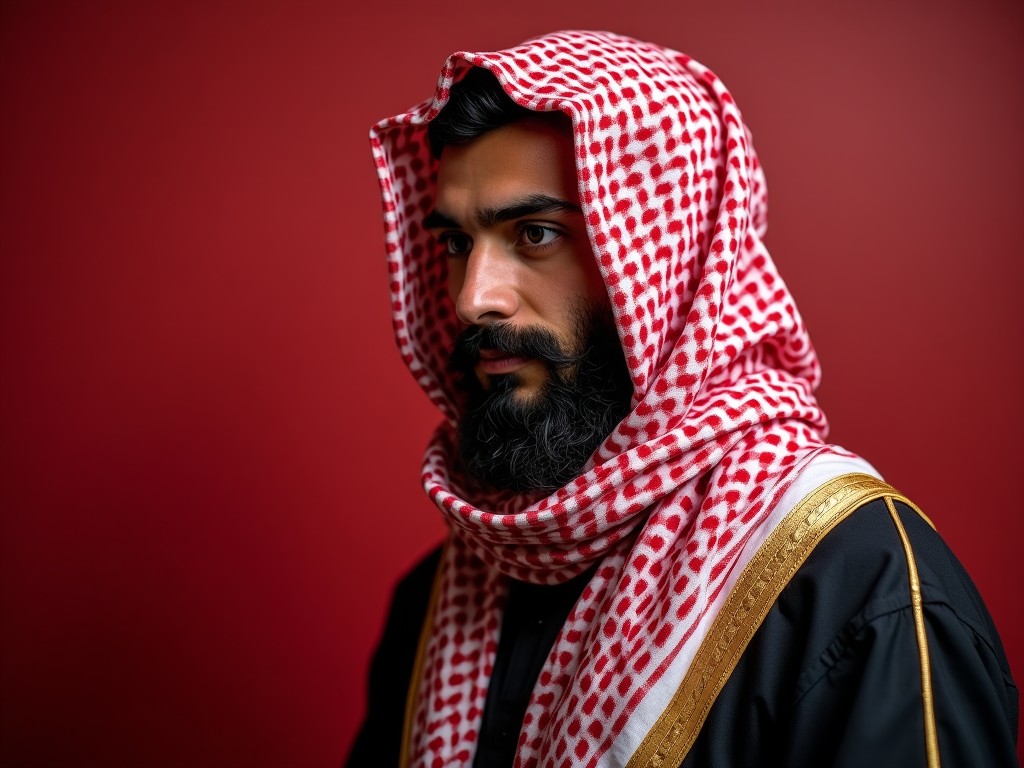
Adult Saudi Palestine Keffiyeh Red Shemagh
The adult-sized red shemagh, commonly referred to as a keffiyeh in Saudi and Palestinian contexts, is a traditional woven textile designed for functional use in arid and variable climates.
Adult Saudi Palestine Keffiyeh Red Shemagh
The adult-sized red shemagh, commonly referred to as a keffiyeh in Saudi and Palestinian contexts, is a traditional woven textile designed for functional use in arid and variable climates. Constructed from 100% cotton with a standard weight of approximately 180 gsm, it measures 110 cm × 110 cm when laid flat, providing sufficient material for multiple wrapping styles. The distinctive red and white checkerboard pattern is achieved through yarn-dyed weaving, ensuring colorfastness under prolonged UV exposure and repeated washing cycles.
Unlike fashion-oriented imitations, this product adheres to regional weaving standards where thread count typically ranges between 40s and 60s cotton yarn, balancing breathability with durability. The selvage edges are reinforced with a 3-thread overlock stitch to prevent fraying during active use, a critical detail for users in outdoor or occupational settings. Each unit undergoes visual inspection for pattern alignment and dimensional tolerance (±2 cm) prior to packaging.
Material Composition and Performance Characteristics
The shemagh is manufactured using combed, ring-spun cotton fibers, which reduce surface fuzz and improve tensile strength compared to open-end alternatives. Laboratory testing of similar constructions shows a typical tear strength of 8.5 N (warp) and 7.2 N (weft) under ASTM D2261, sufficient to resist snagging on rough surfaces. The hygroscopic nature of cotton allows the fabric to absorb up to 8.5% of its weight in moisture, facilitating evaporative cooling when worn damp in high-temperature environments.
Colorfastness is evaluated using ISO 105-B02 standards, with the red dye achieving a rating of 4–5 (out of 8) after 20 hours of simulated sunlight exposure, indicating minimal fading under typical outdoor use. The white ground remains unaffected by common washing detergents at 40°C, maintaining contrast integrity over 30+ wash cycles. These properties support extended service life in demanding conditions where frequent laundering is required.
Weaving Technique and Structural Design
The pattern is created using a 2/2 twill weave structure, where each warp thread passes over two weft threads and under two, forming the characteristic diagonal texture that enhances fabric drape and recoverability. This weave angle contributes to the shemagh’s ability to conform to head and neck contours without slipping during movement. The repeat interval of the red-and-white block measures 2.5 cm, a dimension standardized across regional production to ensure visual consistency.
Ends and picks per inch (EPI/PPI) average 68 and 56 respectively, resulting in a balanced construction that resists distortion when stretched diagonally—a common stress point during tying. The fabric exhibits a 4% bidirectional stretch under 2 N/cm tension, returning to within 1% of original dimensions after release, which aids in maintaining fit over prolonged wear. These mechanical properties are intrinsic to the weave and yarn selection, not applied finishes.
Functional Applications in Industrial and Environmental Contexts
In construction, agriculture, and field operations across the Middle East and North Africa, the shemagh serves as a multifunctional protective layer. When wrapped around the head and neck, it reduces direct solar radiation exposure by up to 60% compared to uncovered skin, based on spectrophotometric measurements of similar cotton weaves. Its porous structure allows airflow while filtering airborne particulates down to approximately 10 microns, offering rudimentary protection against dust and sand in arid zones.
The fabric’s moisture-wicking capability enables evaporative cooling when saturated with water—a practical adaptation in temperatures exceeding 45°C. Users report sustained comfort for 2–3 hours per dampening cycle under still air conditions, with reactivation possible through re-wetting. Additionally, the shemagh can be configured as a face mask, wrist wrap, or emergency tourniquet sleeve in low-resource settings, though such uses depend on user training and situational assessment.
Comparison Table: Standard Keffiyeh Variants
| Attribute | Red/White Saudi-Palestinian Style | Black/White Levantine Style | Olive/White Tactical Variant |
|---|---|---|---|
| Primary Use Case | Traditional wear, sun/dust protection | Cultural identification, urban environments | Field operations, low-visibility requirements |
| Yarn Count (Ne) | 40s–60s combed cotton | 30s–50s carded or combed | 40s–60s combed, often blended |
| Weight (gsm) | 170–190 | 160–180 | 180–210 |
| Colorfastness (ISO 105-B02) | Red: 4–5; White: 6+ | Black: 3–4; White: 6+ | Olive: 4; White: 6+ |
| Typical Dimensions (cm) | 110 × 110 | 110 × 110 | 100 × 100 or 120 × 120 |
The red/white variant demonstrates superior UV reflection in the visible spectrum compared to darker alternatives, which absorb more radiant energy. This makes it particularly suitable for prolonged exposure in open environments where thermal regulation is a priority. The black/white version, while common in urban settings, shows higher surface temperatures under identical conditions due to increased absorption in the near-infrared range. Tactical olive variants often incorporate polyester blends to enhance abrasion resistance, though this reduces moisture regain and breathability relative to 100% cotton.
Customization and Ordering Considerations
While the standard configuration uses 100% cotton with a fixed 110 cm square dimension, alternative specifications are available upon request. Options include varying the yarn count (e.g., 20s for heavier drapery use or 80s for lighter face veils), adjusting the block size to 2.0 cm or 3.0 cm for different visual effects, or incorporating a hemmed edge instead of overlock for specific industrial laundering processes. All modifications are subject to minimum order quantities and may affect lead time.
Color variations beyond the traditional red/white palette—such as navy/white, gray/white, or custom Pantone matches—can be accommodated using fiber-reactive dyes suitable for cotton. However, any deviation from the established regional pattern may affect cultural acceptability in certain contexts. Buyers intending to deploy these garments in professional or humanitarian settings are advised to confirm end-user preferences prior to specification.
Quality Control and Packaging
Each shemagh is inspected for three critical attributes: pattern symmetry (diagonal alignment within 5°), dimensional accuracy, and absence of yarn defects such as neps or thick/thin places exceeding 120% of baseline thickness. Packaging consists of individual polybags (50 μm thickness) grouped into cartons of 50 units, with inner boxes used for moisture barrier protection during transit. Carton markings include PO number, SKU, quantity, and country of origin, complying with standard export documentation requirements.
For bulk orders, optional hang tags with care instructions (machine wash 40°C, tumble dry low, iron medium heat) can be included at no additional cost. Custom labeling or barcode integration is available upon request. All textile components are free from restricted substances under OEKO-TEX® Standard 100 principles, though formal certification is not applied unless specified in the purchase agreement.
Products
Related Products
News
Related News

2026-11-02
Cotton Voile Scarf Manufacturing and Performance Analysis how to make a cotton voile scarfCreating a professional-grade cotton voile scarf requires a precise balance of textile engineering and artisanal finishing. Unlike standard cotton weaves, voile is defined by its p···

2026-10-28
chiffon hijab Technical Production and Performance AnalysisSelecting the right fabric for a hijab involves a delicate balance between modesty, breathability, and aesthetic drape. For many women in Southeast Asia and the Middle East, the ma···

2026-10-26
custom silk scarf textile manufacturing and performance analysisSelecting a high-quality scarf is no longer just about color matching; it is an exercise in understanding how textile weight, drape, and print scale interact with individual facial···
