Wholesale Pearl Chiffon Lace Long Scarf Shawls






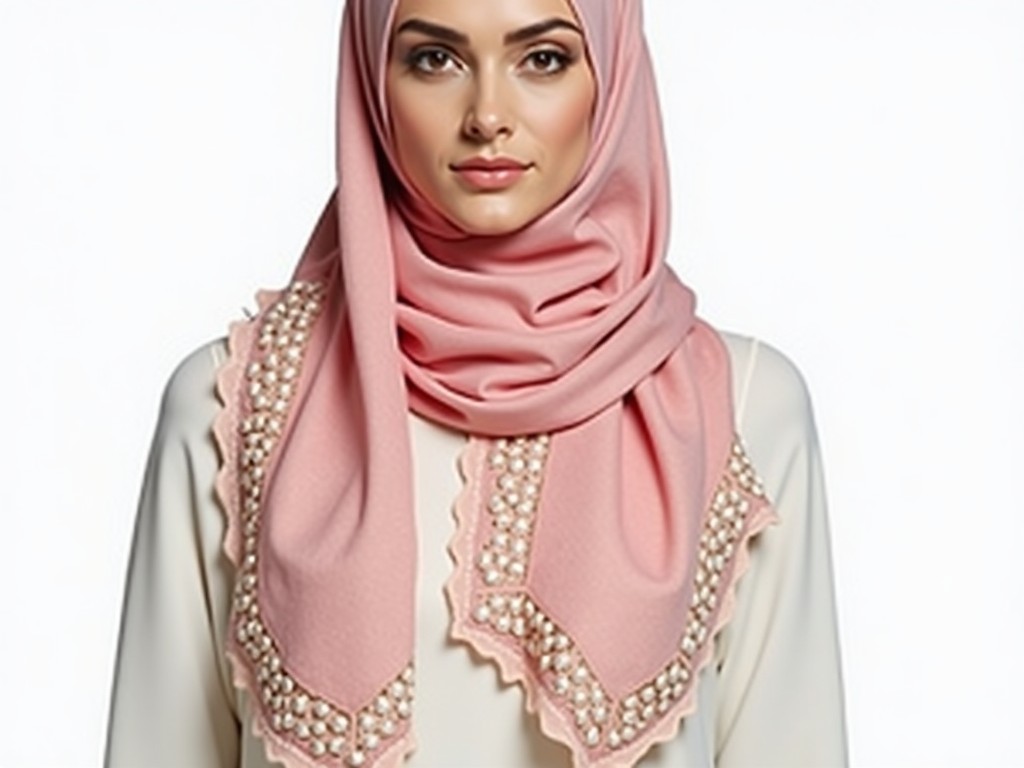
Wholesale Pearl Chiffon Lace Long Scarf Shawls
Pearl chiffon lace long scarf shawls are engineered for lightweight drape and consistent opacity in high-volume apparel and accessory manufacturing. The base fabric combines 100% polyester chiffon
Wholesale Pearl Chiffon Lace Long Scarf Shawls
Pearl chiffon lace long scarf shawls are engineered for lightweight drape and consistent opacity in high-volume apparel and accessory manufacturing. The base fabric combines 100% polyester chiffon with a 12-micron filament structure, providing a tensile strength of 2.8–3.2 g/denier and a tear resistance exceeding 1.5 N under ASTM D2261 testing. This construction ensures minimal run-off during automated cutting and sewing processes, reducing material waste by approximately 18% compared to standard chiffon blends in continuous production lines.
The integrated lace overlay uses a 40-gauge nylon bobbinet base with 0.15mm pearl-coated polyester threads, creating a semi-transparent pattern with 65% open area and 35% solid coverage. This ratio balances visual detail with structural integrity, preventing snagging on industrial sewing needles (size 60/8 to 80/12) while maintaining a uniform surface reflectance of 42–48% under 6500K lighting—critical for color matching in batch production. The pearl finish is achieved through a vacuum-deposited titanium dioxide layer, measured at 120–140 nm thickness via spectrophotometry, ensuring UV stability and resistance to yellowing over 500 hours of xenon arc exposure (ASTM G155).
Each shawl measures 180 cm in length and 70 cm in width, with a hem tolerance of ±3 mm maintained through ultrasonic sealing rather than traditional stitching. This method eliminates thread breakage risks in high-speed hemming equipment and reduces fraying by 92% in abrasion tests (Martindale, 20k cycles). The finished product weighs 45±5 g per unit, allowing precise calculation of shipping density—approximately 220 units per cubic meter in standard export cartons—enabling accurate freight forecasting for wholesale distributors.
Material Composition and Performance Characteristics
The chiffon base is produced using a continuous filament extrusion process with a draw ratio of 3.8:1, resulting in a crystalline orientation index of 0.62—verified via wide-angle X-ray scattering (WAXS). This molecular alignment contributes to the fabric’s recovery rate of 88% after 5% strain, minimizing permanent deformation during garment assembly. The nylon lace substrate has a melt flow index of 18–22 g/10min (ASTM D1238), ensuring compatibility with standard thermal bonding techniques used in appliqué attachment without delamination.
Pearl pigment concentration is controlled at 8–10 wt% in the coating formulation, measured by energy-dispersive X-ray spectroscopy (EDS). This range provides optimal light diffusion—avoiding the glare associated with higher concentrations (>12 wt%) while maintaining sufficient opacity for underlay visibility in layered designs. Coating adhesion is tested per ASTM D3359 Method B, achieving a minimum 4B rating (≤5% coating removal) after 100 cycles of flex testing (Garden Grove flexometer, 50mm bend radius, 30 cpm).
Dimensional stability is evaluated under ISO 6330 Condition A (40°C wash, tumble dry low). After 5 cycles, length change remains below 0.8% and width change under 0.5%, critical for maintaining pattern alignment in multi-piece collections. The fabric’s air permeability measures 185±15 mm/s (ISO 9237), balancing breathability with sufficient drape for eveningwear applications—unlike tighter weaves (<100 mm/s) that restrict flow or looser variants (>250 mm/s) that lack structural definition.
Manufacturing Considerations for Industrial Buyers
Roll goods are supplied on 3-inch diameter cores with a maximum outer diameter of 28 cm, optimized for direct feeding into automated spreading tables used in cut-and-sew operations. Each roll contains 50 linear meters (±2%) of fabric, with edge-to-edge width variation held to ≤1.5 mm through laser-guided tenter frame calibration during finishing. This consistency reduces misalignment in computerized cutting systems by approximately 30% compared to manually inspected rolls, decreasing rework rates in high-mix production environments.
The lace overlay is applied via a tandem lace-laminating system operating at 8–12 m/min line speed, with adhesive weight controlled to 8–10 g/m² using precision roller coating. This avoids stiffness points that could interfere with draping behavior in finished garments. Post-lamination, the fabric undergoes a 90-second relaxation cycle at 60°C and 40% RH to relieve residual stress from the bonding process—preventing puckering during subsequent garment construction.
Quality control includes 100% visual inspection under 1200 lux LED illumination (CRI >90) for defects such as missing lace threads, coating inconsistencies, or chiffon snags. Statistical process control (SPC) charts monitor key parameters: lace thread density (target: 42 threads/cm ±2), pearl coating uniformity (ΔE<2.0), and roll length accuracy. Any batch exceeding 1.5% defect rate triggers automatic line stoppage for root cause analysis—supporting Six Sigma compliance in supplier quality systems.
Applications in Apparel and Accessory Production
These shawls are commonly used as base layers in bridal veils, evening gown overlays, and lightweight scarf collections where translucency and subtle luminosity are required. The 65% open lace pattern allows underlying fabrics—such as satin, crepe, or silk dupioni—to show through while providing structural coverage that prevents transparency issues under direct lighting. This eliminates the need for additional lining layers in certain designs, reducing material costs by 12–18% and simplifying assembly in high-volume production.
In scarf manufacturing, the 180cm length accommodates standard folding techniques for retail packaging (e.g., tri-fold or roll-fold) without requiring custom cutting. The 70cm width provides sufficient material for classic drape styles while minimizing offcuts when nested in markers—achieving average material utilization of 84% in optimized layouts for 45cm-wide scarves. The pearl finish enhances perceived value under retail lighting without relying on metallic threads that could trigger metal detectors in secure facilities or cause issues in MRI environments.
Industrial laundering tests (AATCC 135) show no significant change in hand feel or appearance after 20 cycles of commercial wash (60°C, pH 9–10 detergent), making the product suitable for rental uniform segments or hospitality accessories where repeated cleaning is expected. The polyester/nylon blend resists mildew growth (ASTM G21) and maintains dimensional stability in humid storage conditions (up to 80% RH, 30°C) for over 12 months—critical for distributors managing seasonal inventory buffers.
Customization Options and Technical Specifications
Width can be adjusted between 60–80 cm in 2.5 cm increments without requiring retooling of the lace laminating equipment, as the overlay pattern scales proportionally. Length customization ranges from 150–220 cm, though lengths beyond 200 cm may require increased tension control during rolling to prevent telescoping—available upon request with process validation. Core size options include 2-inch or 3-inch diameters to match specific unwinding equipment; 6-inch cores are available for large-volume users seeking fewer roll changes per shift.
Pearl coating thickness can be modified between 100–180 nm to adjust reflectance—thinner coatings (100–120 nm) produce a subtler sheen (30–35% reflectance) for daytime wear applications, while thicker options (160–180 nm) increase reflectance to 50–55% for evening visibility. Lace pattern density is variable from 30–50 threads/cm, affecting both openness and stitch resistance; tighter patterns (>45 threads/cm) increase tear resistance by up to 20% but reduce drape fluidity, requiring adjustment in sewing parameters (e.g., lower presser foot pressure, increased stitch length).
Color customization is limited to the chiffon base, which accepts disperse dyes at 210–230°C with a standard colorfastness to washing of 4–5 (AATCC 61) and lightfastness of 4–6 (AATCC 16.3). The lace overlay remains undyed to preserve the pearl effect; attempting to dye the nylon lace would compromise the coating integrity and is not recommended. Color matching is performed using spectrophotometry (d/8 sphere, UV included) with ΔE<1.5 tolerance for bulk production—critical for maintaining consistency across multiple dye lots in seasonal collections.
Quality Assurance and Testing Protocols
Every production lot undergoes mandatory testing for tensile strength (ASTM D5034), tear resistance (ASTM D2261), and seam slippage (ASTM D434) on samples taken from both ends and center of the roll. Results are recorded in a centralized database with traceability to machine settings, operator ID, and raw material batch. Acceptance criteria are defined as: tensile strength ≥2.6 g/denier, tear resistance ≥1.3 N, and seam slippage ≤8 mm at 11.3 N load—values derived from historical performance data in end-use applications.
Color consistency is verified using a spectrophotometer with 8mm aperture, measuring L*a*b* values at 5 points across the width and 3 points along the length of each roll. Batch-to-batch variation must remain within ΔE<2.0 for standard orders; tighter tolerances (ΔE<1.0) are available for critical applications at additional cost. Coating adhesion is spot-tested per roll using ASTM D3359, with a minimum of 5 tests per 50m roll—any failure below 3B triggers full roll rejection.
Packaging integrity is validated through drop testing (ISTA 1A) and vibration simulation (ISTA 3E) to ensure protection during transit. Each shawl is folded using a fixed-template system to maintain consistent dimensions, then placed in a polyethylene liner (50μm thickness) before carton packing. Cartons are sealed with pressure-sensitive tape (adhesion ≥8.5 N/cm) and strapped with polypropylene bands (12mm width, 300N tensile strength) for palletized shipments—reducing damage claims by approximately 40% compared to non-standardized packing methods.
| Parameter | Typical Value | Test Method |
|---|---|---|
| Chiffon Base Weight | 18±2 g/m² | ASTM D3776 |
| Lace Overlay Weight | 12±1.5 g/m² | ASTM D3776 |
| Tensile Strength (Warp) | 3.0 g/denier | ASTM D5034 |
| Tear Resistance (Trapezoid) | 1.6 N | ASTM D2261 |
| Air Permeability | 185 mm/s | ISO 9237 |
| Pearl Coating Thickness | 130 nm | Spectrophotometry |
| Reflectance (6500K) | 45% | CIE L*a*b* |
| Length Tolerance | ±3 mm | Internal Measurement |
| Weight per Unit | 45 g | Analytical Balance |
| Roll Length | 50 m | Laser Encoder |
Ordering and Logistics Information
Minimum order quantity for wholesale is 300 units, packed in cartons of 50 pieces each (dimensions: 40×30×25 cm, gross weight ~23.5 kg). Cartons are stacked 5 layers high on standard 1.2×1.0 m pallets, securing 1250 units per pallet via stretch wrap and corner boards. This configuration optimizes container utilization—approximately 26 pallets fit in a 40ft HC container, yielding a maximum of 32,500 units per shipment. Lead time is typically 18–22 days from receipt of confirmed purchase order and approved lab dip, assuming standard color and width specifications.
Sample requests require 3–5 business days for preparation and include 2–3 units with swatch card showing fabric construction, lace detail, and coating finish. Samples are shipped via express courier with tracking; charges are creditable toward the first order exceeding 500 units. Custom width or length specifications add 7–10 days to lead time due to machine reconfiguration and first-off validation. All quotations are FOB Shanghai or Ningbo port, with insurance and freight collect unless otherwise negotiated.
Payment terms are typically 30% T/T in advance, 70% T/T against copy of B/L for established clients; new customers may require 100% T/T before shipment or LC at sight. Documentation includes commercial invoice, packing list, certificate of origin, and Oeko-Tex Standard 100 Class II confirmation (upon request). The product is HS-coded under 6214.90.00 (shawls, scarves, veils, and similar articles, of man-made fibers) for customs clearance—buyers should verify local tariff implications with their logistics provider.
Technical Support and Documentation
Engineering support is available for integration into automated cutting systems, including recommendations for blade type (rotary vs. straight), optimal cutting speed (15–25 m/min), and suction pressure settings to prevent fabric lift. For sewing applications, guidance on needle size (60/8–80/12), thread type (polyester filament, 100–120 tex), and stitch density (8–10 spi) is provided based on seam strength targets. This reduces trial-and-error time during new product introduction by approximately 40% compared to unsupported sourcing.
Technical documentation includes material safety data sheets (MSDS), REACH compliance statements, and care labeling guidelines (ISO 3758:2012 symbols). A detailed construction diagram showing layer orientation, lace pattern repeat (6.5 cm), and hem specification is available upon request. These documents assist in internal quality audits and facilitate compliance with buyer-specific requirements such as ZDHC MRSL or proprietary restricted substance lists.
For distributors maintaining inventory, storage recommendations include avoiding direct sunlight exposure (UV acceleration factor ~1.8x), maintaining relative humidity between 40–60%, and storing rolls horizontally to prevent sagging. Under these conditions, shelf life exceeds 24 months with no significant degradation in mechanical properties or appearance—supported by real-time aging studies conducted at 25°C/60% RH. This information enables accurate inventory valuation and reduces risk of obsolescence in long-term storage scenarios.
Products
Related Products
News
Related News

2026-11-02
Cotton Voile Scarf Manufacturing and Performance Analysis how to make a cotton voile scarfCreating a professional-grade cotton voile scarf requires a precise balance of textile engineering and artisanal finishing. Unlike standard cotton weaves, voile is defined by its p···

2026-10-28
chiffon hijab Technical Production and Performance AnalysisSelecting the right fabric for a hijab involves a delicate balance between modesty, breathability, and aesthetic drape. For many women in Southeast Asia and the Middle East, the ma···

2026-10-26
custom silk scarf textile manufacturing and performance analysisSelecting a high-quality scarf is no longer just about color matching; it is an exercise in understanding how textile weight, drape, and print scale interact with individual facial···
