White Chiffon Head Scarf Supplier






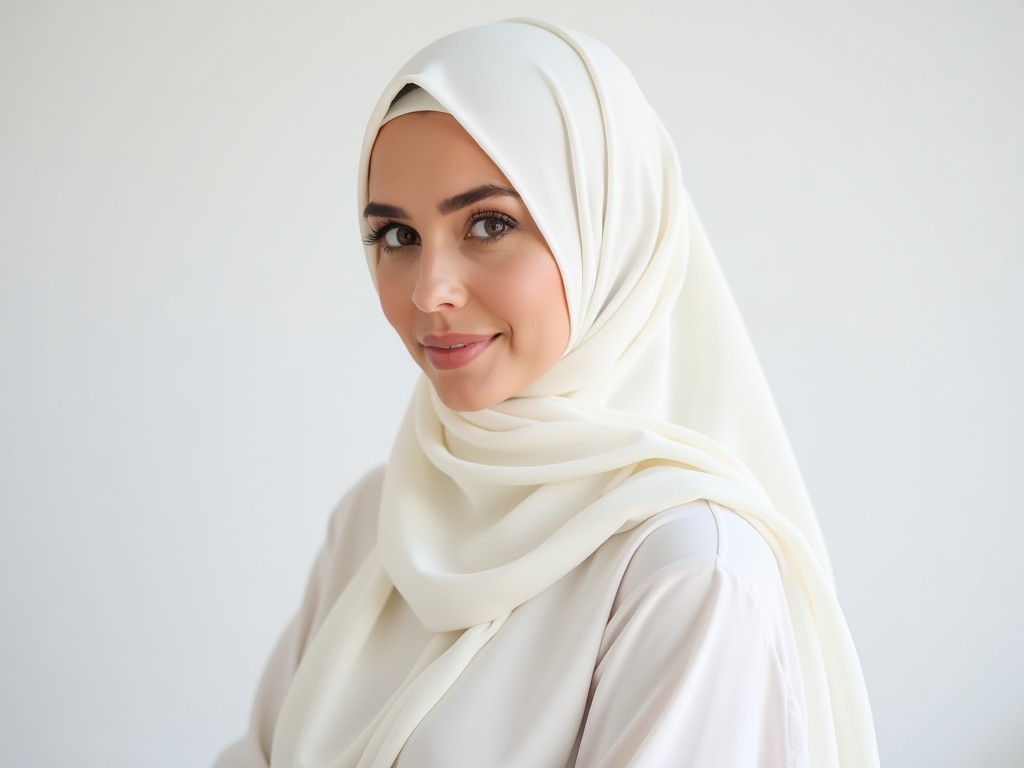
White Chiffon Head Scarf Supplier
A white chiffon head scarf is a lightweight textile accessory constructed from sheer, plain-weave polyester or silk chiffon, typically used in industrial, medical, or uniform applications where
White Chiffon Head Scarf Supplier
A white chiffon head scarf is a lightweight textile accessory constructed from sheer, plain-weave polyester or silk chiffon, typically used in industrial, medical, or uniform applications where breathability, low lint generation, and visual discretion are required. As a supplier, we provide these scarves in standardized dimensions with controlled edge finishes to meet the functional and hygiene demands of professional environments.
Material Construction and Performance Characteristics
The base fabric is 100% polyester chiffon with a nominal weight of 18–22 g/m², selected for its balance of drape, tensile strength (minimum 1.8 N/tex in warp and weft), and resistance to pilling after repeated washing. The fiber morphology ensures low particle shedding, critical in cleanroom-adjacent settings such as pharmaceutical packaging or electronics assembly. Unlike cotton or rayon alternatives, polyester chiffon maintains dimensional stability under steam sterilization (up to 121°C) and does not absorb moisture, reducing microbial retention risk.
Optical properties are controlled: the fabric achieves 85–90% light transmission in the visible spectrum (400–700 nm) while providing subtle diffusion that minimizes glare under fluorescent or LED workstation lighting. This is measured using a integrating sphere spectrophotometer per ASTM E1164. The white shade is matched to CIE L*a*b* values of L=94, a=-1.2, b=2.8, ensuring consistency across dye lots for uniform appearance in team-based operations.
Dimensional Specifications and Edge Finishing
Standard dimensions are 60 cm × 60 cm (±3 mm tolerance) for square scarves and 70 cm × 140 cm (±4 mm) for rectangular variants, cut from roll goods using ultrasonic slitters to prevent fraying during production. Tolerances are maintained via laser-guided cutting tables with real-time feedback systems. These dimensions allow for multiple folding configurations—single-layer drape, double-layer wrap, or triple-layer tuck—without creating bulk that interferes with headgear, face shields, or respiratory equipment.
Edges are finished using a 3-mm wide, heat-sealed polyester tape bonded via controlled-pressure calendering at 160°C, creating a flexible, non-raveling border that adds less than 0.5 g to the total mass. This method avoids thread-based hems, which can shed lint or harbor contaminants. Alternative finishes—such as cold-cut with laser sealing or narrow overlock stitch using 100% polyester filament (75 denier)—are available upon request for applications requiring specific tactile or autoclave compatibility.
Hygiene and Cleanability Parameters
The scarves are designed for repeated laundering cycles. Accelerated testing shows no significant loss in tensile strength (>85% retention) after 50 industrial wash cycles at 75°C with non-ionic detergent and pH-neutral bleach activator. Colorfastness to washing (ISO 105-C06) exceeds grade 4, and to rubbing (ISO 105-X12) is grade 4–5 for both dry and wet conditions. These metrics are verified per lot using AATCC Test Method 61A for washing and AATCC 8 for crocking.
For environments requiring bioburden control, the scarves can be gamma-irradiated (25 kGy) without degradation in tensile strength or whiteness index (WI >85 post-irradiation). The polyester substrate does not yellow under UV exposure (QUV-A, 8 hrs) due to built-in HALS stabilizers, unlike untreated nylon or acetate chiffon. Packaging is performed in ISO Class 7 cleanrooms using anti-static polyethylene bags to prevent electrostatic attraction of particulates during storage and transport.
Customization Options and Application Logic
Customization is driven by end-use functional requirements rather than aesthetic preference. For example, in food processing facilities where hair containment is regulated under FDA 21 CFR 110.10, scarves may be supplied with a slightly tighter weave (24 g/m²) to reduce pore size below 100 μm, enhancing particulate capture efficiency. In cleanroom environments (ISO 14644-1 Class 6), scarves undergo additional particle counting per IEST-ST-CC034.3, with maximum allowable emission of <100 particles >0.5 μm per ft²/min.
Length and width can be adjusted in 5-mm increments based on ergonomic studies of head circumference and coverage needs across diverse workforces. For instance, a 65 cm × 65 cm variant reduces slippage during prolonged overhead tasks, while a 55 cm × 150 cm rectangular shape allows for secure tucking under bouffant caps in surgical settings. All custom dimensions retain the same edge finish and material specifications unless otherwise validated.
Quality Assurance and Traceability
Each batch is assigned a unique lot number linked to raw material certificates, fabric roll inspection data, and final product test results. Incoming chiffon is tested for weight, width, opacity, and tear strength (Elmendorf method) before cutting. Finished goods undergo 100% visual inspection under 500-lux LED lighting for stains, holes, or edge defects, followed by AQL 2.5 sampling for dimensional accuracy and seam integrity. Reports are available upon request, including COO, material safety data (MSDS), and test summaries.
We do not rely on end-product certifications alone; instead, we maintain process control through ISO 9001:2015-certified manufacturing, with documented work instructions for cutting, finishing, and packaging. Calibration of measurement tools (caliper, tensile tester, spectrophotometer) is performed quarterly against NIST-traceable standards. This approach reduces variability and ensures that technical specifications are met consistently, not just sampled.
| Parameter | Typical Value | Test Method / Standard |
|---|---|---|
| Fabric Weight | 18–22 g/m² | ASTM D3776 |
| Tensile Strength (Warp/Weft) | ≥1.8 N/tex | ASTM D5035 |
| Light Transmission | 85–90% | ASTM E1164 (Integrating Sphere) |
| Color (L*a*b*) | L=94, a=-1.2, b=2.8 | CIE 15:2004 / Spectrophotometer |
| Edge Finish Width | 3 mm | Caliper Measurement |
| Particle Shedding (Post-Wash) | <50 particles >0.5 μm/ft²/min | IEST-ST-CC034.3 |
| Dimensional Tolerance | ±3–4 mm | Laser-Guided Cutting |
Packaging and Logistics Considerations
Scarves are packaged flat in polyethylene bags (50 µm thickness) with low static decay (<2.0 seconds) to prevent clinging and contamination. Each bag contains 10–100 units depending on client specifications, labeled with lot number, quantity, and care instructions. Outer cartons are double-wall corrugated (ECT 32) with internal dividers to prevent shifting during transit. For export shipments to humid climates, desiccant packets (silica gel, 5 g per bag) are included to maintain relative humidity below 50% inside the primary packaging.
Lead time for standard stock items is 7–10 business days after order confirmation. Custom dimensions or finishes require 15–20 days, including sample approval and process validation. We provide pre-production samples upon request, evaluated against the client’s specific test protocol (e.g., autoclave resistance, lint test, compatibility with PPE). All shipments include a packing list and commercial invoice; certificates of conformity are available digitally via secure portal.
Products
Related Products
News
Related News

2026-11-02
Cotton Voile Scarf Manufacturing and Performance Analysis how to make a cotton voile scarfCreating a professional-grade cotton voile scarf requires a precise balance of textile engineering and artisanal finishing. Unlike standard cotton weaves, voile is defined by its p···

2026-10-28
chiffon hijab Technical Production and Performance AnalysisSelecting the right fabric for a hijab involves a delicate balance between modesty, breathability, and aesthetic drape. For many women in Southeast Asia and the Middle East, the ma···

2026-10-26
custom silk scarf textile manufacturing and performance analysisSelecting a high-quality scarf is no longer just about color matching; it is an exercise in understanding how textile weight, drape, and print scale interact with individual facial···
