Vintage Chiffon Head Scarf Supplier






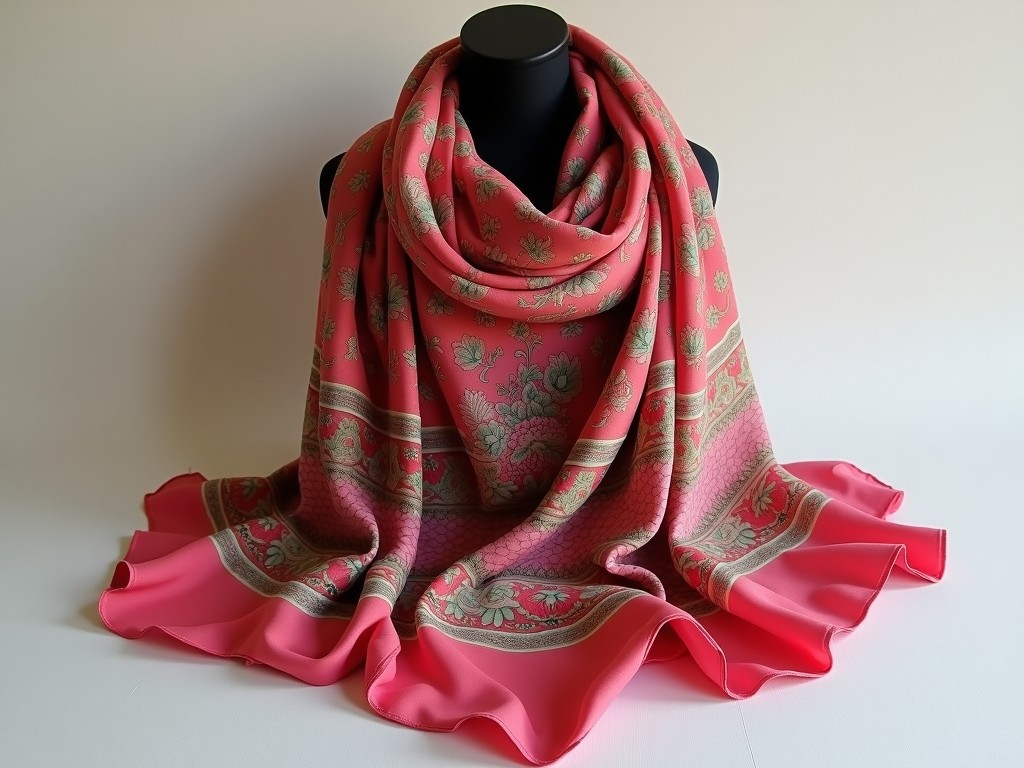
Vintage Chiffon Head Scarf Supplier
Vintage chiffon head scarves are typically constructed from 100% polyester filament yarn with a plain weave structure, resulting in a sheer, lightweight fabric weighing between 15 to 25 gsm. The
Vintage Chiffon Head Scarf Supplier
Material Composition and Weave Structure
Vintage chiffon head scarves are typically constructed from 100% polyester filament yarn with a plain weave structure, resulting in a sheer, lightweight fabric weighing between 15 to 25 gsm. The tight filament count—usually 75D/36F or 100D/48F—provides dimensional stability while maintaining drape and translucency. This construction resists snagging under normal handling and allows for consistent dye uptake across the fabric surface.
The fabric undergoes a controlled heat-setting process at 180–200°C to stabilize the weave and minimize shrinkage to less than 2% after washing. This thermal treatment also enhances the fabric’s ability to hold pleats and gathers without permanent deformation, which is essential for scarves featuring layered or folded designs. Unlike natural silk chiffon, polyester-based versions exhibit superior resistance to UV degradation and moisture-induced weakening.
Colorfastness is achieved through disperse dyeing at high temperatures (130–135°C), ensuring ratings of 4–5 on the gray scale for both washing and light exposure per ISO 105-B02 and ISO 105-B04 standards. This level of performance is critical for scarves intended for repeated use or outdoor wear, where fading or bleeding could compromise appearance.
Dimensional Specifications and Tolerances
Standard vintage chiffon head scarves are produced in square or rectangular formats with nominal dimensions ranging from 50 cm × 50 cm to 70 cm × 100 cm. Cutting tolerances are maintained within ±3 mm along the selvage and ±5 mm on the cut edges, verified using automated vision systems during final inspection. These tight tolerances ensure consistent folding behavior and alignment when scarves are stacked or displayed.
Hemming options include rolled hems (2–3 mm width) or narrow double-fold hems (5–7 mm), both executed with 40/2 polyester thread at 8–10 stitches per centimeter. Rolled hems are preferred for lightweight chiffon as they add minimal weight and prevent edge curling, while double-fold hems offer increased durability for scarves subject to frequent handling. Seam strength is tested to exceed 1.5 N/mm under ISO 13937-2 standards.
Scarf thickness, measured under 0.5 kPa pressure using a thickness gauge, typically falls between 0.08 and 0.12 mm. This range ensures adequate opacity for styling purposes while retaining the characteristic sheerness associated with vintage chiffon. Variations beyond this range may indicate inconsistent yarn tension during weaving or improper heat-setting.
Customization Capabilities
Customization begins with yarn selection, where denier and filament count can be adjusted between 50D/24F and 150D/72F to alter drape, sheerness, and durability. Lower denier yields a more delicate, fluid drape suitable for evening wear, while higher denier increases resistance to tearing and abrasion for utility-focused designs. These adjustments are made during the yarn procurement phase and require re-optimization of loom tension and dyeing parameters.
Printing methods include digital sublimation for photorealistic patterns and screen printing for spot-color designs with Pantone matching. Digital sublimation achieves color penetration without blocking the fabric’s pores, preserving breathability and drape, while screen printing allows for metallic or fluorescent inks that retain flexibility after curing. Both methods are tested for crocking resistance (ISO 105-X12) to ensure minimal color transfer.
Edge treatments can be customized to include picot edging, scalloped cuts, or laser-sealed borders, each requiring specific machine calibration. Picot edging uses a specialized overlock mechanism to create a decorative looped edge, while laser sealing prevents fraying on synthetic fibers by melting the edge at precise temperatures. These finishes are inspected under 10x magnification to verify consistency and absence of thermal damage.
Quality Control and Inspection Protocol
Incoming yarn is tested for tensile strength (min 3.5 cN/tex), elongation at break (15–25%), and batch-to-batch color variance using a spectrophotometer (ΔE < 1.5). Only yarn lots passing these checks are released to weaving, reducing the risk of inconsistent fabric behavior. Each loom is monitored for pick density (target: 60–80 picks/cm) and ends per inch (EP: 80–100) via real-time sensors.
Fabric inspection follows a 4-point system per ASTM D5430, evaluating defects such as broken picks, neps, stains, and misprints over a standardized 100 sqm area. Scarves are inspected individually under 500 lux daylight simulation lighting, with attention to edge uniformity, print registration, and hand feel. Any scarf exceeding 40 penalty points per 100 sqm is downgraded or reprocessed.
Final inspection includes dimensional verification, hem integrity checks, and a 10-second stretch recovery test to assess elastic recovery (>85% after 5% strain). Packaging is verified for correct folding, label placement, and moisture barrier integrity (using desiccant packs rated for 5g H₂O absorption). Random samples undergo accelerated weathering (UV exposure equivalent to 100 hours sunlight) to validate long-term color stability.
Packaging and Logistics Considerations
Scarves are folded to a uniform size (typically 10 cm × 15 cm) using automated folding boards to ensure consistent stacking and minimize creasing during transit. Each unit is placed in a polypropylene sleeve (40 μm thickness) with a desiccant packet to prevent moisture accumulation. This primary packaging protects against dust, humidity, and light exposure during storage and transport.
Secondary packaging consists of corrugated cardboard boxes (single-wall, 150 gsm) with internal dividers to prevent shifting. Boxes are sealed with pressure-sensitive tape and labeled with batch codes, SKU, and care instructions. Palletization follows ISO 6780 standards, with max stack height of 1.8m and load distribution verified via pressure mapping to avoid bottom-layer deformation.
For export shipments, cartons are lined with polyethylene film (50 μm) and secured with polypropylene strapping. Temperature and humidity indicators are included in select batches to monitor transit conditions. Lead times are typically 25–35 days from approved sample to production completion, depending on customization complexity and dye lot scheduling.
| Parameter | Typical Range | Test Method |
|---|---|---|
| Fabric Weight | 15–25 gsm | ISO 3801 |
| Tensile Strength (Warp) | ≥18 N/cm | ISO 13937-2 |
| Colorfastness to Light | Rating 4–5 | ISO 105-B02 |
| Shrinkage (After Wash) | ≤2% | ISO 6330 |
| Seam Strength | ≥1.5 N/mm | ISO 13937-2 |
Applications in Industrial and Commercial Sectors
In the fashion accessory supply chain, vintage chiffon head scarves serve as lightweight layering components for headwear, bridal veils, and ceremonial garments where breathability and drape are critical. Their low bulk density allows for compact storage in inventory systems, reducing warehousing costs compared to heavier fabrics. The fabric’s resistance to wrinkling minimizes the need for steaming or ironing before display, streamlining retail preparation.
Theatrical and costume departments utilize these scarves for period-specific designs due to their ability to mimic the appearance of aged silk chiffon at a fraction of the cost. Their durability under repeated handling and cleaning makes them suitable for rental inventories, where garments undergo multiple use cycles. Flame-retardant treatments (upon request) can be applied to meet safety standards for stage use without significantly altering hand feel.
In promotional and corporate gifting, the scarves function as customizable branding vehicles due to their high surface area and print fidelity. Unlike rigid promotional items, they conform to various body types and styling preferences, increasing perceived value and likelihood of use. Their lightweight nature reduces shipping costs per unit, making them efficient for large-scale distribution campaigns where weight-based freight pricing applies.
Ordering and Technical Support Process
To initiate a quotation, buyers should provide: target dimensions (L × W), preferred yarn denier/filament, color requirements (Pantone or physical sample), hem type, and any special finishes (e.g., laser edge, scallop). A lab dip strike-off is typically delivered within 5–7 business days for color approval, followed by a pre-production sample for dimensional and construction validation.
Minimum order quantities vary based on customization level: solid colors start at 300 units per SKU, while custom prints require 500 units minimum due to screen setup or digital file preparation. Sample development is available at cost, with fees credited toward the first production order. Technical documentation, including material safety data sheets (MSDS) and care labels, is provided upon request.
Ongoing support includes batch-to-batch consistency reports, packaging validation, and compliance documentation for REACH or OEKO-Tex Standard 100 (if applicable). Buyers are advised to conduct their own end-use testing for specific applications, as performance may vary under extreme conditions such as prolonged UV exposure or industrial laundering.
For technical inquiries, customization requests, or to request a sample evaluation kit, contact our engineering team. Provide your application requirements and we will respond with material recommendations, lead time estimates, and pricing within one business day.
Request Technical ConsultationProducts
Related Products
News
Related News

2026-11-02
Cotton Voile Scarf Manufacturing and Performance Analysis how to make a cotton voile scarfCreating a professional-grade cotton voile scarf requires a precise balance of textile engineering and artisanal finishing. Unlike standard cotton weaves, voile is defined by its p···

2026-10-28
chiffon hijab Technical Production and Performance AnalysisSelecting the right fabric for a hijab involves a delicate balance between modesty, breathability, and aesthetic drape. For many women in Southeast Asia and the Middle East, the ma···

2026-10-26
custom silk scarf textile manufacturing and performance analysisSelecting a high-quality scarf is no longer just about color matching; it is an exercise in understanding how textile weight, drape, and print scale interact with individual facial···
