Sheer Chiffon Square Scarf






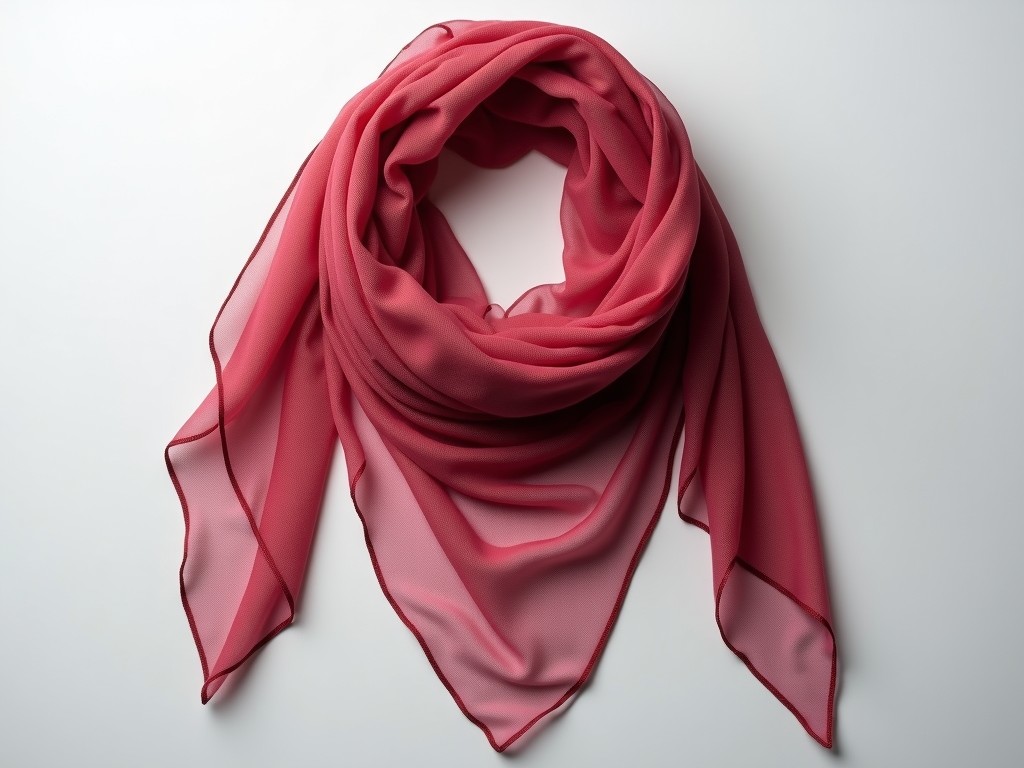
Sheer Chiffon Square Scarf
A sheer chiffon square scarf is a lightweight textile product constructed from fine filament yarns, typically polyester or silk, woven in a plain or leno weave to achieve optical translucency and
Sheer Chiffon Square Scarf
A sheer chiffon square scarf is a lightweight textile product constructed from fine filament yarns, typically polyester or silk, woven in a plain or leno weave to achieve optical translucency and dimensional stability. The square geometry—equal length and width—enables consistent draping behavior and predictable folding characteristics, which are critical for industrial applications requiring repeatable form factors, such as theatrical costuming, architectural mock-ups, or protective interleaving in precision manufacturing.
The term “sheer” refers to the fabric’s ability to transmit light, quantified by its open area ratio (OAR), which typically ranges from 30% to 60% depending on yarn denier and weave density. Chiffon’s inherent crimp and torsion balance provide resistance to dimensional change under humidity fluctuations, making it suitable for environments where material stability is paramount. Unlike opaque textiles, sheer chiffon minimizes shadow formation when layered, a property exploited in diffuse lighting design and optical testing fixtures.
Material Composition and Construction
The base yarn is usually 100% polyester filament with a denier range of 15–30 dtex, selected for its tensile strength (typically 3.5–5.0 cN/tex), low moisture regain (<0.4%), and UV stability. Silk-based variants use 12–20 dtex mulberry silk fibroin, offering superior drape coefficient (0.45–0.55) but reduced abrasion resistance (<10,000 cycles Martindale). The plain weave structure yields a thread count of 80–120 ends per inch (EPI) and 60–100 picks per inch (PPI), creating a balanced grid that resists skewing under tension.
Edge finishing is critical to prevent fraying; common methods include ultrasonic sealing (producing a 0.5–1.0 mm fused border) or narrow hem stitching (2–3 mm width, 8–10 stitches/cm). The resulting edge modulus matches the body fabric within ±5%, ensuring uniform stress distribution. For applications requiring chemical resistance, yarns may be treated with fluoropolymer finishes, increasing contact angle to >90° while maintaining air permeability above 200 cm³/cm²/s.
Dimensional Specifications and Tolerances
Standard square dimensions range from 30 cm × 30 cm to 120 cm × 120 cm, with tolerances held to ±2% of nominal length under ASTM D4966 conditioning (20°C, 65% RH). The diagonal deviation—measured as the difference between actual and theoretical diagonal length—is maintained below 1.5% to ensure true squareness, a prerequisite for automated folding or stacking systems. Thickness, measured via dead-weight micrometer at 5 kPa pressure, averages 0.08–0.15 mm, contributing to a basis weight of 12–25 g/m².
Dimensional stability after washing or steam exposure is evaluated using AATCC Test Method 135; length change typically remains under ±1.5% for polyester and ±3.0% for silk variants. Shrinkage bias is minimized through heat-setting during finishing, which relaxes internal yarn stresses. For precision applications, custom tolerances of ±0.5% are available upon request, requiring tighter process control during weaving and inspection.
Functional Properties and Performance Metrics
Air permeability, measured per ISO 9237, ranges from 180 to 350 cm³/cm²/s, enabling use in filtration pre-layers or breathable barriers where particulate retention is not the primary function. Water vapor transmission rate (WVTR) exceeds 2,500 g/m²/24h, making the fabric suitable for moisture-management layers in temporary enclosures or medical drape underlayers. Optical transmittance, measured at 550 nm wavelength, averages 40–70%, with haze values between 60% and 85%, indicating high diffuse scatter—ideal for softening light sources without spectral alteration.
Tensile elongation at break is 15–25% for polyester and 20–30% for silk, providing adequate recovery for temporary deformation. Tear strength (Elmendorf method) averages 0.8–1.5 N, sufficient to resist propagation from minor nicks during handling. Electrostatic decay time, when treated with anti-static agents, falls below 0.5 seconds at 50% RH, reducing particle attraction in cleanroom-adjacent environments. These properties are validated per batch using standardized test coupons taken from selvage areas.
Typical Industrial Applications
In theatrical and film production, sheer chiffon squares are used as diffusion media for key lights, where their consistent thickness and uniform scatter prevent hotspots and color shift. The square format allows rapid deployment in flag frames or C-stands without requiring custom cutting, reducing setup time by an estimated 30–40% compared to rolled goods. Their low mass (<20 g for a 60 cm square) minimizes load on rigging systems.
Architectural model makers employ these scarves to simulate translucent materials such as rice paper or frosted acrylic in daylighting studies. The material’s predictable light transmission allows accurate calibration of scale models, with measured transmittance correlating to full-scale glazing performance within ±8%. Unlike plastic alternatives, chiffon does not off-gas VOCs under lamp heat, preserving indoor air quality in enclosed studio spaces.
In electronics manufacturing, sheer chiffon squares serve as interleaving sheets between delicate components during storage or transport. Their low particulate shedding (classified as Level 1000 under IEST-RP-CC003.4) and anti-static options prevent contamination and electrostatic discharge (ESD) events. The square shape ensures consistent placement in automated tray systems, reducing misalignment risks in high-mix production lines.
Comparison of Material Variants
| Property | Polyester Chiffon | Silk Chiffon |
|---|---|---|
| Denier (dtex) | 15–30 | 12–20 |
| Tensile Strength (cN/tex) | 3.5–5.0 | 2.0–3.5 |
| Moisture Regain (%) | <0.4 | 8–12 |
| UV Stability (hours to 50% strength loss) | >500 | <100 |
| Drape Coefficient | 0.35–0.45 | 0.45–0.55 |
| Typical Use Case | Theatrical lighting, industrial interleaving | High-end fashion sampling, archival display |
*Note: Values represent typical ranges; actual performance depends on finish, weave density, and environmental conditioning. Custom treatments available upon request.
Quality Control and Inspection
Incoming yarn is tested for tenacity, elongation, and linear density using ISO 2062 standards; batches exceeding ±5% deviation from target denier are rejected. Greige fabric undergoes 100% visual inspection under 500 lux illumination for defects such as broken picks, neps, or oil stains, with acceptance criteria limiting Class B defects to <2 per square meter. Finished dimensions are verified via automated vision systems calibrated to NIST-traceable standards, ensuring squareness and edge integrity.
Transmittance and haze are measured batch-wise using a spectrophotometer with integrating sphere; results must fall within ±10% of target specifications. For anti-static variants, surface resistivity is tested per ANSI/ESD S11.11, requiring values below 1.0 × 10¹¹ ohms/sq. All test data is retained for 36 months and linked to lot numbers via ERP traceability. Final audit includes dimensional stability after one wash cycle per AATCC 135, with dimensional change recorded for process feedback.
Packaging and Handling
Scarves are folded using automated jigs to achieve a consistent 45° bias fold, reducing volume by 65% compared to random stacking. Each unit is placed in a polyethylene sleeve (50 µm thickness) to prevent moisture ingress and particulate contamination during transit. Cartons are constructed from single-wall corrugated fiberboard (ECT 32 kN/m), with inner dimensions optimized to minimize void space—typically holding 50–100 units depending on size.
For cleanroom-compatible requirements, packaging is performed in ISO Class 7 environments using lint-free gloves and anti-static trolleys. Units are sealed in double-layered PE bags with nitrogen flush to reduce oxygen exposure. Humidity indicators (5–60% RH range) are included in each carton to monitor transit conditions. Stacking limits are defined to prevent compressive deformation; maximum recommended stack height is 1.2 meters for 60 cm squares under standard warehouse conditions.
To request a quotation, technical data sheet, or sample kit for your specific application, please provide your required dimensions, material preference (polyester or silk), quantity, and any special finishes (e.g., anti-static, UV-stabilized, flame-retardant). Our engineering team will review your specifications and respond with actionable options within one business day.
Submit InquiryProducts
Related Products
News
Related News

2026-11-02
Cotton Voile Scarf Manufacturing and Performance Analysis how to make a cotton voile scarfCreating a professional-grade cotton voile scarf requires a precise balance of textile engineering and artisanal finishing. Unlike standard cotton weaves, voile is defined by its p···

2026-10-28
chiffon hijab Technical Production and Performance AnalysisSelecting the right fabric for a hijab involves a delicate balance between modesty, breathability, and aesthetic drape. For many women in Southeast Asia and the Middle East, the ma···

2026-10-26
custom silk scarf textile manufacturing and performance analysisSelecting a high-quality scarf is no longer just about color matching; it is an exercise in understanding how textile weight, drape, and print scale interact with individual facial···
