Printed Chiffon Hijab Scarf






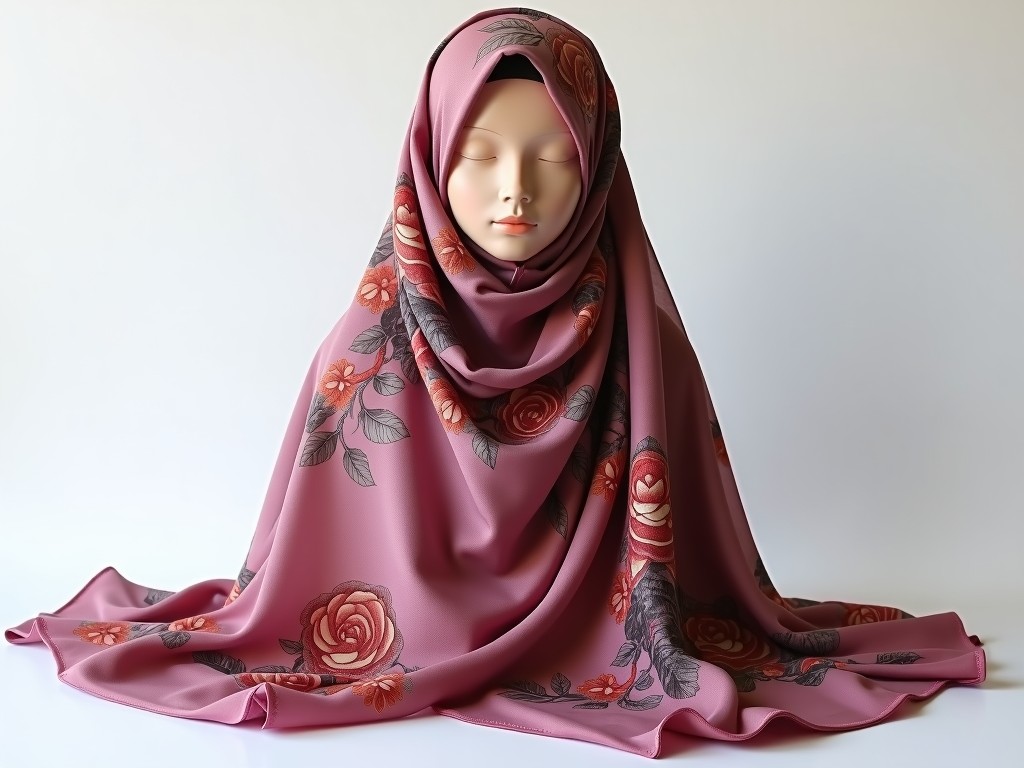
Printed Chiffon Hijab Scarf
This document details the technical characteristics, manufacturing considerations, and application suitability of printed chiffon hijab scarves intended for bulk procurement by textile distributors,
Printed Chiffon Hijab Scarf – Industrial Technical Specification
This document details the technical characteristics, manufacturing considerations, and application suitability of printed chiffon hijab scarves intended for bulk procurement by textile distributors, apparel manufacturers, and modest fashion supply chains. The focus is on material behavior, dimensional stability, print fidelity, and compliance with industrial handling requirements.
Chiffon, as a lightweight plain-weave fabric, derives its drape and translucency from tightly twisted filament yarns—typically polyester or silk—woven in a balanced construction. For hijab applications, the fabric must balance sheerness with sufficient opacity for coverage, while maintaining resistance to snagging and distortion during wear and storage.
Printing on chiffon presents specific challenges due to its low mass and open structure. Pigment penetration, ink migration, and thermal sensitivity during fixation must be controlled to prevent bleed-through, staining, or hand alteration. Industrial buyers require predictable performance across large lot sizes, making process control and material selection critical.
Material Composition and Construction
The base fabric is constructed from 100% polyester filament yarn with a nominal denier of 30–40 dtex per filament, twisted to 3–4 turns per inch in both warp and weft directions. This yields a plain weave with a thread count of approximately 80–100 ends per inch (EPI) and 60–80 picks per inch (PPI), resulting in a nominal weight of 18–22 gsm.
The tight twist imparts tensile strength (typically 3.5–4.5 cN/tex) and tear resistance (average 1.2–1.8 N) despite the low weight. The fabric exhibits a standard regain of 0.4% at 65% RH, ensuring dimensional stability under normal storage conditions. Shrinkage after relaxation is limited to ≤2% in warp and ≤3% in weft when tested per AATCC 135.
For applications requiring enhanced opacity or moisture management, a micro-encapsulated titanium dioxide finish may be applied to the yarn pre-weaving, increasing diffuse reflectance by 15–20% without significantly altering hand or drape. This additive is bound to the polymer matrix and does not migrate or flake under normal use.
Printing Technology and Colorfastness
Sublimation printing is the preferred method for polyester chiffon due to its ability to transfer dyes into the fiber matrix rather than sitting on the surface. This preserves the fabric’s lightweight hand and breathability. The process involves printing dispersed dyes onto transfer paper at 300–350 dpi, followed by calendering at 190–210°C and 10–20 seconds dwell time under 2–3 bar pressure.
Color penetration is verified via cross-sectional microscopy, showing dye diffusion of 8–12 μm into the fiber core. Surface residue is minimized (<0.5 g/m²) to prevent stiffening or reduced air permeability. The resulting print exhibits a rub fastness (dry/wet) of ≥4.0 on the Gray Scale and lightfastness of ≥5 (Blue Wool Scale) after 20 AFU exposure, suitable for indoor and limited outdoor use.
For designs requiring high detail or gradient transitions, digital sublimation allows for precise dot gain control (±5%) and color density uniformity (ΔE<2.0 across the print area). Pigment-based inks are not recommended for chiffon due to their tendency to clog fine yarn interstices and alter drape.
Dimensional Specifications and Tolerances
Standard hijab scarf dimensions are defined by two primary variables: width (across the grain) and length (along the grain). Common industrial sizes include 70 cm × 180 cm, 75 cm × 200 cm, and 80 cm × 220 cm, with length allowing for multiple wrapping styles. Width is critical for coverage and is held to ±0.5 cm tolerance.
Length tolerance is ±1.0 cm due to potential relaxation during rolling and handling. The fabric is cut using ultrasonic or heated blade systems to prevent fraying, with edge seal integrity verified by 90° peel strength >0.8 N/cm. Ends are left raw or optionally hemmed with a 3-mm double-fold stitch using 100% polyester thread (75 denier, 27 tex).
When flat, the scarf exhibits a bias stretch of 8–12% at 0.5 cN/tex load, enabling conformability without permanent deformation. Recovery after 5 minutes of rest exceeds 90%, ensuring the garment returns to near-original dimensions after wear. These properties are measured per ASTM D5034 and D4964.
Quality Control and Inspection Protocol
Incoming yarn is tested for tenacity, elongation at break (typically 45–65%), and boil-off shrinkage. Fabric inspection occurs at three stages: greige (pre-print), post-print pre-fixation, and final product. Each stage uses 4-point system under 300 lux illumination, with defects categorized as follows:
- Major: holes, tears, ink bleed >3 mm, misprint >5 mm offset
- Minor: slubs, thin places, color variation ΔE>3.0, light soil
- Critical: chemical residue, odor, pH outside 4.5–7.5 range
Acceptable quality level (AQL) is set at 2.5 for major defects and 4.0 for minor. Final inspection includes a 10-cycle wash test (40°C, neutral detergent) to assess color bleeding and dimensional change, followed by visual and tactile evaluation for hand alteration. All rolls are labeled with lot number, print code, and QC pass/fail status.
For export shipments, moisture content is verified to be <0.8% via oven-dry method (105°C, 3 hrs) to prevent mildew during transit. Each carton includes a desiccant packet (5g silica gel) and is sealed with poly strapping to resist deformation.
Applications and End-Use Performance
Printed chiffon hijab scarves are primarily used in modest fashion collections where lightweight layering, breathability, and aesthetic versatility are required. The fabric’s drape allows for fluid folding and styling without bulk, making it suitable for warm climates or indoor environments with controlled temperature.
In institutional settings such as healthcare or hospitality, the scarf’s low lint generation (rated Class 2 per IEST-RP-CC003.4) and ease of laundering support reuse cycles. The polyester base resists wrinkling and retains pleat integrity when heat-set, reducing ironing frequency.
For retail distribution, the scarf’s foldability enables high-density packing—approximately 120–150 units per standard carton (40×30×20 cm)—with minimal creasing due to the fabric’s recovery properties. UV stabilizers can be added upon request for extended outdoor exposure, increasing lightfastness to ≥6 (Blue Wool Scale) after 40 AFU.
Customization Options
Beyond standard sizes and prints, the following parameters are adjustable based on project requirements:
- Yarn denier: 20–50 dtex (affects weight, opacity, and durability)
- Weave density: adjustable EPI/PPI for tailored air permeability
- Finish: hydrophilic, antimicrobial, or anti-static treatments
- Edge treatment: rolled hem, laser-cut, or ultrasonically sealed
- Packaging: flat-fold, rolled on core, or individual polybag
Color matching is performed using spectrophotometric data (CIE L*a*b*) under D65 illumination, with lab-dip approval required before bulk production. Custom designs may include repeat patterns, border prints, or placement graphics, with minimum repeat length of 15 cm to ensure continuity.
Tooling costs for custom screens or digital setup are amortized over lots exceeding 500 pieces. Lead time for sample approval is 5–7 business days; production lead time ranges from 10–18 days depending on finish complexity and order size.
| Parameter | Typical Range | Test Method |
|---|---|---|
| Fabric Weight | 18–22 gsm | ASTM D3776 |
| Tensile Strength (Warp) | 3.5–4.5 cN/tex | ASTM D5034 |
| Tear Strength (Elmendorf) | 1.2–1.8 N | ASTM D1424 |
| Sublimation Print Rub Fastness (Wet) | ≥4.0 Gray Scale | AATCC 8 |
| Lightfastness (Xenon Arc) | ≥5 Blue Wool Scale | AATCC 16.3 |
| Dimensional Change (Wash) | ≤2% Warp, ≤3% Weft | AATCC 135 |
| Moisture Regain (65% RH) | 0.4% | ASTM D2495 |
All technical data presented reflects typical values derived from controlled laboratory testing. Actual performance may vary based on specific yarn lot, environmental conditions, and end-use handling. Custom specifications are available upon request and require mutual agreement on test methods and acceptance criteria prior to order confirmation.
To request a formal quotation, provide detailed requirements including: desired dimensions, print artwork (in vector or high-res raster format), yarn preference, finish requirements, packaging instructions, and target order volume. Samples can be submitted for approval prior to bulk production.
For technical inquiries or to initiate a sample request, contact our engineering team via the inquiry form. We recommend discussing application-specific challenges early in the design phase to ensure material and process alignment.
Products
Related Products
News
Related News

2026-11-02
Cotton Voile Scarf Manufacturing and Performance Analysis how to make a cotton voile scarfCreating a professional-grade cotton voile scarf requires a precise balance of textile engineering and artisanal finishing. Unlike standard cotton weaves, voile is defined by its p···

2026-10-28
chiffon hijab Technical Production and Performance AnalysisSelecting the right fabric for a hijab involves a delicate balance between modesty, breathability, and aesthetic drape. For many women in Southeast Asia and the Middle East, the ma···

2026-10-26
custom silk scarf textile manufacturing and performance analysisSelecting a high-quality scarf is no longer just about color matching; it is an exercise in understanding how textile weight, drape, and print scale interact with individual facial···
