Plain Chiffon Hijab Colours






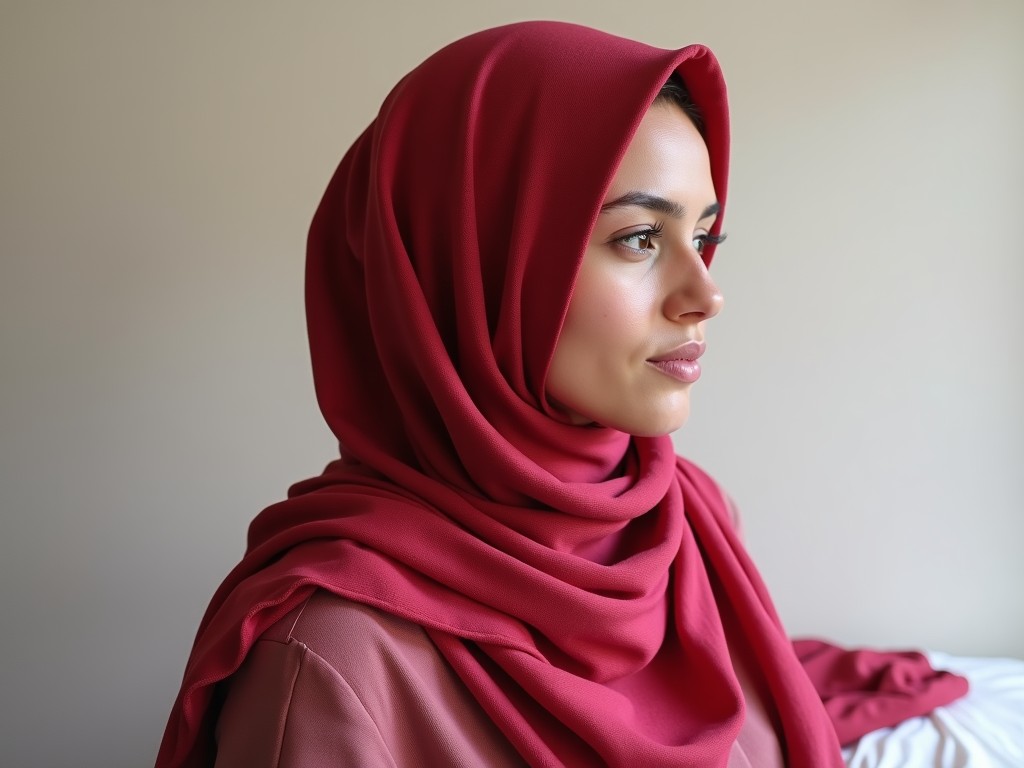
Plain Chiffon Hijab Colours
Plain chiffon hijabs are lightweight, semi-sheer textile products designed for consistent drape and breathability in daily wear applications. Their construction relies on tightly twisted filament
Plain Chiffon Hijab Colours
Plain chiffon hijabs are lightweight, semi-sheer textile products designed for consistent drape and breathability in daily wear applications. Their construction relies on tightly twisted filament yarns woven in a plain weave structure, resulting in a fabric with low opacity and high air permeability. This section outlines the technical characteristics that define performance, colour stability, and suitability for industrial-scale production and end-use requirements.
Material Composition and Weave Structure
The base fabric is typically 100% polyester filament yarn with a denier range of 20D to 30D, selected for its tensile strength, dimensional stability, and resistance to hydrolysis under humid conditions. The plain weave construction yields a balanced thread count of approximately 60 ends per inch (EPI) by 60 picks per inch (PPI), providing uniform surface texture and minimal skew. This structure ensures predictable elongation under load, typically 15–20% at break, which supports consistent folding and styling behavior without permanent deformation.
Yarn twist levels are maintained between 80–120 turns per meter to optimize light diffusion and reduce surface glare while preserving tear resistance above 1.2 N in both warp and weft directions. The fabric undergoes heat setting at 180–200°C for 60–90 seconds to stabilize molecular orientation, reducing residual shrinkage to less than 2% after repeated washing cycles at 40°C. These parameters are critical for maintaining colour uniformity and dimensional accuracy in bulk production.
Colour Specification and Dyeing Process
Colouration is achieved through disperse dyeing at 130–135°C under controlled pH (4.5–5.5) to ensure molecular dispersion within the polyester amorphous regions. Standard colour matching follows Pantone Textile Cotton eXtended (TCX) references, with delta-E (CIE2000) tolerance kept below 1.5 for lot-to-lot consistency in production batches exceeding 500 kg. This level of precision is necessary for industrial buyers requiring predictable colour reproduction across multiple shipments.
Common colour categories include neutral tones (ivory, beige, light grey), mid-spectrum shades (dusty rose, sage green, slate blue), and deeper hues (navy, charcoal, burgundy). Each shade is formulated with specific dye concentrations to compensate for chiffon’s inherent translucency, which can shift perceived colour under varying lighting conditions. For example, a 2% owf (on weight of fabric) dye concentration for navy may require adjustment to 2.5% owf for pastel pink to achieve equivalent visual depth due to differences in dye affinity and fabric scattering properties.
Dimensional Standards and Tolerances
Standard finished dimensions for plain chiffon hijabs are 180 cm in length by 70 cm in width, with a allowable tolerance of ±2% in both axes. This range accommodates typical cutting and sewing variances while ensuring the final product fits within standard packaging and display fixtures. Length is measured along the selvage edge to prevent skew-related inaccuracies, and width is taken at the midpoint to account for potential taper from roller tension during winding.
Hemming is performed using a 3-thread overlock stitch with a stitch density of 8–10 stitches per cm, providing edge durability without adding stiffness. The folded edge width is maintained at 3–4 mm to minimize bulk while preventing fraying. These specifications are validated through ASTM D2261 tear resistance and ASTM D5034 tensile strength testing on finished units, with minimum acceptable values of 1.5 N tear and 25 N breaking strength per 5 cm width.
Comparison of Common Colour Variants
| Colour Category | Typical Dye Concentration (owf) | Light Fastness (ISO 105-B02) | Wash Fastness (ISO 105-C06) |
|---|---|---|---|
| Ivory | 0.3% | 4–5 | 4–5 |
| Dusty Rose | 1.8% | 3–4 | 4 |
| Navy | 2.2% | 5 | 4–5 |
| Charcoal | 2.5% | 5 | 4–5 |
The table above reflects typical performance values derived from standardized testing protocols. Actual results may vary based on specific dye lots, finishing treatments, and end-use environmental exposure. Industrial buyers are advised to request lab-certified colourfastness reports for critical applications involving prolonged UV exposure or frequent industrial laundering.
Quality Control and Inspection Protocol
Each production lot undergoes 100% visual inspection under 5000 lux daylight simulation (D65) to detect colour variation, yarn defects, or printing inconsistencies. Critical control points include greige fabric inspection pre-dyeing, post-dyeing shade verification, and final dimension check after cutting and folding. Defects are classified according to ISO 9001 AQL standards, with major defects (e.g., colour shift > delta-E 2.0, holes > 2 mm) limited to 0.65% and minor defects (e.g., slubs, slight skew) to 2.5% per lot.
Colour consistency is verified using a spectrophotometer with 8mm aperture and UV exclusion, measuring L*a*b* values at five points across the fabric width. Batch approval requires average delta-E < 1.0 from the approved standard and no individual point exceeding 1.5. This method ensures that perceived colour remains uniform under varying viewing angles and lighting conditions, a key concern for buyers supplying retail or uniform programs where visual consistency impacts brand perception.
Packaging and Handling Considerations
Finished hijabs are folded to a uniform size of 20 cm × 15 cm using automated folding tables with tension control to prevent creasing. Each unit is placed in a polypropylene bag with anti-static properties (surface resistivity < 10¹² Ω/sq) to reduce dust attraction during storage and transit. Bags are sealed with heat-seal tape and packed into corrugated cartons with a bursting strength of at least 275 kPa, containing 50–100 units depending on client specifications.
Cartons are labelled with batch number, colour code, dimensions, and care instructions in both English and Arabic. Humidity indicators are included in each master carton to monitor moisture exposure during long-term storage or international shipment. These measures mitigate risks of mildew, colour bleeding, or fibre degradation, particularly important for sea freight lasting over 25 days or storage in tropical climates.
Applications in Industrial and Commercial Contexts
Plain chiffon hijabs are selected in institutional settings such as healthcare facilities, aviation service providers, and corporate uniform programs where lightweight, non-cling fabric is required for extended wear. Their low thermal retention (measured at 0.08 W/m·K) and high air permeability (>150 mm/s) reduce heat buildup during prolonged use, making them suitable for environments with elevated ambient temperatures or mandatory head covering policies. Unlike opaque fabrics, chiffon’s translucency allows for layered styling without adding significant bulk, a factor in designs requiring modesty compliance without compromising comfort.
In distributed supply chains, the fabric’s low weight (approximately 18–22 gsm) reduces volumetric shipping costs compared to heavier alternatives, while its wrinkle recovery minimizes the need for ironing at point-of-sale. These logistical advantages are particularly valuable for e-commerce fulfilment centers handling high-volume, SKU-diverse apparel inventories where storage efficiency and handling speed directly impact operational costs.
Products
Related Products
News
Related News

2026-11-02
Cotton Voile Scarf Manufacturing and Performance Analysis how to make a cotton voile scarfCreating a professional-grade cotton voile scarf requires a precise balance of textile engineering and artisanal finishing. Unlike standard cotton weaves, voile is defined by its p···

2026-10-28
chiffon hijab Technical Production and Performance AnalysisSelecting the right fabric for a hijab involves a delicate balance between modesty, breathability, and aesthetic drape. For many women in Southeast Asia and the Middle East, the ma···

2026-10-26
custom silk scarf textile manufacturing and performance analysisSelecting a high-quality scarf is no longer just about color matching; it is an exercise in understanding how textile weight, drape, and print scale interact with individual facial···
