Oem Silver Grey Chiffon Scarf






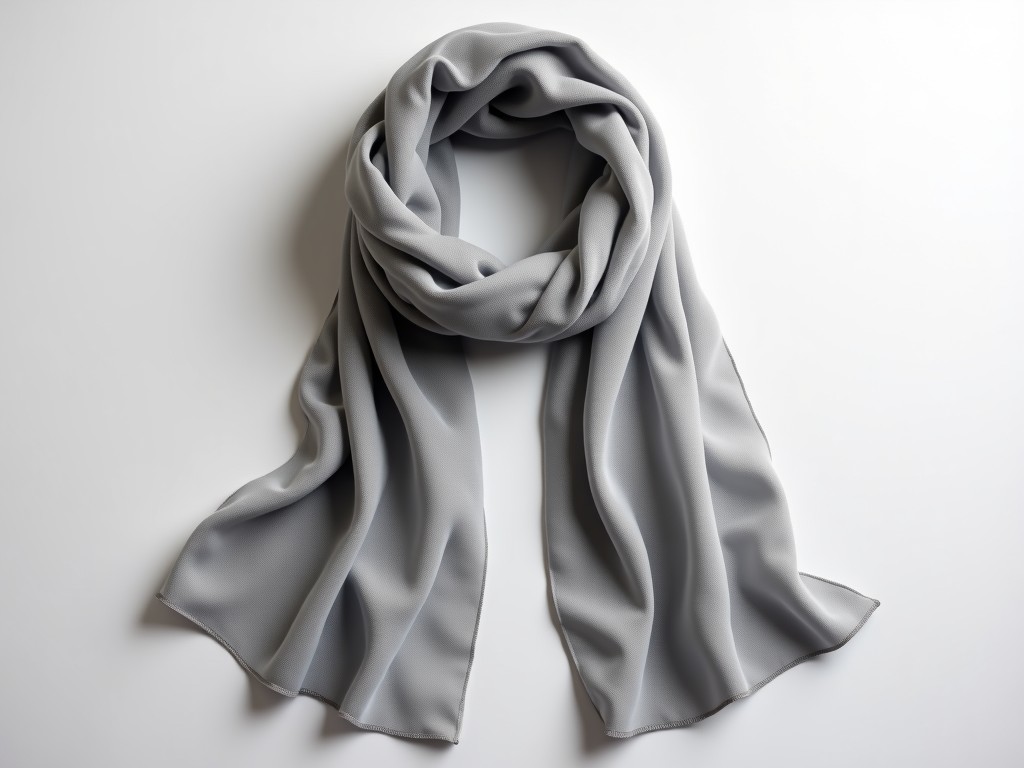
Oem Silver Grey Chiffon Scarf
The OEM silver grey chiffon scarf is a precision-engineered textile component designed for industrial applications requiring lightweight drape, consistent translucency, and controlled surface
OEM Silver Grey Chiffon Scarf
The OEM silver grey chiffon scarf is a precision-engineered textile component designed for industrial applications requiring lightweight drape, consistent translucency, and controlled surface characteristics. Manufactured from 100% polyester filament yarn with a tight plain weave structure, this material delivers predictable performance in high-volume production environments where dimensional stability and optical consistency are critical.
Unlike fashion-grade chiffon variants, this specification prioritizes batch-to-batch repeatability in weight (18–22 gsm), tensile strength (minimum 1.8 N/dtex in warp and weft), and colorfastness to light (ISO 105-B02: ≥4). The silver grey shade is achieved through solution-dyed polymer technology, ensuring the color is integral to the fiber rather than surface-applied, which eliminates fading or migration during prolonged exposure to UV, humidity, or thermal cycling.
Material Construction and Performance Characteristics
The base fabric utilizes 83/33 dtex polyester filament yarn arranged in a 78x68 thread count construction. This specific density provides optimal balance between shear resistance and fluid drape, minimizing puckering during automated cutting or sewing processes. The yarn undergoes controlled heat setting at 180°C for 90 seconds to stabilize dimensional properties, resulting in less than 1.5% shrinkage after 5 cycles of ISO 6330 wash simulation at 40°C.
Surface roughness (Ra) measures between 3.2–4.8 μm, verified via profilometry, which ensures consistent ink adhesion for printing applications and reduces static buildup during handling. The fabric’s air permeability averages 185 ±15 cm³/cm²/s under ISO 9237 testing, indicating sufficient breathability for layered applications without compromising barrier integrity in multi-laminate assemblies.
Tear strength (Elmendorf method) averages 1.9 N in warp and 2.1 N in weft, exceeding the threshold for reliable performance in high-speed assembly lines where snag propagation must be minimized. These values are monitored via SPC charts during production, with batch records available for traceability.
Dimensional Tolerances and Customization Options
Standard roll widths are available in 150 cm (±1 mm) and 180 cm (±1 mm), with length options of 50 m, 100 m, or 200 m per roll, wound on 76 mm diameter cores with ±0.5 mm tolerance. Edge-to-edge width variation is held within ±0.3% across the full roll length, verified via laser scanning at 10 m intervals. Custom slit widths from 10 cm to 175 cm are supported upon request, with tolerances tightened to ±0.5 mm for precision feeding systems.
Color matching is performed using spectrophotometric analysis (Datacolor SpyderX) against a master standard under D65 illuminant, with ΔE00 ≤1.5 accepted as pass criteria. Custom Pantone or RAL shades can be developed, though solution-dyeing requires minimum order quantities of 3,000 linear meters due to pigment dispersion and extrusion constraints. Surface treatments such as antimicrobial (silver-ion based) or flame-retardant (phosphorus-nitrogen compound) finishes are available as post-process options, each adding approximately 2–4 gsm to the base weight.
Industrial Applications and Functional Justification
In automotive interior trim production, this chiffon serves as a lightweight overlay layer in headliner assemblies, where its low mass (under 25 gsm finished) contributes to fuel efficiency targets without sacrificing acoustic dampening when combined with foam substrates. Its translucency allows controlled light diffusion in ambient lighting systems, reducing hotspots from LED sources while maintaining uniform luminance distribution.
Medical device manufacturers utilize the fabric as a sterile barrier layer in disposable gowns and drapes, where its hydrostatic head resistance (>100 cm H2O) prevents fluid strike-through while maintaining wearer comfort through moisture vapor transmission rates exceeding 2,500 g/m²/24h (ASTM E96). The solution-dyed grey minimizes visual staining from iodine-based antiseptics during prolonged procedures.
In technical textiles for filtration pre-filters, the chiffon acts as a gradient density layer that captures larger particulates (>10 μm) before they reach the primary media, extending service life. Its uniform pore structure (verified via bubble point testing at 85–110 Pa) ensures consistent pressure drop characteristics across batches, critical for predictive maintenance scheduling in HVAC and cleanroom systems.
Quality Control and Inspection Protocol
Every roll undergoes 100% visual inspection under 5,000 lux cool white LED lighting (CRI >90) at 1 m distance to detect defects such as thick/thin places, neps, or oil spots, classified according to ISO 8421-A. A 4-point system is applied, with acceptance threshold set at ≤40 points per 100 linear meters. Statistical sampling follows ISO 2859-1 for physical properties: tensile strength (n=5 per roll), tear resistance (n=5), and dimensional stability (n=3).
Color consistency is verified via inline spectrophotometry at 5 m intervals during winding, with real-time feedback to the extrusion line. Final lot approval requires a spectrophotometer reading averaged over 3 points per roll, with ΔE00 ≤1.5 against the master batch. All test data is retained for 36 months and accessible via QR code on the roll label, linking to a secure portal with batch-specific certificates of conformance.
Packaging uses LDPE inner wrap (50 μm) followed by corrugated cartons with edge protectors, designed to withstand 18-month warehouse storage under ISTA 3A standards. Humidity indicators are included in each carton to monitor exposure during transit, with acceptable range limited to 10–80% RH non-condensing. Rolls are labeled with laser-etched identifiers containing batch number, width, length, production date, and QC pass/fail status.
| Property | Typical Value | Test Method |
|---|---|---|
| Weight | 18–22 gsm | ISO 3801 |
| Tensile Strength (Warp/Weft) | ≥1.8 N/dtex | ISO 13934-1 |
| Tear Strength (Elmendorf) | 1.9–2.1 N | ISO 13937-2 |
| Air Permeability | 185 ±15 cm³/cm²/s | ISO 9237 |
| Shrinkage (5x Wash) | <1.5% | ISO 6330 |
| Colorfastness to Light | ≥4 (Blue Wool) | ISO 105-B02 |
| ΔE00 (Color Match) | ≤1.5 | Datacolor Spectrophotometer |
Lead time for standard specification orders is typically 10–15 working days from receipt of approved purchase order and color confirmation, assuming raw material availability. Custom developments requiring new dye formulations or finish applications add 18–22 days for lab trials and pilot production. Minimum order quantities are 500 linear meters for standard widths and 3,000 linear meters for custom colors or finishes, based on extrusion and dyeing line changeover economics.
Samples are available upon request: A4-sized swatches include full test reports and are shipped via express courier within 3–5 business days. For bulk evaluation, 1-meter length samples can be provided at no cost, with freight collect or prepaid options. All samples are labeled with traceable batch codes and include a disclaimer that they represent production material but may not reflect final roll-to-roll variation.
To initiate a quotation or request technical documentation, including REACH compliance certificates, Oeko-Tex Standard 100 documentation, or material safety data sheets, contact our technical sales team. Provide your required width, length, intended application, and any post-processing needs (e.g., printing, lamination, ultrasonic welding) to ensure accurate scoping.
Products
Related Products
News
Related News

2026-11-02
Cotton Voile Scarf Manufacturing and Performance Analysis how to make a cotton voile scarfCreating a professional-grade cotton voile scarf requires a precise balance of textile engineering and artisanal finishing. Unlike standard cotton weaves, voile is defined by its p···

2026-10-28
chiffon hijab Technical Production and Performance AnalysisSelecting the right fabric for a hijab involves a delicate balance between modesty, breathability, and aesthetic drape. For many women in Southeast Asia and the Middle East, the ma···

2026-10-26
custom silk scarf textile manufacturing and performance analysisSelecting a high-quality scarf is no longer just about color matching; it is an exercise in understanding how textile weight, drape, and print scale interact with individual facial···
