China Royal Blue Chiffon Scarf






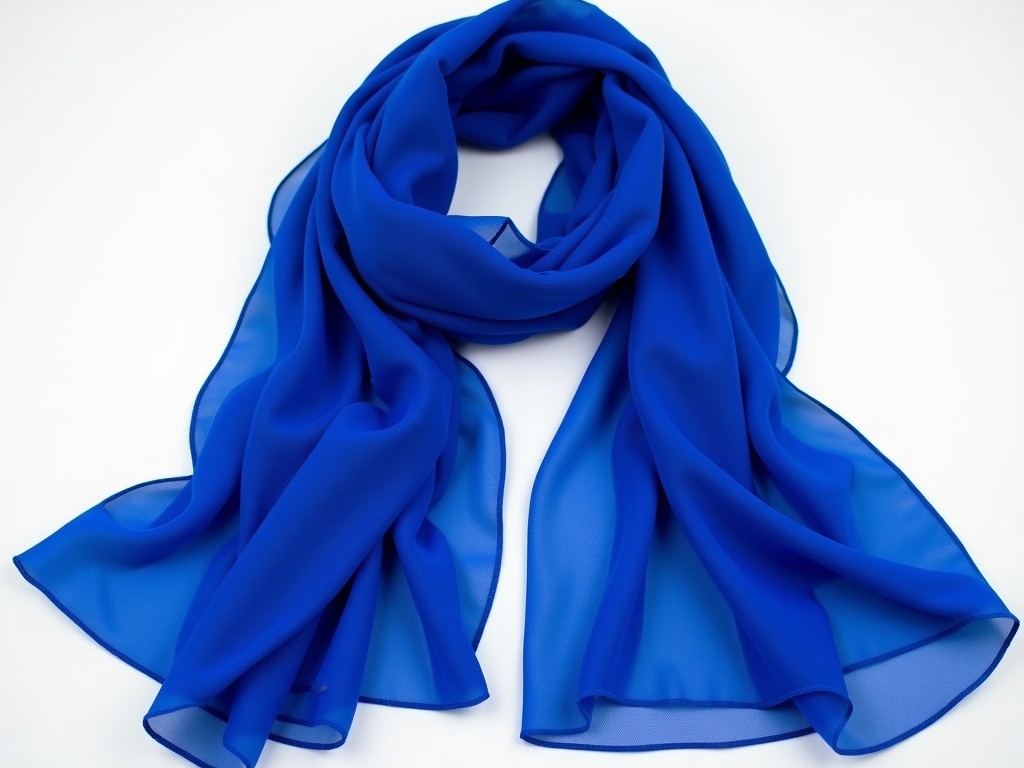
China Royal Blue Chiffon Scarf
Royal blue chiffon scarves are lightweight textile products made from synthetic or natural fibers, commonly used in apparel and decorative applications. The color royal blue is typically achieved
China Royal Blue Chiffon Scarf
Royal blue chiffon scarves are lightweight textile products made from synthetic or natural fibers, commonly used in apparel and decorative applications. The color royal blue is typically achieved through dyeing processes using reactive or disperse dyes, depending on the fiber composition. Chiffon refers to a plain-weave fabric characterized by its sheer appearance, lightweight drape, and slight texture from highly twisted yarns. These properties make it suitable for applications requiring fluidity and visual elegance without significant weight.
The fabric weight of chiffon typically ranges from 15 to 30 grams per square meter (gsm), contributing to its translucent quality and ease of movement. Royal blue shades in textiles are standardized using color matching systems such as Pantone or RAL, ensuring consistency across production batches. For industrial buyers, specifying both the base fabric construction and the exact color reference is critical to avoid variability in appearance. These scarves are often used as accessories, linings, or decorative elements where lightweight drape and color fidelity are prioritized.
Material Composition and Construction
Chiffon scarves are commonly produced using polyester, nylon, or silk fibers, each offering distinct mechanical and aesthetic properties. Polyester chiffon provides high tensile strength, resistance to stretching, and excellent color retention after repeated washing or UV exposure. Nylon chiffon offers superior abrasion resistance and elasticity, though it may yellow over time under prolonged sunlight. Silk chiffon, while less common in mass production, delivers natural luster, breathability, and a softer hand feel, though it requires more careful handling during processing.
The plain-weave structure of chiffon uses highly twisted S- and Z-twist yarns in both warp and weft directions, typically ranging from 80 to 120 twists per inch depending on yarn count. This twisting creates the fabric’s characteristic slight puckering and contributes to its drape and sheerness. Yarn density (ends per inch and picks per inch) influences opacity and durability; standard chiffon scarves often use 60x60 to 80x80 constructions. These parameters directly affect the scarf’s behavior in use, including resistance to tearing and how it hangs when worn or displayed.
Dyeing and Color Fastness
Achieving a consistent royal blue color in chiffon requires precise control over dye penetration, fixation, and rinsing processes. For polyester chiffon, disperse dyes are applied under high temperature (130–140°C) and pressure to ensure molecular dispersion within the fibers. Nylon chiffon typically uses acid dyes, which bond via ionic interactions in acidic dye baths. Post-dyeing treatments such as reduction clearing or soaping are essential to remove unfixed dye and prevent bleeding or staining during use.
Color fastness properties are critical for scarf applications exposed to light, washing, or friction. Standard testing includes ISO 105-B02 for light fastness (target: grade 4 or higher), ISO 105-C06 for washing fastness, and ISO 105-X12 for rubbing fastness. Disperse-dyed polyester generally achieves better light and wash fastness than acid-dyed nylon, though both can meet industrial requirements with proper process control. Buyers should request test reports confirming fastness ratings for their intended use case, especially if the scarf will be worn frequently or exposed to sunlight.
Dimensions and Customization Options
Standard chiffon scarves are produced in rectangular or square formats, with common dimensions ranging from 60x60 cm to 90x180 cm, depending on intended use. Smaller sizes (e.g., 50x50 cm) are often used as neck accessories or hair wraps, while larger formats (e.g., 70x200 cm) serve as shawls or decorative drapes. The lightweight nature of chiffon allows for larger dimensions without excessive weight, though edge stability becomes a consideration at greater lengths.
Customization options include hem finishes such as rolled hems, baby hems, or ultrasonic sealing, which prevent fraying without adding stiffness. Screen printing or digital printing can be applied for logos, patterns, or gradients, though ink selection must account for the fabric’s thinness and dye absorption characteristics. Some manufacturers offer custom dye matching to specific Pantone or RAL references, requiring lab dips for approval before bulk production. These options allow buyers to tailor the product to branding or functional needs while maintaining the core chiffon characteristics.
Quality Control and Inspection
Quality inspection for chiffon scarves focuses on visual appearance, dimensional stability, and defect identification under standardized lighting. Common defects include snags, runs, uneven dyeing (barre), water spots, and printing misregistration. Inspection is typically conducted under 6000K daylight simulation at a distance of 30–50 cm, with 100% visual checks for first articles and reduced sampling (e.g., 2.5% AQL) for bulk lots per ANSI/ASQ Z1.4.
Dimensional accuracy is verified using calibrated measuring tools, with tolerances typically held within ±3% for length and width. Color consistency is assessed using spectrophotometers or colorimeters, comparing production samples to approved lab dips with delta-E values kept below 2.0 for acceptable match. For printed scarves, registration accuracy is checked to ensure alignment of multi-color designs within ±0.5 mm. These controls help ensure that the final product meets both aesthetic and functional expectations in downstream applications.
Packaging and Shipping Considerations
Due to their lightweight and compressible nature, chiffon scarves are commonly packaged in polybags, either individually or in multiples, to protect against moisture and soiling during transit. For bulk shipments, scarves are often folded and placed in inner cartons before being packed into export-standard master cartons. Tissue paper or separators may be used between layers to prevent friction-related damage, especially for darker colors like royal blue that can show white marks from abrasion.
Master carton dimensions are optimized for palletization, with common configurations holding 50 to 200 units depending on scarf size and folding method. Weight per carton typically ranges from 5 to 15 kg, allowing for efficient handling and reduced shipping costs. For long-distance transport, especially via sea freight, moisture-absorbing desiccants are recommended to prevent mildew or staining in humid environments. Clear labeling with SKU, color code, quantity, and country of origin facilitates customs clearance and inventory management.
Applications in Industrial and Commercial Sectors
Royal blue chiffon scarves are used in apparel manufacturing as lightweight accessories, scarves, or layered elements in garments where drape and translucency enhance design. In the event and hospitality sectors, they serve as table runners, chair sashes, or decorative wraps for themed functions, where the color provides visual impact without adding bulk. The sheer quality allows underlying surfaces or lighting effects to remain visible, contributing to ambient aesthetics.
In theatrical and performance costume design, chiffon is favored for its ability to catch light and move fluidly with motion, making it suitable for veils, overlays, or background elements. The royal blue shade is often selected for its association with formality and depth, particularly in stage lighting where cooler tones retain visibility under various gels. Industrial buyers in these sectors prioritize consistent color lots and reliable supply chains to maintain visual continuity across productions or installations.
Products
Related Products
News
Related News

2026-11-02
Cotton Voile Scarf Manufacturing and Performance Analysis how to make a cotton voile scarfCreating a professional-grade cotton voile scarf requires a precise balance of textile engineering and artisanal finishing. Unlike standard cotton weaves, voile is defined by its p···

2026-10-28
chiffon hijab Technical Production and Performance AnalysisSelecting the right fabric for a hijab involves a delicate balance between modesty, breathability, and aesthetic drape. For many women in Southeast Asia and the Middle East, the ma···

2026-10-26
custom silk scarf textile manufacturing and performance analysisSelecting a high-quality scarf is no longer just about color matching; it is an exercise in understanding how textile weight, drape, and print scale interact with individual facial···
