Scarf Manufacturers Technical Production Analysis

Latest Articles
chiffon hijab Technical Production and Performance Analysis
2026-10-28
custom silk scarf textile manufacturing and performance analysis
2026-10-26
Scarf Manufacturers Technical Production Analysis
2026-10-22
Voile Valance how to hang valance scarf swag voile Installation Analysis
2026-10-20
Voile Window Scarf Technical Manufacturing and how to make a voile window scarf
2026-09-21
2026-10-22
Scarf Manufacturers Technical Production Analysis
Selecting a manufacturing partner for textile accessories often comes down to a delicate balance between material precision and design flexibility. In the specialized world of headwear and fashion scarves, the ability to execute complex digital prints while maintaining fabric breathability is what separates standard production from high-end garment engineering.
The global market is seeing a shift toward hyper-customization, where B2B buyers no longer seek generic catalogs but rather comprehensive OEM and ODM capabilities. This evolution demands that production lines integrate everything from weaving and printing to specialized finishing, such as laser-cut edges and waterproof treatments, to meet diverse regional cultural and climatic needs.
Understanding the technical nuances of these processes is essential for brands looking to scale. By analyzing the operational standards of professional scarf manufacturers, businesses can better navigate the complexities of fabric selection and production efficiency.
Integrating Vertical Production Chains
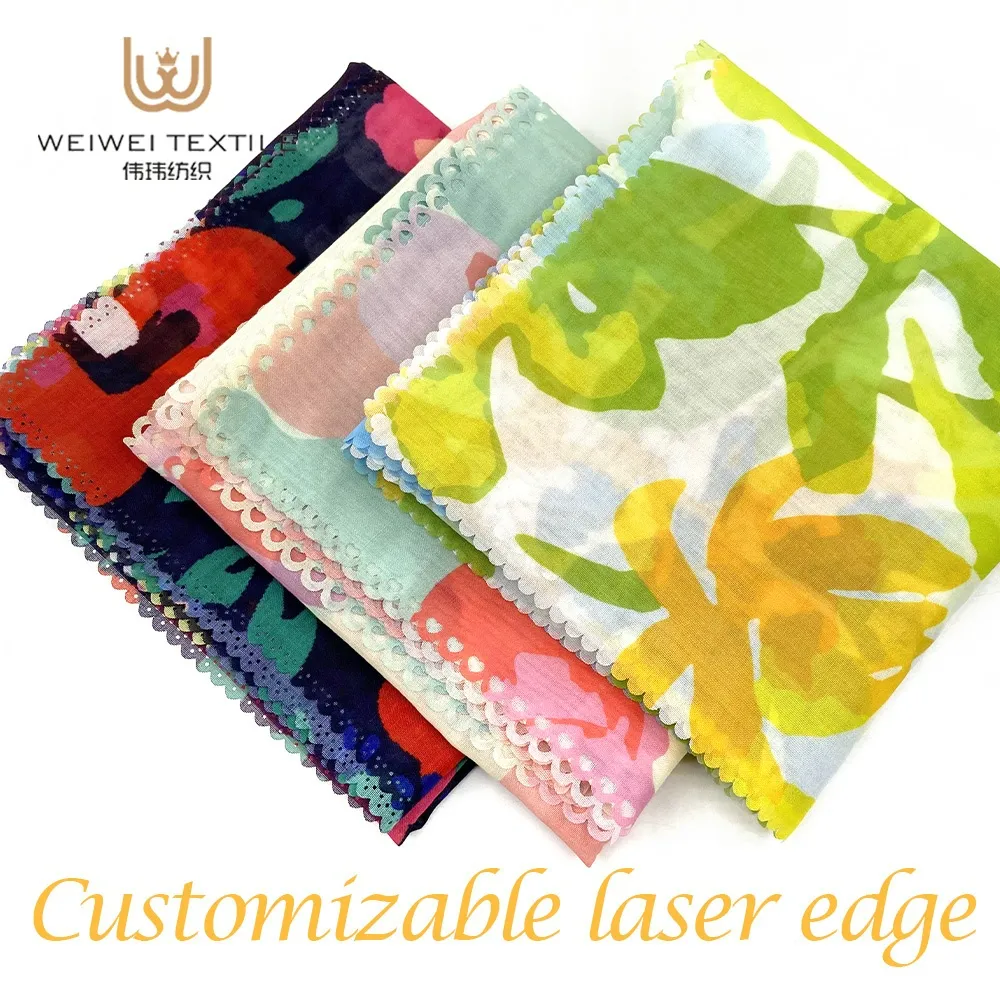
The most efficient production models in the textile industry are those that internalize the entire value chain. A vertical integration strategy—combining weaving workshops, printing facilities, and finished product processing under one roof—significantly reduces lead times and minimizes quality variance between raw fabric and final assembly.
For example, Xinji Weiwei Textile utilizes a 10,000 square meter facility to maintain a daily capacity of 50,000 pieces. By controlling the process from the initial weave to the final laser-cut edge, the risk of color mismatch or fabric defects is drastically lowered, ensuring that complex designs for products like the Sudan Toub or Muslim hijabs remain consistent across mass production.
Technical Evaluation of Textile Materials
Fabric selection is not merely about aesthetics but about functional performance. Cotton voile is prized for its lightweight and breathable nature, making it an industry standard for hijabs in warmer climates. In contrast, satin and chiffon are selected for their drape and luster, often serving formal or luxury market segments where visual impact is prioritized over raw breathability.
The technical challenge lies in how these materials respond to different printing methods. Digital printing allows for high-resolution floral and abstract patterns without compromising the softness of the fabric. However, the material's absorption rate must be precisely calibrated to avoid ink bleeding, especially when producing intricate border prints or a variety of personalized colors.
Furthermore, the integration of specialized finishes, such as waterproof coatings or fragrance infusions, adds a layer of functional value. These treatments must be applied using methods that do not clog the weave of the fabric, ensuring that a waterproof cotton voile scarf remains breathable while repelling moisture.
The Precision of Digital Printing and Finishing
Finishing is where a generic piece of fabric becomes a high-value fashion accessory. Traditional hemming is increasingly being replaced by laser-cutting technology, which provides a clean, fray-resistant edge that maintains the geometric integrity of the scarf. This is particularly critical for square scarves where symmetry is a key quality metric.
True customization in textile manufacturing extends beyond color choice; it encompasses the synergy between digital print accuracy, edge precision, and the ability to execute specific OEM labels and packaging requirements.
The shift toward ODM (Original Design Manufacturing) services allows brands to leverage the manufacturer's R&D capabilities. By providing a set of expectations regarding size, logo placement, and fabric weight, clients can receive prototypes that are optimized for their specific target demographic, whether it be high-fashion satin scarves or durable daily-wear voile.
Material Suitability Performance Index
When evaluating fabrics for different use cases, manufacturers use relative performance indices to guide selection. For instance, cotton voile scores highest in breathability and ease of draping, whereas satin excels in luminosity and formal appeal. Chiffon offers a middle ground, providing a sheer, ethereal quality that is highly sought after for floral prints.
The following index illustrates the relative strengths of common materials used by scarf manufacturers based on functional requirements.
Figure 2. Material Performance Comparison Index
Application Scenarios for Specialized Scarves
The application of a printed scarf depends heavily on the intersection of face shape and occasion. For example, in a professional office setting, a structured one-sided drape using shawl cotton voile provides a polished edge. Conversely, for formal events, an asymmetric cascade using floral chiffon or satin creates a high-glamour silhouette.
Functional fashion is also gaining traction, particularly with the development of waterproof cotton voile. This material is designed for active and rainy days, where the fabric's stain-resistant and quick-dry properties allow it to be worn in a sporty turban style without sacrificing the aesthetic of digital-print florals.
Shifts in Global Customization Demand
User expectations are shifting away from mass-market uniformity toward personalized expression. This trend is evident in the demand for "Print-Mixing," where consumers pair large-scale floral hijabs with micro-patterns. Manufacturers must now be capable of producing small-batch custom orders without sacrificing the efficiency of large-scale mass production.
Color psychology also plays a critical role in current procurement. There is a rising demand for specific palettes: soft pastels for fresh, elegant looks; bold jewel tones (emerald, sapphire) paired with earthy neutrals for sophisticated statements; and classic monochromatic schemes that emphasize the texture of silk or voile.
The ability to offer reversible prints—providing two distinct looks in one product—is another example of how manufacturers are responding to the consumer's desire for versatility and value.
Manufacturer Selection Framework
Evaluating scarf manufacturers requires a structured approach that looks beyond the unit price. The primary focus should be on the manufacturer's capacity for vertical integration and their willingness to accept small-order customization, which is vital for testing new designs before committing to mass production.
A critical trade-off often exists between production speed and customization depth. While some factories can produce vast quantities of generic scarves, only those with specialized workshops for printing and finishing can handle complex OEM requests involving specific labels, custom packaging, and laser-cut edges.
The following framework provides a relative assessment of different manufacturing capabilities to help buyers make an informed decision based on their specific business model.
| Capability Factor | Mass Production Focus | Customization Focus | Integrated ODM Focus |
|---|---|---|---|
| Minimum Order (MOQ) | Very High | Low to Medium | Flexible |
| Design Input | Fixed Catalog | Client-Provided | Collaborative R&D |
| Edge Finishing | Standard Hem | Various Options | Precision Laser Cut |
| Lead Time | Short (Standard) | Medium (Custom) | Variable (Project-based) |
| Quality Control | Batch Sampling | Piece-by-Piece | Integrated System |
| Service Scope | Product Only | OEM Basics | Full OEM/ODM Solution |
Questions & Answers
A professional manufacturer is defined by vertical integration—controlling weaving, digital printing, and finishing in one facility. This ensures quality consistency and reduces lead times. Key indicators include the ability to offer both OEM and ODM services, the use of precision technology like laser-cut edges, and a quality control system capable of handling both small custom orders and mass production without variance in fabric hand-feel or print clarity.
Selection depends on the intended use and climate. Cotton voile is ideal for daily wear due to its breathability and light weight. For formal occasions, printed silk or satin is preferred for its luxury sheen and elegant drape. Chiffon is a versatile choice for floral prints and an ethereal look. If the product is intended for active use or rainy weather, waterproof-treated cotton voile is the most functional option.
OEM (Original Equipment Manufacturing) is when a manufacturer produces a scarf based on the client's exact specifications and designs. ODM (Original Design Manufacturing) is more collaborative; the manufacturer uses its own R&D and design expertise to propose styles, materials, and patterns to the client, who then approves or modifies them. ODM is particularly useful for brands that want to leverage industry trends without having an in-house design team.
Laser cutting uses a high-precision beam to seal the fabric edges as it cuts, which prevents fraying and ensures a perfectly straight line. This is superior to traditional hemming for square scarves and high-fashion items because it maintains the fabric's natural drape and prevents the "bulkiness" associated with folded seams, resulting in a cleaner, more modern finish.
While digital printing is highly versatile, the results vary by material. It works exceptionally well on cotton voile and polyester blends, allowing for intricate floral and abstract designs. For natural silk or high-density satin, specific ink formulations and heat-setting processes are required to ensure color fastness and prevent the ink from altering the fabric's texture. A professional manufacturer will calibrate the print settings for each specific material.
Modern manufacturers, like Xinji Weiwei Textile, implement flexible production lines that can switch between mass production and small-batch customization. By utilizing digital printing—which doesn't require expensive screens for every color—they can produce low volumes of personalized designs economically. This allows new brands to test market viability with small quantities before scaling up to mass production.
Final Thoughts
The transition toward highly customized, functionally enhanced textiles is redefining the role of the manufacturer. It is no longer enough to simply produce a garment; the ability to integrate technical finishes—such as waterproof coatings and laser-cut edges—with high-resolution digital printing is now a baseline requirement for competitiveness.
For businesses, the key to sustainable growth lies in partnering with a manufacturer that offers vertical integration and flexible OEM/ODM services. By aligning material selection with specific user needs and regional fashion trends, brands can create products that truly resonate with their audience while maintaining rigorous quality standards.
Products
Related Products
News
Related News
2026-10-28
chiffon hijab Technical Production and Performance AnalysisSelecting the right fabric for a hijab involves a delicate balance between modesty, breathability, and aesthetic drape. For many women in Southeast Asia and the Middle East, the ma···
2026-10-26
custom silk scarf textile manufacturing and performance analysisSelecting a high-quality scarf is no longer just about color matching; it is an exercise in understanding how textile weight, drape, and print scale interact with individual facial···
2026-10-22
Scarf Manufacturers Technical Production AnalysisSelecting a manufacturing partner for textile accessories often comes down to a delicate balance between material precision and design flexibility. In the specialized world of head···